By Wednesday of the Third Week of Lent, something curious begins to happen.
We have been digging. Clearing. Rearranging. The fig tree has been tended. The tables have been overturned. And now we find ourselves, rather unexpectedly, standing beside a well.
The Church often places before us, around this point in Lent, the story of Jesus and the Samaritan woman. It is a conversation that begins politely enough and ends somewhere altogether more profound.
It begins with thirst.
And thirst, if we are honest, is not always something we enjoy admitting.
The Samaritan woman arrives at the well at midday — not the fashionable hour for water collection. Noon suggests avoidance. It suggests a desire not to be seen. Which, in a small town, is an entirely understandable instinct.
Jesus meets her there.
Lent, by the third week, has a way of bringing us to the well at noon. The respectable spiritual energy of earlier days gives way to something more honest. We begin to notice what we are actually thirsty for.
Approval. Certainty. Control. A sense that we are doing faith correctly.
Jesus, inconveniently, asks for water — and then begins speaking about living water. About a depth that goes beyond surface solutions. About thirst that is not merely physical but existential.
Now, this is where the humour gently creeps in.
Because most of us are quite content with manageable thirst. We prefer hydration strategies that do not require personal revelation. “Just tell me how much prayer per day,” we say, “and I shall schedule it between emails.”
But Jesus does not offer a hydration plan. He offers transformation.
“Those who drink of this water will be thirsty again,” he says. Which is a remarkable understatement about the human condition.
The well is deeper than we thought.
Lent, especially in its middle weeks, asks us to consider what we have been drawing from. Where we have gone for relief. Which wells we have trusted.
Some of them are shallow.
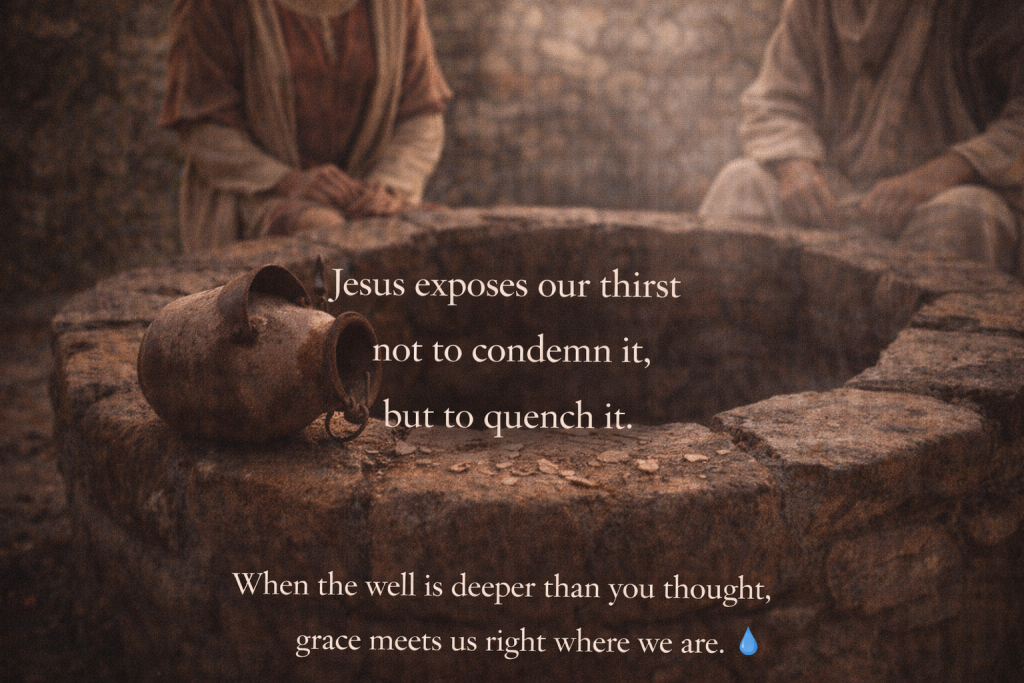
The remarkable thing about the story is not that the woman is questioned. It is that she is known — and not dismissed. Jesus names her story without shaming it. He exposes thirst without condemning it.
The result is not humiliation. It is joy.
She leaves her water jar behind. Which may be the most hopeful detail in the entire Gospel. When you have found living water, you do not cling quite so tightly to old containers.
If Lent feels revealing this week, take heart. You are not alone at the well. The One who asks for water also gives it.
And if you discover that your spiritual bucket has a crack in it — welcome to the human race.
Grace, fortunately, is not stored in buckets.
Companion Prayer
Living Water,
You meet us at the wells
we return to again and again.
You know our thirst
before we name it.
You see our story
without turning away.
Draw us deeper.
Quench what cannot be satisfied
by surface solutions.
Give us courage
to leave old jars behind
and trust the water you give.
Stay with us at the well.
Amen.