There is a great deal to be said for showing up.
This is not, admittedly, one of the more glamorous spiritual disciplines.
Nobody has ever produced a glossy coffee-table book called Showing Up: Photographs of People Who Arrived When They Said They Would. There are very few stained-glass windows depicting someone putting on their coat because it is time to go to church. And I have yet to see a religious medal commemorating the heroic Christian virtue of getting out of bed when the alarm rings.
We prefer our spirituality with a little more drama.
We like conversion experiences. Mountaintops. Burning bushes. Visions in the night. Voices from heaven. Seas dramatically parting at precisely the right moment.
But most of the Christian life happens nowhere near a burning bush.
Most of it happens in kitchens.
And offices.
And hospital rooms.
And parish halls.
And grocery stores.
And in that mysterious place beside the front door where you were absolutely certain you left your keys.
Ordinary Time has a way of reminding us of this.
The great celebrations of Thanksgiving are behind us. All Saints is approaching, but it has not yet arrived. The trees are losing their leaves. The daylight is quietly packing its bags and leaving earlier every afternoon. Life settles again into its familiar rhythms.
And perhaps that is exactly where God wants to meet us.
The Spiritual Life Is Mostly Repetition
There is something wonderfully repetitive about Christianity.
We pray the same prayers.
We hear the same Scriptures.
We gather around the same table.
We say the same words.
“The Lord be with you.”
“And also with you.”
We confess our sins again, despite having confessed them quite sincerely last week.
We receive the bread and wine again.
We say Amen again.
Then we go home and attempt, with varying degrees of success, to live like people who meant what we just said.
And the following Sunday we come back and do it all again.
From the outside, this might look terribly inefficient.
Surely after two thousand years we ought to have finished by now.
But perhaps repetition is not evidence that Christianity has failed.
Perhaps repetition is how Christianity works.
Love itself is repetitive.
You do not tell someone you love them once and then consider the matter permanently settled.
You say it again.
You show it again.
You forgive again.
You listen again.
You make supper again.
You wash the dishes again, despite the deeply suspicious fact that everyone in the household appears determined to make them dirty again immediately.
Love lives by repetition.
So does faith.
God Seems Rather Fond of Ordinary Places
One of the persistent surprises of Scripture is how often God appears in places where nobody has prepared adequately for the occasion.
Moses is tending sheep.
Samuel is trying to sleep.
David is out in a field.
Mary is at home.
Peter is fishing.
The disciples are walking along a road.
The risen Christ appears beside a lake and cooks breakfast.
Apparently heaven is considerably less concerned with impressive venues than we are.
God keeps appearing in ordinary places.
Which means we may have spent far too much time waiting for extraordinary circumstances.
We imagine that when life becomes less complicated, we will pray more faithfully.
When work settles down, we will become more attentive.
When the family crisis passes, we will become more generous.
When we finally get ourselves organized, we will become the people God intended us to be.
This is a dangerous spiritual fantasy because life has shown remarkably little interest in becoming less complicated.
There is always another appointment.
Another bill.
Another disagreement.
Another laundry basket.
Another email beginning with the ominous phrase, “Just following up…”
If God intends to wait until our lives are perfectly arranged before meeting us, God may be waiting a very long time.
Fortunately, God appears to have made other arrangements.
God meets us now.
Faithfulness Is Usually Smaller Than We Imagine
We sometimes imagine faithfulness as something heroic.
And occasionally it is.
There are moments when discipleship demands courage that costs us something significant.
But most faithfulness is much smaller.
It is making the telephone call.
Visiting the person who is lonely.
Saying the prayer even when we do not particularly feel like praying.
Making room at the table.
Offering forgiveness before resentment becomes furniture.
Choosing kindness when sarcasm would have been considerably more entertaining.
Faithfulness often looks like doing the next loving thing.
Then doing another.
Then another.
This may not seem particularly impressive.
But neither does planting a seed.
The Kingdom of God, Jesus tells us, seems rather fond of seeds.
Small things placed faithfully into the earth.
Things that disappear before they grow.
Things that require patience.
Things whose transformation happens mostly where nobody can see it.
Perhaps much of holiness works the same way.
The Saints Mostly Kept Showing Up
All Saints Day is coming.
Soon we will remember the great cloud of witnesses who have gone before us.
We may imagine saints as people whose spiritual lives possessed a clarity ours does not.
But saints were human beings.
They became tired.
They became discouraged.
They occasionally misunderstood things.
They probably had mornings when prayer felt dry and afternoons when patience disappeared somewhere shortly after lunch.
Their holiness was not that they never struggled.
Their holiness was that they kept turning toward God.
Again.
And again.
And again.
Perhaps sainthood is not primarily about extraordinary spiritual achievement.
Perhaps it is about a lifetime of returning.
Returning to prayer.
Returning to mercy.
Returning to the table.
Returning to hope.
Returning to Christ.
There is something profoundly encouraging about that.
Because most of us can manage returning.
Just Come Back Tomorrow
There will be days when your prayers feel profound.
There will also be days when your prayers consist mostly of staring out the window while attempting to remember what you were praying about.
There will be Sundays when worship lifts your heart.
There will be Sundays when you find yourself wondering whether the person three pews ahead has always had that coat.
There will be days when you feel wonderfully close to God.
And days when God seems to have stepped out briefly without leaving a forwarding address.
Keep showing up.
Not because showing up earns God’s love.
Grace has never operated on an attendance sheet.
Show up because love grows through presence.
Friendship grows through presence.
Community grows through presence.
Faith grows through presence.
And somewhere in the ordinary repetition of prayer and meals and conversations and Eucharists and dishes and errands and autumn mornings, something holy is happening.
We may not notice it immediately.
Grace is often rather discreet.
But perhaps one day we will look back and discover that while we thought we were merely showing up, God was quietly shaping us.
Prayer by prayer.
Meal by meal.
Sunday by Sunday.
Act of kindness by act of kindness.
Until the ordinary life we were living became the place where holiness had been growing all along.
And perhaps that is one of the quiet secrets of Ordinary Time.
God does not always ask us to do something extraordinary.
Sometimes God simply asks us to come back tomorrow.
And, wonderfully, God promises to be there too.
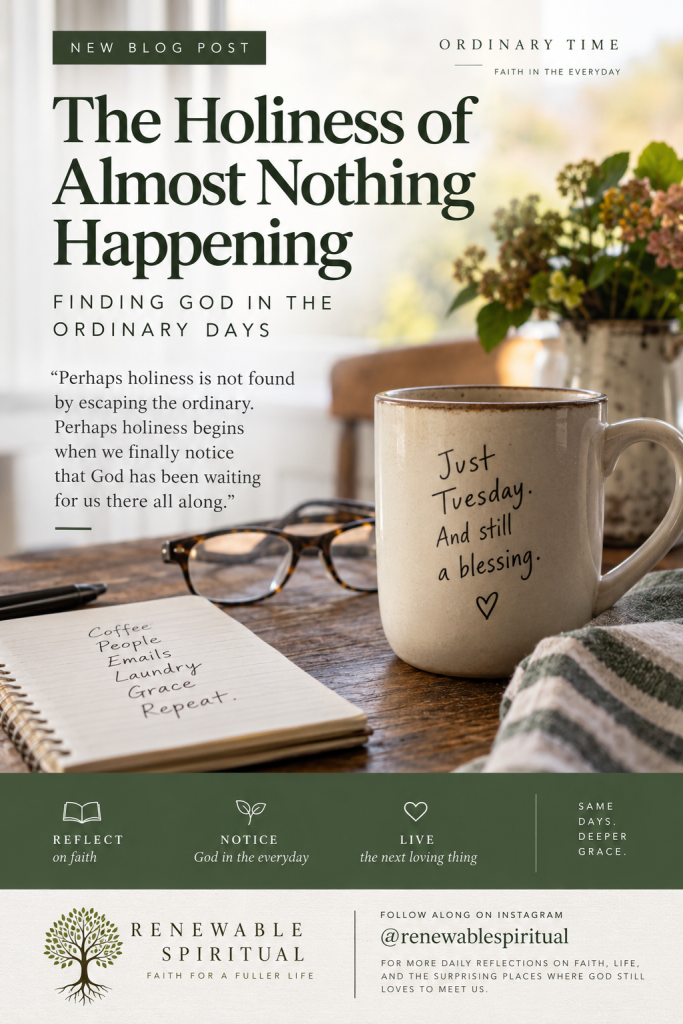
“Holiness may be less about doing extraordinary things and more about returning faithfully to ordinary things with love.”
Follow along on Instagram @renewablespiritual for more daily reflections on faith, life, and the surprising places where God still loves to meet us.
Companion Prayer
Faithful God,
Meet us in the ordinary places of our lives. Give us grace to keep showing up, courage to begin again, and eyes to recognize your presence in small acts of love and faithfulness. When we grow weary, remind us that holiness is often formed quietly—in returning, forgiving, serving, praying, and loving again.
Help us to trust that wherever love calls us to return, you are already there.
Amen.