There is something wonderfully peculiar about the Church calendar.
Just when the world begins preparing for Christmas, when shopkeepers are dusting off their artificial snow, radio stations are threatening to play the same twelve Christmas songs until we surrender, and otherwise sensible people are contemplating the purchase of inflatable reindeer large enough to require municipal planning permission, the Church announces that we are about to celebrate a King.
Not just any king, mind you.
The King.
Jesus Christ, King of the Universe.
It is a magnificent title. It sounds as though it ought to be accompanied by trumpets, velvet robes, a procession of dignitaries, and perhaps a rather elaborate luncheon at which the sandwiches have had their crusts removed.
But there is a slight difficulty.
The King we are preparing to celebrate seems remarkably uninterested in behaving like a king.
At least, not the sort of king the world has come to expect.
And therein lies the beginning of a rather extraordinary journey.
The Trouble with Kings
Human beings have always had a peculiar fascination with power.
We admire it. We pursue it. We build institutions around it. We invent impressive titles to describe it. And, when we finally acquire a little of it ourselves, we become remarkably skilled at explaining why everyone else ought to do precisely as we say.
I have spent enough years in the Church to know that ecclesiastical power is not entirely immune from this temptation.
Indeed, one occasionally suspects that if Jesus were to walk into certain church meetings, someone would immediately ask whether he had submitted his report in the proper format and whether his proposed changes had been approved by the appropriate committee.
And should he suggest washing everyone’s feet, there would undoubtedly be a lengthy discussion about insurance coverage, approved cleaning products, and whose responsibility it was to provide the towels.
We laugh because we recognize ourselves.
We like order. We like certainty. We like knowing who is in charge.
And we especially like knowing that whoever is in charge agrees with us.
Yet the Gospel persistently introduces us to a God who seems determined to challenge almost everything we assume about authority.
Jesus does not arrive surrounded by military officers.
He does not establish his headquarters in a palace.
He does not demand that the crowds kneel before him.
He sits at tables with people whose reputations are questionable, touches those whom respectable society has learned to avoid, and tells stories in which the people we least expect turn out to understand the kingdom of God rather better than the religious professionals.
One might reasonably conclude that Jesus has not read the standard manual on successful leadership.
Or perhaps he has read it and decided that it is fundamentally mistaken.
A Kingdom That Begins at the Bottom
As we move toward Christ the King Sunday, the Church invites us to consider a profoundly unsettling truth.
The kingdom of God does not operate according to the world’s understanding of greatness.
In the world’s kingdoms, power generally moves downward.
Those at the top make decisions. Those beneath them carry those decisions out. The farther one climbs, the more important one becomes, until eventually one reaches the glorious position of being able to summon someone else to discover why the photocopier is not working.
But Jesus turns the whole arrangement upside down.
When his disciples argue about greatness, he places a child among them.
When they seek positions of honour, he speaks about becoming servants.
When Peter reaches for a sword, Jesus tells him to put it away.
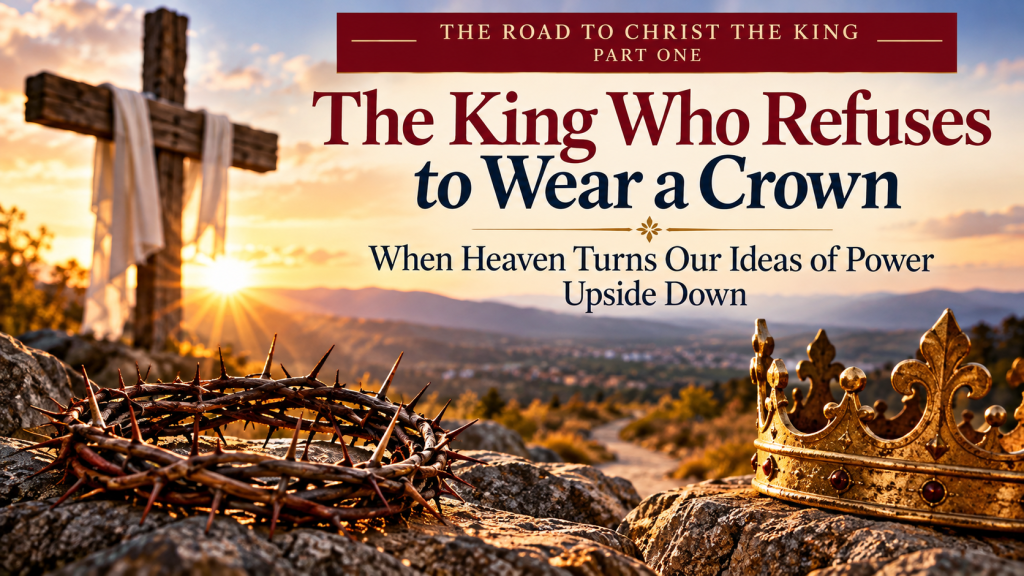
And when the world finally places a crown upon his head, it is woven from thorns.
There is no royal throne of polished gold.
There is a cross.
No army stands ready to defend his honour.
There are soldiers gambling for his clothing.
No cheering crowd celebrates his coronation.
There are voices mocking him, challenging him to prove his power by saving himself.
And yet the Church dares to proclaim that here, in this terrible and astonishing moment, we see the true nature of divine kingship.
Not power exercised through domination.
Not authority maintained through fear.
Not greatness measured by the number of people required to obey.
But love poured out without reservation.
Mercy offered even to those who do not deserve it.
And a kingdom established not by taking life, but by giving it.
That is the King toward whom we are walking.
The Dangerous Business of Following Jesus
Of course, there is a problem with proclaiming Christ as King.
It means that we cannot simply admire him.
We must follow him.
And following Jesus has an unfortunate tendency to interfere with our carefully arranged lives.
It is one thing to sing enthusiastically about Christ reigning in glory.
It is quite another to allow that reign to reshape the way we treat the neighbour whose politics make us furious, the stranger whose circumstances we do not understand, or the person who has hurt us so deeply that forgiveness seems almost unimaginable.
It is relatively easy to declare that Christ is Lord while standing in a beautiful church surrounded by candles, stained glass, and people who know when to stand and when to sit.
It becomes considerably more challenging when we encounter Christ in the hungry person asking for food, the lonely person longing for companionship, or the refugee hoping that someone will make room.
The kingdom of God has a habit of appearing in places where we would never think to look for royalty.
And that, I suspect, is precisely the point.
Jesus never asks us to build a kingdom in which we become important.
He invites us into a kingdom in which love becomes important.
A kingdom where dignity is not something earned by achievement.
Where mercy is not reserved for the deserving.
Where justice is not an inconvenience to be postponed until after the next election.
And where the last, the lost, and the least are not unfortunate interruptions to the work of the Church.
They are the very people among whom Christ has promised to be found.
The Crown We Keep Trying to Give Him
There is something almost comical about the human tendency to remake Jesus in our own image.
Throughout history, people have dressed him in the clothing of their own cultures, enlisted him in their political causes, and confidently announced that he supports their particular understanding of how the world ought to operate.
Were Jesus to agree with every opinion attributed to him, he would possess the most bewilderingly contradictory collection of convictions in human history.
He would also require a very large filing cabinet.
But the Christ of the Gospels refuses to remain safely contained within our expectations.
He will not become the mascot of our ambitions.
He will not bless every exercise of power merely because someone has attached his name to it.
And he will not allow us to confuse religious respectability with faithful discipleship.
The crown we keep trying to place upon his head is often the crown we secretly wish to wear ourselves.
A crown of control.
A crown of certainty.
A crown that guarantees our own comfort while leaving the structures of injustice undisturbed.
But Christ wears a different crown.
And his kingdom demands a different kind of loyalty.
Not loyalty to the preservation of our privileges.
Not loyalty to the triumph of our particular tribe.
But loyalty to the costly, transforming love of God.
Between the Saints and the King
There is a beautiful wisdom in the way the Church brings us to this moment.
Only recently, we celebrated All Saints and remembered the great company of faithful witnesses who have gone before us.
We recalled extraordinary lives, certainly.
But we also remembered ordinary people whose holiness was revealed through kindness, courage, patience, sacrifice, and quiet perseverance.
People who loved when loving was difficult.
People who served without expecting applause.
People who stood beside the vulnerable when it would have been easier to look away.
People who discovered that following Jesus was less about becoming impressive and more about becoming faithful.
And now, as the Church year draws toward its conclusion, we discover that these saints have been pointing us toward the same destination all along.
Christ the King.
Not a distant monarch demanding admiration from the safety of heaven.
But the living Lord whose reign becomes visible whenever mercy triumphs over cruelty, forgiveness interrupts hatred, and love refuses to surrender to fear.
The saints were never meant to be the final destination of our admiration.
They were signposts.
And the signposts all point toward Jesus.
A Different Kind of Victory
We live in a world that has become increasingly fascinated with winning.
Winning arguments.
Winning elections.
Winning influence.
Winning the approval of people we have never met on social media.
Even ordinary conversations can begin to resemble competitive sporting events, although without the benefit of referees, clear rules, or the possibility of a decent cup of tea afterward.
And yet Jesus invites us to imagine victory differently.
What if the greatest victory is not defeating an enemy, but finding the courage to love one?
What if strength is not measured by our ability to silence another person, but by our willingness to listen?
What if greatness is found not in accumulating more, but in discovering how much we can give away?
What if the kingdom of God advances not through the triumph of the powerful, but through the faithfulness of ordinary people who refuse to abandon compassion?
These are not sentimental questions.
They are deeply political, profoundly spiritual, and sometimes personally inconvenient questions.
They challenge the assumptions upon which much of our world has been constructed.
And they challenge the Church itself.
Because if we proclaim Christ as King, then our congregations ought to become places where his kind of kingship is unmistakably visible.
Places where the hungry are fed.
Where strangers are welcomed.
Where wounded relationships are given the possibility of healing.
Where difficult truths can be spoken without abandoning love.
And where the dignity of every human being is treated not as a fashionable ideal, but as a sacred responsibility.
The credibility of our proclamation that Christ is King will be measured less by the splendour of our worship than by the depth of our love.
That may be an uncomfortable thought.
But the Gospel has never been particularly interested in making us comfortable.
It is far more interested in making us new.
Walking Toward the Throne
Over these coming days, as we approach Christ the King Sunday, I want to invite us to walk slowly toward this extraordinary vision of divine authority.
We will consider what it means to live under the reign of Christ in a world obsessed with power.
We will explore the strange strength of humility, the revolutionary nature of mercy, the demands of justice, and the hope that emerges when we remember that no earthly kingdom has the final word.
We will ask what it means to call Jesus our King not merely with our lips, but with our lives.
And perhaps, along the way, we will discover that the kingdom of God is not nearly as far away as we sometimes imagine.
It may be waiting in the next act of kindness.
The next difficult conversation approached with grace.
The next meal shared with someone who is lonely.
The next opportunity to choose reconciliation rather than resentment.
The next moment when we decide that love matters more than being right.
For the King we follow is not waiting for us at the end of a magnificent royal procession.
He is already walking beside us.
He is present in the ordinary, the overlooked, and the unexpected.
And he continues to invite us into a kingdom whose foundations are not built upon fear, but upon love.
The King Who Changes Everything
Perhaps that is the greatest surprise of Christ the King Sunday.
We arrive expecting to celebrate the power of God.
And we discover the humility of God.
We arrive expecting a throne.
And we are shown a cross.
We arrive expecting a monarch who commands others to serve him.
And we encounter a Saviour who kneels to wash the feet of his friends.
It is a strange kingdom.
A kingdom that begins with surrender.
A kingdom whose strength is revealed through vulnerability.
A kingdom in which the King gives everything, even his life, so that others might live.
And perhaps the most astonishing thing of all is that this King invites us to participate in his reign.
Not by becoming powerful.
But by becoming loving.
Not by demanding recognition.
But by offering service.
Not by building walls around what we possess.
But by opening doors to those who have been left outside.
So, as we begin this final journey toward the close of the Church year, perhaps we might carry one question with us:
If Christ truly is our King, what would change in the way we live tomorrow?
Not simply in the way we worship next Sunday.
Not merely in the prayers we recite or the hymns we sing.
But in the way we speak to one another.
The way we use our resources.
The way we respond to suffering.
The way we treat those with whom we disagree.
The way we love.
Because the kingdom of Christ is not simply something we are waiting to enter someday.
It is a reality we are called to embody today.
And the King who refuses the world’s understanding of power continues to call us into the extraordinary freedom of his love.
The world may still insist that greatness belongs to those who possess the most impressive crowns.
But we Christians have been given a rather different vision.
We follow a King whose crown was made of thorns.
Whose throne was a cross.
Whose royal decree was forgiveness.
And whose final victory was love.
The world tells us that kings are recognized by the power they hold over others. Jesus shows us that the true King is recognized by the love he pours out for them.
And that, my friends, is a kingdom worth living for.
Even if it does require us to surrender the occasional crown of our own.
Especially then.
Amen.
Follow along on Instagram @renewablespiritual for more daily reflections on faith, life, and the surprising places where God still loves to meet us.
Companion Prayer
Gracious Christ, our Servant King, teach us to recognize your kingdom not in power or privilege, but in mercy, humility, and love. Free us from the crowns we fashion for ourselves, and give us courage to serve as you have served. May our words reflect your truth, our actions reveal your compassion, and our lives become signs of your kingdom already among us. Amen.