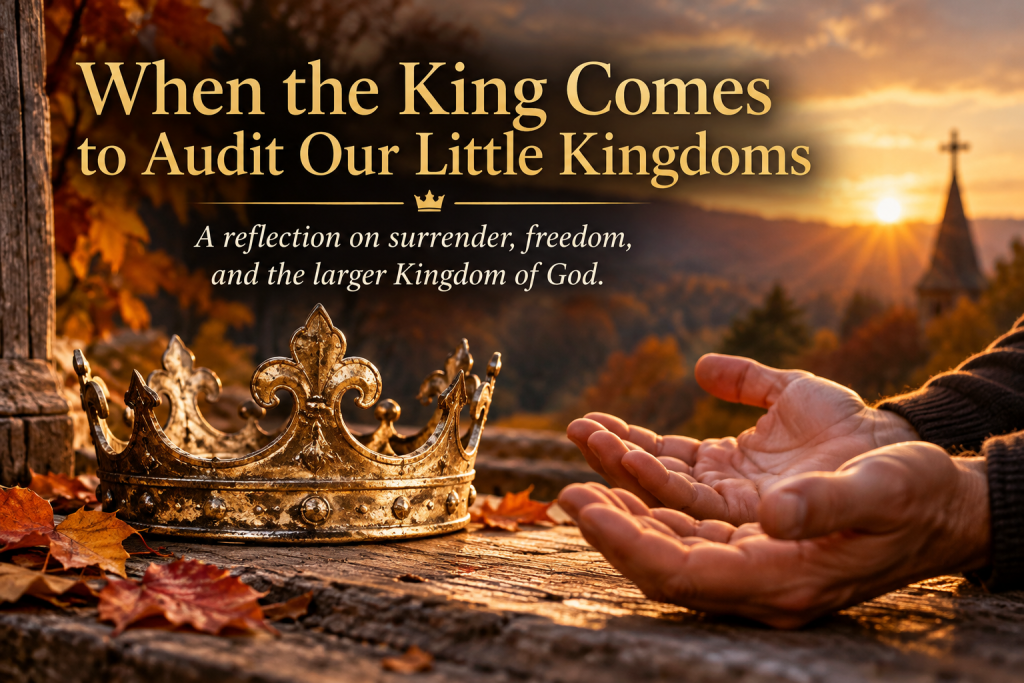
November 20, 2026 | Fifth Reflection in the Journey Toward Christ the King Sunday
On the uncomfortable possibility that Christ’s reign might require us to surrender a few things we have become rather fond of controlling.
There is a remarkable human talent that rarely receives the recognition it deserves.
We are extraordinarily good at building little kingdoms.
Not necessarily the sort with castles, drawbridges, and battlements, although I suspect a few of us would rather enjoy having a moat. Particularly if it could be used to discourage unsolicited visitors and people selling replacement windows.
No, our kingdoms tend to be considerably smaller and much more personal.
There is the kingdom of my opinions.
The kingdom of my schedule.
The kingdom of how things ought to be done.
The kingdom of what I believe other people should be doing, which, curiously enough, is often the largest and most vigorously defended territory of all.
We establish borders, appoint ourselves rulers, and occasionally declare war when someone moves the furniture without consulting us.
And then, just as we are becoming comfortable with our arrangements, the Church calendar announces that Christ the King Sunday is approaching.
Which raises a rather awkward question.
If Christ is King, what exactly does that make me?
And, perhaps more importantly, what becomes of all the little kingdoms I have spent a lifetime constructing?
The Unfortunate Problem of Divine Sovereignty
We Christians are generally quite enthusiastic about proclaiming that Jesus Christ is Lord.
We sing it.
We pray it.
We embroider it on banners.
We announce it with considerable confidence during worship, particularly when the organ is playing something appropriately majestic.
But there is a subtle difference between declaring that Christ is Lord of the universe and allowing Him to be Lord of Tuesday afternoon.
The universe, after all, is a rather large place. We can safely entrust it to divine management without feeling that our immediate arrangements are threatened.
Tuesday afternoon is another matter entirely.
Tuesday afternoon contains our appointments, our frustrations, our carefully constructed expectations, and the people who insist upon doing things differently from the way we would prefer.
Surely, we reason, the Almighty has more pressing matters to attend to.
Galaxies to maintain.
Stars to supervise.
The occasional miracle to arrange.
There seems little reason for God to become involved in how we respond to an irritating email or whether we speak kindly to someone who has thoroughly exhausted our patience.
And yet the Gospel suggests otherwise.
The reign of Christ is not simply a theological statement about who possesses ultimate authority.
It is a claim upon the whole of human life.
Including Tuesday afternoon.
Especially Tuesday afternoon.
The Rich Young Ruler and the Art of Negotiation
There is a wonderful and rather troubling encounter in the Gospels between Jesus and a wealthy man who wants to know what he must do to inherit eternal life.
It is a perfectly reasonable question.
Indeed, it sounds rather like the sort of question one might ask at a parish annual meeting.
What are the requirements?
What are the expectations?
Can we establish a manageable list of responsibilities, preferably with a clear completion date?
Jesus begins by reminding him of the commandments.
The man responds that he has kept them since his youth.
One can almost hear the satisfaction in his voice.
A respectable religious life.
A sound moral record.
All the necessary boxes ticked.
Then Jesus looks at him with love and invites him to sell what he owns, give to the poor, and follow Him.
And suddenly the conversation becomes considerably less comfortable.
The man goes away grieving because he has many possessions.
I have always found this encounter particularly moving because Jesus does not condemn the man.
Mark tells us that Jesus loved him.
That detail matters enormously.
The invitation to surrender is not an act of divine hostility.
It is an act of divine love.
Jesus sees that something good has become something controlling.
The man’s possessions are no longer simply things he owns.
They have become things that own him.
And Christ invites him into freedom.
Not the freedom of having everything.
But the freedom of no longer being possessed by what we possess.
This is where the Gospel begins to sound dangerously personal.
Because wealth is only one of the things to which we cling.
Some of us cling to recognition.
Some to certainty.
Some to resentment.
Some to the comforting conviction that we have always been right.
And some of us have accumulated enough grievances over the years to open a modest museum, complete with guided tours and a gift shop.
The invitation of Christ is not simply to surrender our money.
It is to surrender whatever has quietly taken His place upon the throne of our hearts.
When Being Right Becomes More Important Than Being Loving
I suspect one of the most difficult kingdoms to surrender is the kingdom of being right.
It is an exceptionally comfortable kingdom.
The borders are clearly marked.
The citizens agree with us.
The national anthem consists largely of the phrase, “I told you so.”
And there is very little immigration.
Unfortunately, it is also a kingdom in which grace can have difficulty finding accommodation.
Jesus never suggested that truth was unimportant.
Quite the opposite.
He proclaimed truth with remarkable courage, frequently at considerable personal cost.
But He refused to separate truth from love.
That is a distinction our world desperately needs to recover.
We live in an age in which disagreement has become almost a competitive sport.
People assemble themselves into opposing camps, rehearse their arguments, and prepare for battle.
Listening is often treated as a tactical weakness.
Changing one’s mind is regarded as surrender.
And admitting that someone with whom we disagree might nevertheless possess wisdom is considered dangerously close to treason.
The Church, sadly, has not always distinguished itself in this regard.
We have occasionally managed to turn the Good News of Jesus Christ into a series of arguments about who has the authority to decide where the furniture belongs.
And yet Christ calls us to something greater.
He calls us to be truthful without becoming cruel.
To be faithful without becoming self-righteous.
To hold convictions without surrendering compassion.
To recognize that another person’s dignity does not depend upon their agreement with us.
The reign of Christ begins to become visible when winning the argument matters less than loving the person.
That does not mean abandoning truth.
It means remembering that truth, in the Christian understanding, is ultimately revealed in a Person whose life was marked by mercy.
The Kingdom of Tomorrow
There is another little kingdom many of us work very hard to maintain.
The kingdom of tomorrow.
We like to believe that the future can be managed if only we plan carefully enough.
We make lists.
We develop strategies.
We establish goals.
We create five-year plans, ten-year projections, and committees to review the progress of the committees responsible for implementing the original plans.
As someone who has spent a good many years in the life of the Church, I can assure you that we are quite capable of producing an impressive volume of paperwork while remaining uncertain whether anyone has remembered to turn on the heat.
Planning is not the problem.
Wisdom requires preparation.
Faithfulness requires responsibility.
The problem arises when our desire to plan becomes a refusal to trust.
We begin to imagine that everything depends upon our ability to anticipate every difficulty, prevent every disappointment, and guarantee every outcome.
And when life refuses to cooperate, as life rather frequently does, we become anxious, frustrated, or afraid.
Jesus offers another way.
He tells His disciples not to be consumed by worry about tomorrow.
He does not suggest that tomorrow is unimportant.
He reminds them that tomorrow belongs to God.
There is an enormous difference between responsible stewardship and the illusion of absolute control.
One is an expression of faith.
The other is an exhausting attempt to become God without having the necessary qualifications.
And, speaking personally, I have found that the position appears to have been filled already.
The Courage to Open Our Hands
As the Church year draws toward its conclusion, perhaps this is one of the invitations hidden within the celebration of Christ the King.
Before we can truly welcome the reign of Christ, we must begin to recognize the smaller reigns we have established in competition with His.
Not because God is threatened by our independence.
But because our little kingdoms are often too small for the lives God longs to give us.
Our resentments make the world smaller.
Our fear makes the future smaller.
Our insistence upon control makes our relationships smaller.
Our determination always to be right makes our capacity for wonder smaller.
And Christ comes to enlarge our hearts.
He invites us to exchange possession for generosity.
Certainty for trust.
Resentment for forgiveness.
Control for faithfulness.
Self-importance for humility.
Not because these things are easy.
But because they are the beginning of freedom.
There is a lovely image in the spiritual life of learning to pray with open hands.
It is a simple gesture.
Palms turned upward.
Fingers relaxed.
Nothing clenched.
Nothing defended.
It is surprisingly difficult to do when we have spent so much of our lives holding tightly to the things we fear losing.
Yet open hands are capable of receiving what clenched fists cannot.
And perhaps that is what surrender to Christ really means.
Not becoming passive.
Not abandoning responsibility.
Not surrendering our God-given intelligence or our capacity to act.
But recognizing that the deepest security of our lives does not come from our ability to control everything.
It comes from belonging to the One who holds us in love.
An Uncomfortable Coronation
In just a few days, we will gather to proclaim Christ the King.
We will sing the hymns.
Offer the prayers.
Hear the Scriptures.
And declare once again that Jesus Christ reigns over all creation.
But perhaps the most important part of that celebration will take place after the final hymn has ended.
When we return to our homes.
Our relationships.
Our responsibilities.
Our disagreements.
Our anxieties.
Our unfinished business.
Because that is where the sovereignty of Christ becomes more than a declaration.
That is where it becomes discipleship.
It becomes real when we choose reconciliation over the satisfaction of remaining offended.
When we share something we could easily have kept.
When we listen before we judge.
When we admit that we were wrong.
When we release the future from our desperate need to manage it.
When we allow the love of Christ to challenge the comfortable boundaries of our private kingdoms.
I suspect that is why Jesus speaks so often about losing our lives in order to find them.
He knows how easily we mistake control for security.
How quickly we confuse possession with abundance.
How often we imagine that surrender must mean defeat.
But in the Kingdom of God, surrender to love is not defeat.
It is liberation.
And the King who invites us to surrender is not interested in humiliating us.
He is interested in making us whole.
The Crown We Were Never Meant to Wear
There is a certain relief in discovering that we were never intended to be sovereign over everything.
We are not responsible for holding the universe together.
We are not required to solve every problem.
We do not have to win every argument, control every outcome, or carry every burden.
We are called to be faithful.
To love.
To serve.
To trust.
To act with courage and compassion in the places where God has planted us.
And to leave room for grace to accomplish what our best efforts cannot.
Perhaps the most radical prayer we can offer as Christ the King Sunday approaches is also one of the simplest.
Lord, the Kingdom is Yours.
Not mine.
Yours.
It is a prayer that can change the way we live.
Because once we stop pretending to be sovereign, we become free to be disciples.
Once we loosen our grip upon our little kingdoms, we discover the astonishing generosity of God’s greater Kingdom.
And once we acknowledge Christ as King, we no longer need to spend our lives defending a crown that was never ours to wear.
Which is fortunate, really.
Most of us would look rather ridiculous in one.
And I suspect the parish budget would struggle to accommodate the expense.
So perhaps, as the Church year approaches its end, we might begin with one small act of surrender.
One grudge released.
One fear entrusted to God.
One apology offered.
One generous act undertaken without expectation of recognition.
One moment in which we choose love over the need to be right.
The Kingdom of God does not become real because we have finally mastered the art of religious language.
It becomes visible when our lives begin to reflect the reign of the One we proclaim.
Christ does not ask us to surrender our little kingdoms because He wants to make our lives smaller. He asks because His Kingdom is infinitely larger than anything we could build for ourselves.
And perhaps that is the great freedom of Christ the King.
We can finally put down the crown.
Open our hands.
And discover that we were never meant to rule the world.
We were meant to love it.
Thanks be to God.
Follow along on Instagram @renewablespiritual for more daily reflections on faith, life, and the surprising places where God still loves to meet us.
Companion Prayer
Lord Jesus Christ, our gracious King, forgive us for the little kingdoms we build around our fears, our pride, and our need for control. Teach us to loosen our grip, open our hands, and trust in the abundance of Your Kingdom. Give us the courage to surrender what keeps us from loving freely, and the grace to follow where You lead. May our lives reflect not our own importance, but the generosity of Your reign. Amen.