There is something wonderfully inconvenient about Jesus.
Just when we think we have worked out what God ought to look like, how God ought to behave, and precisely where God ought to sit in the grand arrangement of the universe, Jesus comes along and upsets the furniture.
And, rather irritatingly, He never seems particularly concerned about putting it back.
As we move through these final days of the Church year, approaching the great celebration of Christ the King, we find ourselves confronted by one of Christianity’s most astonishing claims: that the carpenter from Nazareth, who owned very little, commanded no armies, and died under the authority of a Roman governor, is the sovereign Lord of all creation.
It is not, by ordinary human standards, a particularly convincing royal résumé.
There are no impressive military victories, no marble palaces, no treasury overflowing with gold, and certainly no royal carriage drawn by six magnificent horses. Indeed, Jesus appears to have borrowed a donkey for His most celebrated public procession, which, from the standpoint of imperial public relations, was hardly likely to impress the Roman authorities.
And yet, the Church has spent two thousand years insisting that this is precisely what true kingship looks like.
Perhaps the problem is not that Jesus makes a rather unusual King.
Perhaps the problem is that we have spent far too long misunderstanding what a king is supposed to be.
The Trouble with Earthly Crowns
Human beings have always had a peculiar fascination with power.
We admire it, pursue it, argue about it, and occasionally convince ourselves that we would exercise it far more wisely than the people currently in possession of it.
This is particularly noticeable during elections, when nearly everyone suddenly becomes an expert in economics, international diplomacy, public administration, and the proper management of national affairs.
I have often thought that if the wisdom expressed around coffee tables could be gathered into one place, Canada would be governed with such remarkable efficiency that Parliament could adjourn permanently and everyone could go home for supper.
Unfortunately, the wisdom usually begins to evaporate somewhere between the second cup of coffee and the arrival of the bill.
We have inherited a deeply rooted assumption that power means control.
The powerful person is the one who gives the orders, occupies the important chair, possesses the impressive title, and has other people available to carry out the less attractive duties.
Power, in this understanding, is something exercised over others.
And then Jesus arrives.
He gathers a group of fishermen, tax collectors, and assorted unlikely companions. He eats with people respectable society prefers to avoid. He touches those considered unclean, welcomes children whom others regard as interruptions, and tells stories in which the last become first and the first discover, to their considerable annoyance, that they have been standing in the wrong queue.
His entire ministry seems designed to challenge our assumptions about greatness.
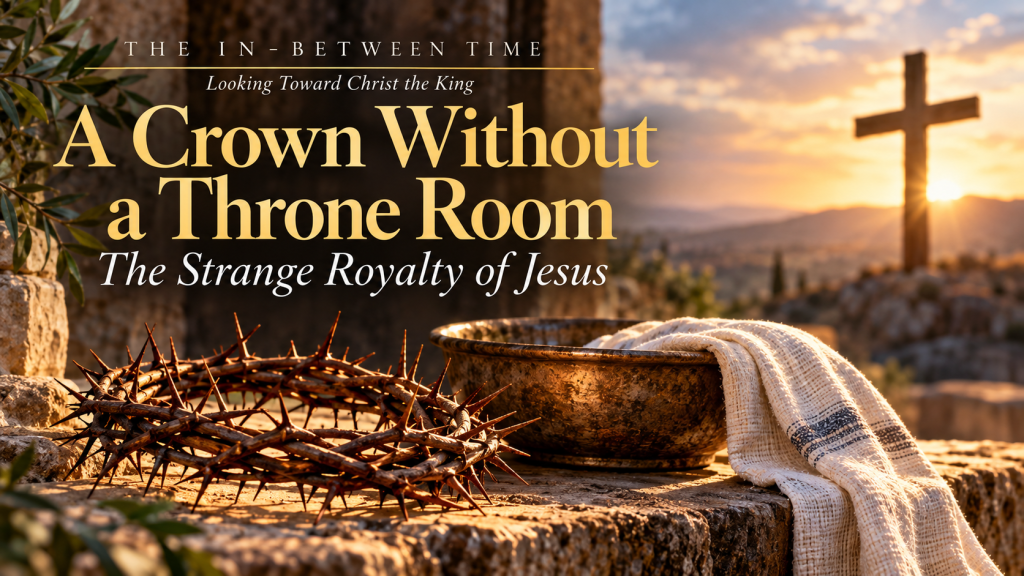
And nowhere is that challenge clearer than in the upper room, when Jesus takes a towel, kneels before His disciples, and washes their feet.
The One whom Christians confess as Lord of heaven and earth assumes the position of a servant.
No throne. No sceptre. No ceremonial announcement.
Just a basin of water and a towel.
If this is what kingship looks like, we may have to reconsider a good deal of what we have been taught about success.
The King Who Kneels
There is a remarkable moment in John’s Gospel when Jesus tells His disciples:
“You call me Teacher and Lord—and you are right, for that is what I am.” (John 13:13)
Notice that Jesus does not reject His authority.
He does not pretend that He is merely another member of the committee, waiting patiently for someone to second the motion.
He knows who He is.
But He immediately demonstrates that divine authority is not expressed through domination.
It is expressed through love.
The King kneels.
The Lord serves.
The One through whom all things came into being washes the dust from tired human feet.
This is not an accidental gesture of kindness. It is a revelation of the very character of God.
And that matters enormously.
Because whenever we imagine God primarily as a distant ruler demanding obedience, we risk overlooking the God revealed in Jesus Christ: the God who comes near, who enters human suffering, who bears the weight of our brokenness, and who refuses to abandon us even when we have made a spectacular mess of things.
God’s greatness is not diminished by humility.
God’s greatness is revealed through it.
There is a lesson here for the Church, although I suspect it is one we occasionally misplace beneath our vestments, committee reports, and carefully organized structures of authority.
The Church has always been rather fond of titles.
Bishops, archbishops, deans, canons, rectors, wardens, and an assortment of other offices can make an Anglican directory resemble the cast list of a particularly elaborate historical drama.
Having occupied a few ecclesiastical offices myself, I can assure you that the titles do not necessarily come with any extraordinary increase in wisdom.
Nor, regrettably, do they guarantee that the photocopier will work when needed.
But at their best, these offices are not honours to be possessed. They are responsibilities to be carried.
Christian leadership is never meant to be an imitation of worldly prestige.
It is meant to be an imitation of Christ.
And Christ, inconveniently enough, keeps reaching for the towel.
A Kingdom That Refuses to Behave
One of the most extraordinary things about the Kingdom of God is how consistently it overturns our expectations.
In the kingdoms of this world, strength is often measured by the ability to defeat an enemy.
In the Kingdom of God, strength is revealed in the courage to forgive one.
In the kingdoms of this world, wealth establishes importance.
In the Kingdom of God, generosity reveals the richness of the human heart.
In the kingdoms of this world, greatness is frequently measured by the number of people who serve us.
In the Kingdom of God, greatness is measured by our willingness to serve others.
And in the kingdoms of this world, the weak are often forgotten.
In the Kingdom of God, they are placed at the very centre of divine concern.
This is why the kingship of Jesus cannot be reduced to a pleasant religious metaphor.
It is a direct challenge to the way we organize our lives, our communities, and our priorities.
To proclaim Christ as King is to declare that no earthly power possesses ultimate authority over our conscience, our compassion, or our commitment to justice.
It means that the hungry cannot simply be dismissed as someone else’s responsibility.
It means that the stranger cannot be reduced to a problem to be managed.
It means that reconciliation matters more than winning every argument.
And it means that the Church must be prepared to measure its faithfulness not merely by the splendour of its worship, the size of its buildings, or the sophistication of its administration, but by the degree to which its life reflects the love of Jesus.
That can be an uncomfortable measurement.
Particularly for those of us who have spent a considerable amount of time in church meetings discussing matters that, in the eternal scheme of things, may not occupy a prominent place in the heavenly agenda.
I rather suspect that when we finally stand before the throne of God, we shall not be asked whether the minutes of the property committee were approved unanimously.
We may, however, be asked whether we noticed the person sitting alone at the back of the church.
The Crown and the Cross
As Christ the King Sunday draws nearer, the Church invites us to contemplate the strangest coronation in history.
The crown is made of thorns.
The royal robe is placed upon Jesus in mockery.
The throne is a wooden cross.
And the inscription identifying Him as King is intended as an accusation.
Here is the astonishing heart of the Christian Gospel.
The sovereignty of Christ is revealed not through the destruction of His enemies, but through His willingness to suffer rather than surrender the way of love.
The cross does not mean that evil is harmless, that injustice should be tolerated, or that suffering is somehow desirable.
Quite the opposite.
The cross exposes the cruelty of human systems that depend upon fear, humiliation, and violence.
And the Resurrection declares that these powers do not have the final word.
Love does.
Life does.
God does.
The crown of Christ is not the reward for conquering others. It is the revelation of a love that refuses to abandon them.
That is the kind of King we are preparing to celebrate.
Not a ruler who demands that the world kneel in terror, but the Lord who first kneels in love.
Living Under a Different Crown
So what does all this mean for us on an ordinary Wednesday in November?
After all, most of us will not be required to negotiate international treaties, command armies, or decide the fate of nations before lunchtime.
We are considerably more likely to be occupied with groceries, appointments, family responsibilities, parish obligations, and the mysterious disappearance of the one important piece of paper we were certain we placed somewhere safe.
But the Kingdom of God is not confined to great historical events.
It takes shape in ordinary acts of faithfulness.
It appears when someone chooses patience instead of irritation.
When a neighbour is welcomed rather than ignored.
When a difficult conversation is approached with humility rather than the determination to emerge victorious.
When someone with authority uses it to protect the vulnerable rather than secure personal advantage.
When a congregation opens its doors, shares its table, and remembers that the Church exists not merely for those already inside, but also for those who have yet to discover that they are welcome.
These things may seem small.
But the Kingdom of God has always had a remarkable capacity to begin with small things.
A mustard seed.
A little yeast.
A few loaves of bread.
A child born in Bethlehem.
A towel and a basin of water.
The extraordinary purposes of God are so often revealed through the ordinary generosity of human lives.
And perhaps that is precisely why Jesus remains such an inconvenient King.
He refuses to allow us to postpone discipleship until some grand and impressive opportunity presents itself.
He asks us to begin where we are.
With the people before us.
With the resources we possess.
With the love we are capable of offering today.
The King at the Door
There is a final thought worth carrying with us as we approach the end of the Church year.
We spend a great deal of time imagining what it might mean to stand before Christ the King.
But the Gospels repeatedly invite us to consider what happens when Christ stands before us.
Not necessarily in splendour.
Not necessarily in unmistakable glory.
But in the hungry neighbour, the lonely stranger, the grieving friend, the exhausted caregiver, and the person whose life has become more complicated than anyone should reasonably be expected to manage.
We may spend our lives looking toward a heavenly throne while overlooking the King who has been standing at our door.
And I cannot help thinking that this is one of the great surprises of Christian faith.
The Lord of all creation is not waiting impatiently for us to become important enough to deserve His attention.
He is already here.
In the quiet places.
In the difficult conversations.
In the acts of compassion that nobody notices.
In the grace that enables us to begin again.
And in every moment when love proves stronger than the desire to control.
As Christ the King Sunday approaches, perhaps we might ask ourselves one simple question:
If Jesus is truly our King, what would change if we began to live as though His way of loving were the highest authority in our lives?
Not merely on Sunday.
Not merely when it is convenient.
But in the ordinary, untidy, frequently bewildering business of being human.
For the King we follow has never been particularly interested in impressive thrones.
He is much more interested in transformed hearts.
And when we finally recognize Him, I suspect we shall discover that He has been carrying a towel all along.
Because the truest sign of Christ’s reign is not how many people bow before Him, but how many discover the courage to love as He loves.
And that, my friends, is a kingdom worth belonging to.
Even if it does mean occasionally surrendering the best chair.
Follow along on Instagram @renewablespiritual for more daily reflections on faith, life, and the surprising places where God still loves to meet us.
Companion Prayer
Gracious Christ, our Servant King, teach us to recognize Your greatness in humility, Your authority in compassion, and Your power in love. Free us from the need to control, and give us the courage to serve. May our lives reflect Your Kingdom, not through the crowns we seek, but through the love we share. Amen.