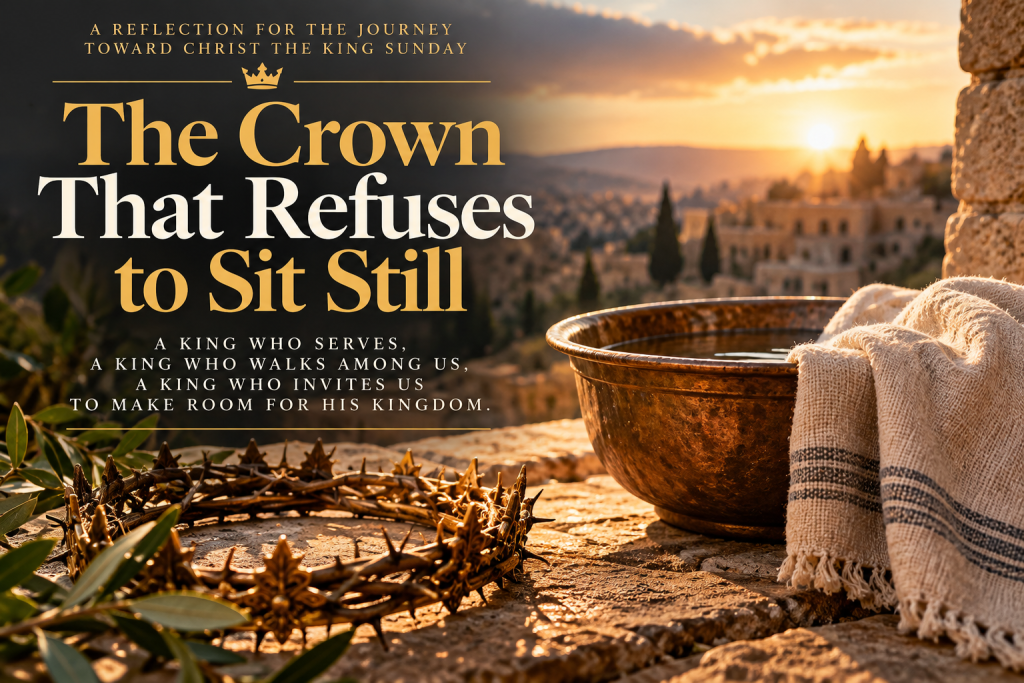
There is something rather comforting about a king who stays where he belongs.
Preferably on a throne.
Ideally in a palace.
Surrounded by people whose principal responsibilities involve polishing silver, announcing visitors, and ensuring that nobody accidentally serves the royal soup at an inappropriate temperature.
Kings, after all, are supposed to be predictable. They issue proclamations, receive dignitaries, attend important ceremonies, and occasionally wave from balconies at people who have been standing in the rain for three hours hoping to catch a glimpse of someone who has never had to find a parking space.
There is a certain reassuring order to the arrangement.
The king remains in the palace. The people remain outside. Everyone knows where they stand.
And then, of course, there is Jesus.
Jesus, who seems to have missed several important lectures on the proper conduct of royalty.
As we continue our journey through these final days of the Church year, moving from the great company of saints toward the celebration of Christ the King, we encounter a rather inconvenient truth.
The King we follow has absolutely no intention of remaining safely on his throne.
And that, I suspect, is precisely what makes him King.
A Kingdom with a Serious Management Problem
If we were designing a kingdom, I imagine most of us would begin with some fairly sensible arrangements.
We would establish a capital city, construct suitable government buildings, appoint a cabinet, and produce a strategic plan. There would be committees, naturally, because no respectable institution can survive without at least one committee devoted to discussing what the other committees ought to be doing.
I have spent enough years in the Church to know that if Jesus returned tomorrow, somebody would immediately propose forming a working group to determine which parish hall he might use.
There would probably be a consultation process.
And, if we were particularly fortunate, a subcommittee on refreshments.
Yet the kingdom Jesus announces seems determined to operate according to an entirely different set of priorities.
Its King is born in borrowed accommodation.
He spends much of his ministry travelling dusty roads without a permanent address.
His closest advisers include fishermen, a tax collector, and several individuals whose qualifications for senior leadership would have caused considerable anxiety in most diocesan offices.
He eats with people respectable society has carefully avoided.
He touches those others consider untouchable.
He speaks to women as though their voices matter.
He welcomes children when his disciples would prefer a little peace and quiet.
And when the opportunity finally arrives for him to demonstrate the full magnificence of his royal authority, he kneels down and washes his disciples’ feet.
One can almost hear the royal protocol officer quietly resigning.
This is not how kings are supposed to behave.
But perhaps that is the point.
The King Who Keeps Turning Up in the Wrong Places
One of the most extraordinary things about Jesus is his persistent habit of appearing precisely where conventional wisdom insists he ought not to be.
He is found among the poor, the hungry, the grieving, the rejected, and the forgotten.
He seems remarkably comfortable in the company of people who have made rather a mess of their lives.
Indeed, he appears to prefer their company to that of those who have become exceptionally skilled at explaining why everyone else is wrong.
This should make those of us who spend our lives in religious institutions just a little uncomfortable.
Because it is terribly easy to become so occupied with maintaining the Church that we forget to notice where Christ has gone.
We polish the candlesticks.
We arrange the flowers.
We prepare the liturgy.
We make certain that the correct hymn is sung at the correct moment, in the correct key, by people who have been given sufficient warning.
All good things, of course.
I am an Anglican priest. I have no intention of declaring war on decent liturgy. There are limits to theological recklessness.
But somewhere beyond our carefully arranged sanctuaries, Christ is already at work.
He is sitting beside someone in a hospital waiting room.
He is standing with a family wondering how they will pay the rent.
He is present in the exhausted parent trying to stretch the grocery budget until payday.
He is encountered in the lonely neighbour who has begun to wonder whether anyone would notice if they disappeared.
And he is waiting for us to recognize him.
Not because he needs our permission to be there.
But because we need our eyes opened to see him.
The Trouble with a King Who Serves
In John’s Gospel, Jesus does something that turns every ordinary understanding of power upside down.
At the Last Supper, knowing that his hour has come, he rises from the table, wraps a towel around himself, and begins washing the feet of his disciples.
John tells us that Jesus acts with the full knowledge that the Father has given all things into his hands.
Think about that for a moment.
All things.
All authority.
All power.
And what does he do with it?
He picks up a towel.
Not a sceptre.
Not a sword.
A towel.
It is one of the most astonishing revelations of divine authority in the whole of Scripture.
Because Jesus does not serve in spite of being King.
Jesus serves because this is what his kingship means.
His authority is not diminished by humility. It is revealed through humility.
His greatness is not threatened by compassion. It is expressed through compassion.
His power does not depend upon keeping others beneath him. It is demonstrated by lifting them up.
And suddenly the entire business of following Christ becomes considerably more demanding.
It is relatively easy to admire a king.
It is rather more difficult to imitate one who insists that greatness is measured by the willingness to serve.
Especially when the person requiring our service happens to be someone we find profoundly irritating.
Jesus, regrettably, never included a convenient exception for irritating people.
I have searched.
It simply is not there.
The Saints Knew Something About This
Only a short while ago, we were celebrating All Saints and remembering the great company of faithful witnesses who have gone before us.
Some were famous.
Some were forgotten.
Some wore crowns, while others barely possessed a second pair of shoes.
But the saints who have left the deepest marks upon the Church were rarely those most impressed by their own importance.
They were the ones who understood that following Christ meant allowing his way of life to reshape their own.
Francis of Assisi abandoned privilege to embrace poverty and simplicity.
Teresa of Calcutta found Christ among those whom the world had largely forgotten.
Countless ordinary Christians, whose names will never appear in a history book or stained-glass window, quietly fed the hungry, visited the sick, forgave their enemies, and remained faithful when faithfulness was costly.
They did not always change the world through grand gestures.
Often they changed it through small acts of love repeated over a lifetime.
A meal delivered.
A hand held.
A stranger welcomed.
A wrong forgiven.
A prayer whispered beside a hospital bed.
These were not merely good deeds performed by unusually nice people.
They were signs of another kingdom breaking into the world.
A kingdom whose King had shown them that love is not weakness, mercy is not surrender, and service is not beneath human dignity.
The saints understood something we are forever in danger of forgetting.
The kingdom of Christ is not simply something we wait to enter after death.
It is something we are called to make visible here and now.
A Crown Without the Usual Privileges
As Christ the King Sunday approaches, it is worth asking ourselves what sort of king we actually want.
Do we want a king who confirms our opinions?
A king who protects our privileges?
A king who blesses our ambitions and reassures us that the people we dislike are, conveniently enough, also the people God dislikes?
That would certainly make religion much easier.
It would also make Jesus considerably less troublesome.
But the Christ we encounter in the Gospels refuses to become the mascot of our preferences.
He calls us beyond ourselves.
He challenges our assumptions.
He exposes our comfortable prejudices.
He asks us to love our enemies, forgive those who wound us, care for the vulnerable, and recognize the dignity of people we would rather avoid.
He even expects us to do these things without first receiving a certificate of appreciation.
An alarming thought, particularly in a culture where almost everything seems to require public recognition.
Yet this is the freedom Christ offers.
Freedom from the endless need to be important.
Freedom from the exhausting business of proving ourselves superior.
Freedom from the illusion that power must always be exercised over someone else.
Under Christ’s reign, greatness is not something we seize.
It is something we discover when we give ourselves away in love.
The King Is Already Out There
There is a wonderful irony in our preparations for Christ the King Sunday.
We spend these days looking forward to celebrating the sovereignty of Jesus, as though we were preparing to welcome a distinguished visitor who will arrive at the appointed hour, accompanied by appropriate music and perhaps a modest procession.
But Christ is not waiting for Sunday to begin reigning.
His kingdom is already breaking into the world.
Every time mercy interrupts cruelty.
Every time forgiveness interrupts resentment.
Every time generosity interrupts greed.
Every time someone chooses to serve rather than dominate.
Every time a frightened person discovers that they are not alone.
Every time the Church remembers that its first responsibility is not to preserve its own importance, but to embody the love of Jesus Christ.
There, the kingdom becomes visible.
Not completely, of course.
We still live in a world marked by suffering, injustice, violence, and the terrible misuse of power.
The fullness of God’s kingdom remains something for which we pray and hope.
Thy kingdom come.
Those words are not a declaration that everything is already as God intends.
They are a prayer that God’s healing reign will continue to transform a world desperately in need of redemption.
And they are also a commitment.
Because whenever we pray for God’s kingdom to come, we are offering ourselves to become part of the answer.
Which is a rather dangerous thing to do before breakfast.
One might begin the morning hoping for a quiet day and discover that God has arranged an opportunity to practice patience with an impossible neighbour.
Or generosity with someone who cannot repay us.
Or forgiveness toward someone who has never apologized.
The kingdom, it seems, is rarely convenient.
But it is always holy.
Following a King Who Will Not Stay Put
Perhaps this is what we most need to remember as the Church year draws toward its conclusion.
Jesus Christ is not a distant monarch who reigns from the safety of heaven while humanity struggles along beneath him.
He is Emmanuel.
God with us.
The Word made flesh.
The King who enters the dust and confusion of human existence, who shares our suffering, bears our wounds, and refuses to abandon us even when we have abandoned ourselves.
He reigns from a cross before he is proclaimed in glory.
His crown is made of thorns before it is recognized as the crown of heaven.
And his victory comes not through the destruction of his enemies, but through the self-giving love that defeats sin and death.
This is the King toward whom we are travelling.
Not a king who demands that the world kneel before his vanity.
But a King before whom we kneel because we have discovered, at last, what true love looks like.
And perhaps the greatest challenge of these days before Christ the King Sunday is not simply to prepare ourselves to celebrate his reign.
It is to ask whether we are willing to live beneath it.
To allow his mercy to shape our judgments.
His humility to reshape our ambitions.
His generosity to challenge our possessions.
His compassion to interrupt our schedules.
His love to transform our relationships.
For the King we follow has never been particularly interested in remaining safely confined to palaces, sanctuaries, theological arguments, or the more respectable corners of our religious imagination.
He is still walking the roads.
Still welcoming strangers.
Still washing feet.
Still calling disciples.
Still turning the world’s understanding of greatness upside down.
And if we wish to follow him, we may have to leave a few comfortable things behind.
Including, quite possibly, the committee meeting.
Although I suspect someone will insist that we take minutes.
The King is not waiting for us to build him a throne. He is inviting us to make room for his kingdom.
And the remarkable thing is that this kingdom begins wherever love is given room to reign.
Even here.
Even now.
Even through us.
Thanks be to God.
Amen.
Follow along on Instagram @renewablespiritual for more daily reflections on faith, life, and the surprising places where God still loves to meet us.
Companion Prayer
Gracious Christ, our Servant King, teach us to recognize your kingdom not in power or privilege, but in mercy, humility, and love. Open our eyes to find you among the forgotten, our hearts to welcome the stranger, and our hands to serve as you have served us. May your kingdom come, not only in the world around us, but through the lives we live today. Amen.