When Heaven’s Majesty Comes Down to Earth and Gets His Hands Dirty
There is something wonderfully inconvenient about Jesus Christ.
Just when we think we have him safely arranged in the proper theological category, with the appropriate liturgical colour, a respectable hymn, and perhaps a rather handsome stained-glass window, he gets up and does something entirely unexpected.
He washes somebody’s feet.
He eats with the wrong people.
He touches a leper.
He welcomes a child.
He forgives someone who has absolutely no business expecting forgiveness.
And then, just when we are beginning to suspect that he has never properly understood how kingship is supposed to work, he climbs onto a cross.
Frankly, if Jesus had employed a competent public relations consultant, the entire Gospel might have unfolded rather differently.
The consultant would almost certainly have recommended a larger palace, a more impressive wardrobe, and considerably fewer conversations with tax collectors. The whole business of riding into Jerusalem on a borrowed donkey would have been regarded as a catastrophic branding decision.
And the cross?
Well, that would have been eliminated from the strategic plan altogether.
But that is precisely the trouble with Jesus.
He has never been particularly interested in looking like a king. He has been entirely committed to showing us what the reign of God actually looks like.
And those are two very different things.
The Problem with Our Expectations
As we draw closer to Christ the King Sunday, the final great celebration of the Church year, we are invited to reconsider something that Christians have been wrestling with for two thousand years.
What exactly do we mean when we call Jesus our King?
Because, whether we care to admit it or not, most of us carry around a rather conventional understanding of kingship.
Kings sit above everyone else.
Kings issue instructions.
Kings possess power, command loyalty, and generally expect that someone else will take care of the washing up.
Even our language betrays us. We speak of people climbing the ladder of success, rising through the ranks, and reaching the top.
Nobody ever seems terribly enthusiastic about reaching the bottom.
Unless, of course, they have dropped their car keys down a drain.
Yet Jesus seems determined to turn the entire ladder upside down.
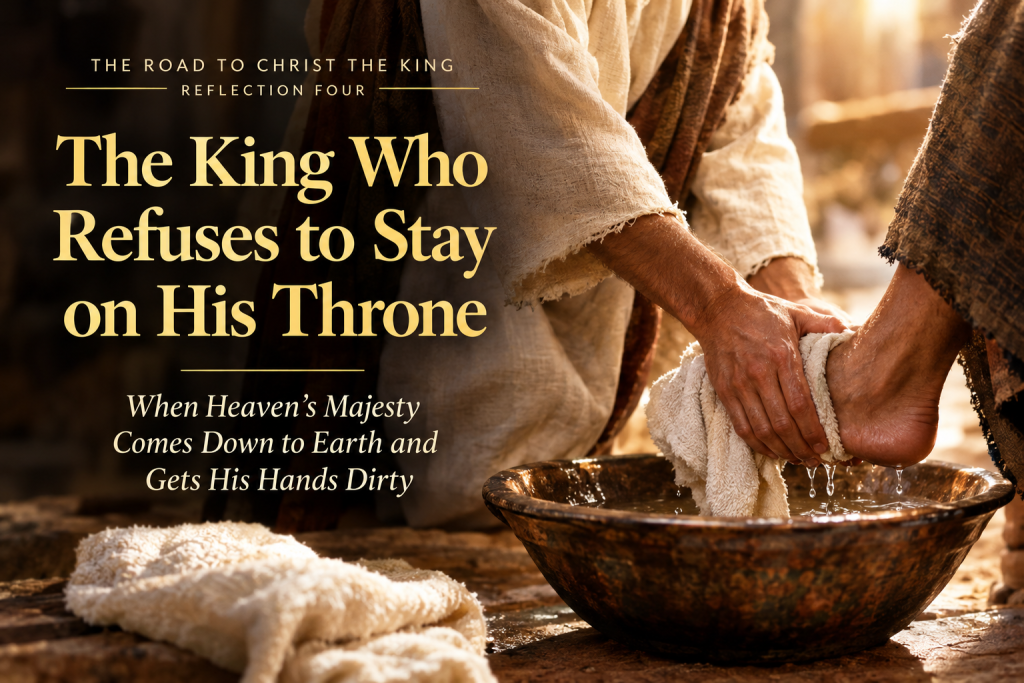
In the thirteenth chapter of John’s Gospel, we encounter one of the most extraordinary moments in all of Scripture.
Jesus, knowing that his hour has come, rises from supper, removes his outer robe, ties a towel around himself, and begins washing the feet of his disciples.
Think about that for a moment.
The one whom Christians proclaim as the eternal Word of God, through whom all things were made, is kneeling on the floor with a basin of water.
The Lord of creation is doing the work of a servant.
The King of heaven is attending to dusty feet.
I suspect that if this had happened at a modern parish council meeting, somebody would immediately have formed a committee to determine whether it complied with diocesan policy.
Peter, at least, reacts with understandable alarm.
“Lord, are you going to wash my feet?”
It is the sort of question one asks when the universe has suddenly stopped behaving according to the established rules.
Peter knows perfectly well who Jesus is supposed to be.
And this is not it.
But Jesus is not merely offering an interesting lesson in humility.
He is revealing the very nature of divine authority.
In the kingdom of God, greatness is not measured by how many people serve you, but by how freely you are willing to serve others.
That is not simply a moral suggestion.
It is a revolution.
A Kingdom Without the Usual Furniture
One of the curious things about earthly power is how much furniture it seems to require.
Thrones. Desks. Official chairs. Raised platforms. Elaborate tables at which important people sit while less important people wonder whether they are permitted to have another biscuit.
We have become remarkably skilled at arranging ourselves according to status.
There are head tables, reserved seats, honorary titles, and parking spaces carefully marked for individuals whose responsibilities apparently make walking an additional twenty feet an unreasonable burden.
And before anyone becomes too comfortable, I should acknowledge that the Church has occasionally developed a rather impressive collection of these arrangements itself.
We have robes, processions, ceremonial chairs, and enough titles to keep a reasonably competent herald occupied for several afternoons.
I say this as someone who has worn more than a few ecclesiastical garments and has occasionally wondered whether the additional layers were intended to symbolize holiness or simply to ensure that clergy perspire sufficiently to appreciate the sufferings of the saints.
None of these things is necessarily wrong.
Symbols can teach. Traditions can deepen our understanding. Beauty can lift our hearts toward God.
But they become dangerous when we begin confusing the symbols of authority with the substance of Christian leadership.
Because the throne of Christ is unlike any throne the world has ever constructed.
His authority is revealed in mercy.
His power is expressed through love.
His majesty is made visible in self-giving sacrifice.
And his crown, before it is ever imagined in gold, is fashioned from thorns.
The Gospel does not abolish the idea of kingship.
It transforms it beyond recognition.
The God Who Comes Down
There is a beautiful theological truth running through the whole Christian story.
God does not wait for humanity to climb high enough to reach heaven.
God comes down.
In the Incarnation, the eternal Son enters the ordinary circumstances of human life.
Not as a distant observer.
Not as a visiting dignitary who has arranged a carefully managed tour of the more presentable neighbourhoods.
But as one of us.
Born into vulnerability.
Raised in an ordinary household.
Acquainted with hunger, exhaustion, grief, disappointment, friendship, and the considerable challenges of dealing with people who are absolutely certain that they are right.
Which, come to think of it, means that Jesus would have been perfectly qualified for parish ministry.
The wonder of the Incarnation is not merely that God becomes visible.
It is that God becomes approachable.
In Jesus, the distance between heaven and earth is crossed by divine love.
And that movement continues throughout his ministry.
He moves toward the wounded.
He moves toward the forgotten.
He moves toward those whom respectable society has quietly decided are best left at the edge of things.
He does not remain above the messiness of human existence.
He enters it.
And this is why the kingship of Christ matters so profoundly.
We do not worship a ruler who observes our suffering from a comfortable distance.
We worship a Saviour who has entered suffering himself.
A King who knows the weight of sorrow.
A King who understands betrayal.
A King who has stood beside graves and wept.
A King whose hands bear the marks of love carried to its ultimate conclusion.
The Kingdom Is Closer Than We Think
There is a temptation, particularly as we approach the end of the Church year, to imagine the kingdom of God as something that belongs almost entirely to the future.
One day Christ will reign.
One day justice will prevail.
One day creation will be restored.
And yes, the Christian hope looks forward to the fulfilment of God’s purposes, when all things will be gathered together in Christ.
But the Gospel insists that the kingdom is already breaking into the world.
Not yet in its fullness.
Not yet without resistance.
But truly and unmistakably.
Whenever mercy interrupts cruelty, something of the kingdom becomes visible.
Whenever forgiveness breaks the cycle of resentment, the reign of Christ draws near.
Whenever someone chooses compassion over convenience, generosity over greed, or reconciliation over revenge, we catch a glimpse of what the world looks like when Jesus is King.
And these glimpses are often astonishingly ordinary.
A neighbour checking on someone who lives alone.
A volunteer preparing a meal for people whose circumstances have become difficult.
A nurse sitting quietly beside a frightened patient.
A family choosing to begin again after a painful disagreement.
A congregation opening its doors not merely to those who already belong, but to those who are still wondering whether there might be room for them.
These are not insignificant acts.
They are signs of the kingdom.
The trouble is that we often miss them because we are looking for something considerably more dramatic.
We want trumpets.
God sends a neighbour with a casserole.
We want thunder from heaven.
God sends someone who listens.
We want a mighty demonstration of divine power.
God gives us a towel and a basin.
And somehow, through these small and faithful acts, the kingdom keeps arriving.
The Danger of Admiring Jesus from a Safe Distance
Of course, there is one rather uncomfortable implication in all of this.
If Jesus is truly our King, then his way of living becomes the pattern for our own.
And that is where things become decidedly inconvenient.
It is one thing to admire the humility of Christ.
It is another thing entirely to practise humility when someone has just taken credit for your work.
It is one thing to celebrate the forgiveness of Jesus.
It is quite another to forgive the person who has spent the past six months being an absolute nuisance.
It is one thing to proclaim that Christ welcomes the stranger.
It is another to make room for someone whose opinions, habits, background, or circumstances challenge our comfortable assumptions.
Christian discipleship has never been simply an exercise in appreciating Jesus.
It is an invitation to follow him.
And following him means allowing his kingdom to reshape our priorities.
It means asking different questions.
Not, “How can I become more important?”
But, “Whom am I being called to serve?”
Not, “How can I protect my position?”
But, “How can I use whatever influence I possess to lift someone else?”
Not, “What am I entitled to receive?”
But, “What has God entrusted to me that I might share?”
These questions are not always comfortable.
Indeed, they have a rather distressing habit of interfering with our plans.
But perhaps that is precisely the point.
The kingdom of God is not simply meant to reassure us that everything we already believe and practise is perfectly acceptable.
It is meant to transform us.
When the King Kneels
There is a particular image I find myself returning to as Christ the King Sunday approaches.
Not the triumphant Christ surrounded by clouds and angels, magnificent though that image may be.
Not even the heavenly throne described in the Book of Revelation, radiant with glory and surrounded by worship.
I find myself returning to the upper room.
To the towel.
To the basin.
To the astonished faces of the disciples.
And to Jesus kneeling before people who still have so much to learn about love.
There is something profoundly hopeful about that scene.
Because those disciples are not particularly impressive.
They misunderstand Jesus.
They argue about greatness.
They make promises they cannot keep.
One will betray him.
Another will deny him.
Most will abandon him when the darkness comes.
And yet Jesus washes their feet.
He does not wait until they have become worthy of his love.
He loves them into the possibility of becoming something more.
That is grace.
And it is grace that makes the kingdom of Christ unlike every other kingdom we have ever known.
Earthly power so often demands that people prove their worth before they are welcomed.
Christ welcomes us, and then begins the patient work of transforming our lives.
Earthly authority frequently protects itself by keeping others at a distance.
Christ draws near.
Earthly kings may command people to kneel before them.
Our King kneels before us, and teaches us what love looks like.
There is the astonishing heart of the Gospel.
A Crown That Changes Everything
As we stand in these final days of the Church year, looking toward Christ the King Sunday and beyond it to the beginning of Advent, perhaps we might reconsider what it means to belong to the kingdom of God.
Perhaps it means loosening our grip on the little kingdoms we have constructed for ourselves.
Our need to be right.
Our desire to be recognized.
Our insistence upon having the final word.
Our tendency to measure success according to the standards of a world that has never quite understood the Gospel.
Perhaps it means discovering that the most important things we do are not always the things that attract attention.
Sometimes the kingdom advances through a quiet apology.
Sometimes through an act of generosity that nobody notices.
Sometimes through the difficult decision to listen rather than argue.
Sometimes through the simple courage of remaining kind in a world that seems increasingly determined to make kindness look foolish.
And perhaps, most importantly, it means remembering that we do not establish the kingdom by our own strength.
Christ is already King.
Our calling is to live as though that astonishing truth actually matters.
Which, I admit, is rather more demanding than simply singing an impressive hymn about it.
But it is also infinitely more beautiful.
Because the King we worship is not waiting at the top of some distant staircase, demanding that we struggle our way upward.
He has already come down.
He has entered our world.
He has taken up the towel.
He has embraced the cross.
And he continues to meet us in the ordinary places where love is offered, mercy is practised, and hope refuses to surrender.
So, as we prepare to celebrate Christ the King, perhaps we should not spend quite so much time imagining the grandeur of his throne.
Perhaps we should pay a little more attention to the towel in his hands.
For there, in that unexpected act of humble service, we discover something that changes everything.
The King of heaven does not reign by making himself greater than everyone else. He reigns by giving himself in love for everyone else.
And if we truly wish to honour him, perhaps the finest tribute we can offer is not another crown, another title, or another splendid procession.
Perhaps it is simply to pick up a towel of our own.
And begin.
Amen.
Follow along on Instagram @renewablespiritual for more daily reflections on faith, life, and the surprising places where God still loves to meet us.
Companion Prayer
Lord Jesus Christ, our Servant King, you laid aside the symbols of power and took up the towel of love. Teach us to serve without seeking recognition, to love without counting the cost, and to discover your kingdom in the ordinary kindnesses of daily life. Give us humble hearts, willing hands, and the courage to follow where you lead. May our lives reflect not the grandeur of earthly thrones, but the glory of your self-giving love. Amen.