Season of Creation, Part Four: Learning to Belong to the World God Loves
There is something wonderfully inconvenient about St. Francis of Assisi.
Just when Christians have managed to organize the universe into sensible categories—people over here, animals over there, useful things in one cupboard, useless things in another—Francis wanders into the room calling the sun his brother and the moon his sister.
This is not how respectable people normally speak.
If I announced at a parish council meeting that I had been consulting with Brother Sun and Sister Moon about next year’s budget, I suspect someone would quietly suggest a sabbatical.
And yet, as the Church approaches the Feast of St. Francis on October 5, perhaps we need a little of his holy eccentricity.
Because Francis understood something that modern life has made remarkably easy to forget:
We do not merely live upon creation. We belong within it.
That may be the most important lesson of the Season of Creation.
Over these weeks, we have reflected upon the goodness of the world God has made. We have considered the spiritual discipline of noticing creation rather than simply passing through it. We have reminded ourselves that Christians care for the earth not because we believe creation is doomed, but because we believe creation is loved.
And now Francis pushes us one step further.
He asks us to remember that creation is not scenery.
It is family.
The World Is Not a Warehouse
Modern society has become remarkably skilled at turning creation into inventory.
Forests become lumber.
Rivers become water supplies.
Fields become acreage.
Animals become livestock.
Mountains become mineral deposits.
Even sunsets eventually become real-estate advertisements.
“Spectacular western exposure!”
Apparently the sun has been setting for billions of years merely to improve property values.
But Scripture offers us a very different vision.
The Bible begins not with a warehouse but with a garden.
God speaks, and light appears. Waters gather. Plants rise from the earth. Birds fill the sky. Creatures move through the seas. Animals wander across the land.
And again and again, before human beings have accomplished anything at all, God looks upon creation and calls it good.
Not useful.
Not profitable.
Not commercially viable.
Good.
Creation possesses value before we decide what it is worth.
That truth has enormous theological consequences.
Because if the world belongs first to God, then we are not its owners in any absolute sense.
We are its neighbours.
Its caretakers.
Its fellow creatures.
Or, to use Francis’s wonderfully affectionate language, its brothers and sisters.
The Gospel According to a Squirrel
I confess that my relationship with the animal kingdom occasionally falls short of Franciscan ideals.
Squirrels, for example.
I am prepared to recognize the theological significance of squirrels in principle.
In practice, however, a squirrel approaching a bird feeder appears to have attended a graduate school devoted entirely to organized crime.
They are astonishing creatures.
You may purchase a bird feeder advertised as ABSOLUTELY SQUIRREL PROOF, which is a phrase apparently written by someone who has never met a squirrel.
Within twenty minutes, one of them will be hanging upside down by a single toenail while another studies the locking mechanism.
There will almost certainly be a third squirrel nearby acting as lookout.
And yet even the neighbourhood squirrel belongs to the extraordinary community of creation.
The psalmist imagines the whole earth praising God:
rivers clapping their hands,
hills singing together for joy,
seas roaring,
trees rejoicing.
Scripture does not imagine humanity performing a solo while creation sits politely in the audience.
It imagines a choir.
We are simply one section.
Admittedly, we are the section that occasionally believes the entire concert was organized for our benefit.
Dominion Was Never Permission to Destroy
One of the saddest theological mistakes Christians have made is treating the biblical language of “dominion” as though God handed humanity the keys to creation and said,
“Do whatever you like. I wasn’t particularly attached to it.”
But biblical dominion is patterned after the reign of God.
And how does God reign?
With mercy.
With justice.
With faithfulness.
With generosity.
With concern for the vulnerable.
Human authority over creation, therefore, can never mean exploitation.
It means responsibility.
The gardener does not own the garden simply because the gardener carries the shovel.
The shepherd does not own the sheep simply because the shepherd holds the staff.
And humanity does not own the earth simply because we have developed remarkably efficient machinery for digging holes in it.
The earth remains God’s.
We are trusted with its care.
That is both an honour and a responsibility.
Perhaps Salvation Is Larger Than We Thought
Christians sometimes speak about salvation as though God’s entire redemptive project consists of rescuing individual human souls from a planet that will eventually be discarded.
But the biblical story is much larger.
St. Paul tells us that creation itself is groaning.
And creation is waiting.
Not for destruction.
For redemption.
The final Christian hope is not that God abandons creation.
It is that God renews it.
A new heaven.
A new earth.
Creation healed.
Creation reconciled.
Creation brought into the fullness God intended from the beginning.
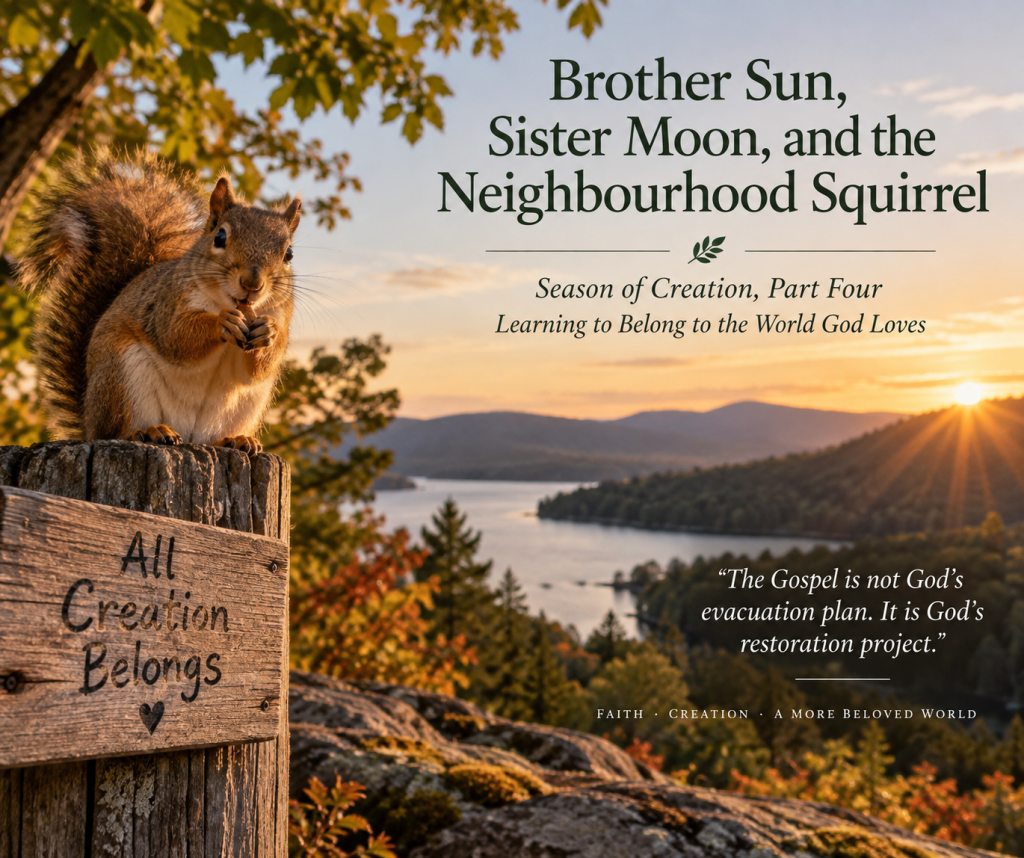
The Gospel, therefore, is not God’s evacuation plan.
It is God’s restoration project.
And Christians are invited to begin living now as citizens of that restored creation.
Small Acts in a Very Large World
This is where environmental conversations can become overwhelming.
The problems are enormous.
Climate change.
Habitat destruction.
Pollution.
Species loss.
Waste.
And most of us are standing in the kitchen wondering whether the yogurt container belongs in recycling.
It can feel absurdly small.
But Christianity has always believed in the holiness of small things.
A mustard seed.
A cup of cold water.
Five loaves and two fish.
A widow’s coin.
Bread and wine.
The Kingdom of God has never been embarrassed by small beginnings.
So plant something.
Waste less.
Walk when you can.
Buy thoughtfully.
Repair something instead of replacing it.
Support farmers who care for their soil.
Leave part of the garden a little untidy for pollinators.
Learn the names of the birds outside your window.
Sit beside a lake without needing to accomplish anything.
Stand beneath a tree and remember that it has been quietly turning sunlight into life while you have been answering emails.
And perhaps occasionally allow yourself to be astonished.
Because astonishment may be one of the first forms of stewardship.
We tend to protect what we have learned to love.
And we tend to love what we have learned to notice.
The Spiritual Discipline of Belonging
Perhaps this is what Francis understood.
He did not love creation because creation was fashionable.
He loved creation because he loved God.
And the deeper he entered into the love of God, the more kinship he discovered around him.
Brother Sun.
Sister Moon.
Brother Wind.
Sister Water.
Brother Fire.
Mother Earth.
Francis did not diminish humanity by speaking this way.
He located humanity properly.
We are creatures among creatures.
Beloved among the beloved.
Dependent upon gifts we did not create.
Breathing air we did not manufacture.
Drinking water we did not invent.
Eating food grown from soil we did not design.
Living beneath a sun we did not ignite.
Every breath is borrowed.
Every meal is received.
Every sunrise arrives as grace.
And Perhaps That Changes Everything
The Season of Creation eventually ends.
The banners come down.
The special prayers disappear from the liturgy.
October arrives.
And the Church calendar moves along.
But creation does not stop being sacred when the Season of Creation ends.
The maple tree outside does not consult the liturgical calendar before changing colour.
The geese do not wait for permission from the Anglican Church of Canada before flying south.
The rivers continue running.
The earth continues turning.
The squirrels continue plotting.
And God continues loving the world.
Perhaps the real purpose of this season has never been to make us environmentally conscious for a few weeks.
Perhaps it has been to teach us how to see.
To walk through the world differently.
To recognize creation not merely as something surrounding our spiritual lives, but as one of the places where our spiritual lives are actually happening.
Because the world is not simply where we wait for heaven.
It is God’s beloved creation.
It is our common home.
It is the neighbourhood into which Christ was born.
And it is the creation God is still redeeming.
So as we come to the Feast of St. Francis, perhaps we might borrow his strange and beautiful vocabulary.
Brother Sun.
Sister Moon.
Sister Water.
Mother Earth.
And yes, even Brother Squirrel.
Though I reserve the right to keep him away from the bird feeder.
For if we can learn again that creation is not merely ours, but that somehow we are its, then stewardship becomes something deeper than obligation.
It becomes gratitude.
It becomes kinship.
It becomes worship.
And perhaps that is where the Season of Creation was trying to lead us all along:
not merely toward saving the earth,
but toward remembering that, by the grace of God,
we belong to it.
Follow along on Instagram @renewablespiritual for more daily reflections on faith, life, and the surprising places where God still loves to meet us.
Companion Prayer
Creator God,
teach us to see the world as gift rather than possession,
to recognize our kinship with all that you have made,
and to walk gently upon the earth you love.
Give us grateful hearts, attentive eyes, and willing hands,
that our care for creation may become an act of worship
and our daily choices a sign of hope.
Through Christ, in whom all things are being made new.
Amen.