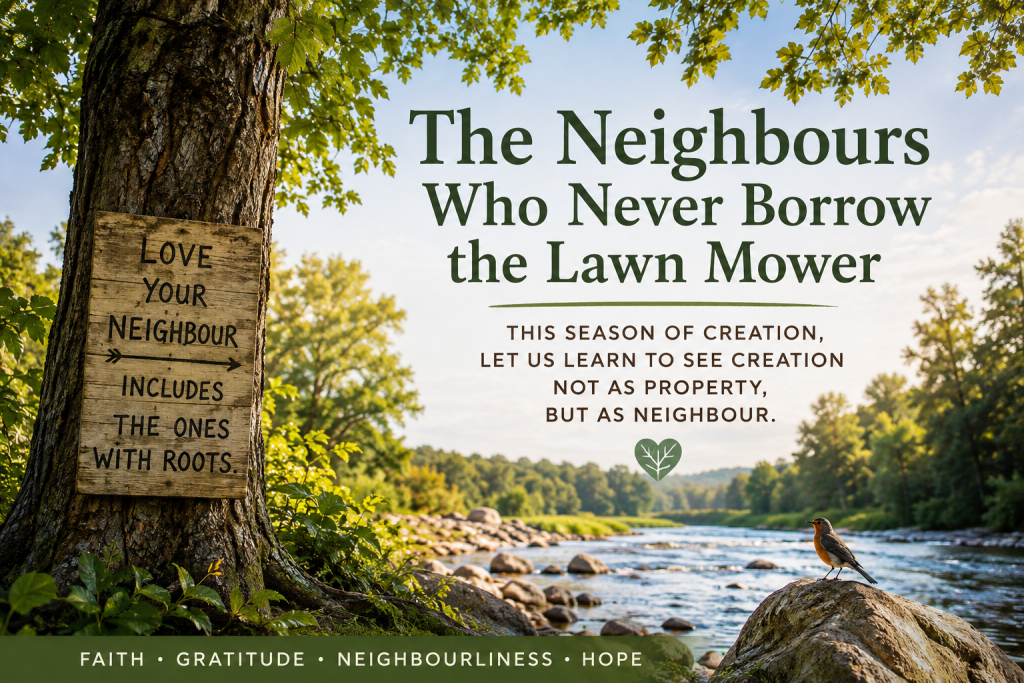
There is a maple tree not far from where I live that has never once asked me for anything.
It has never borrowed twenty dollars.
It has never asked me to help move a sofa.
It has never telephoned at 7:15 on a Saturday morning to say, “Since you’re up…”
As neighbours go, the maple tree is nearly perfect.
And yet, for most of my life, I am not sure I thought of a tree as a neighbour at all.
That may be one of the quiet invitations of this Season of Creation: to reconsider who—or perhaps what—belongs inside the circle of our neighbourliness.
Jesus famously tells us to love our neighbour as ourselves. Naturally, Christians have spent two thousand years discussing precisely who qualifies as a neighbour. This is what Christians do remarkably well. Give us one beautifully simple commandment and, within twenty minutes, someone will have formed a committee to define its jurisdiction.
But Scripture seems much less interested in separating humanity from creation than we sometimes are.
The Psalms speak of rivers clapping their hands and hills singing together for joy. Isaiah imagines mountains and hills bursting into song while the trees applaud. Jesus tells us to consider the lilies and watch the birds.
Apparently, God has been conducting a rather large choir while most of us have been standing in the parking lot discussing the music.
Creation, in Scripture, is not merely the stage upon which the important human drama takes place.
Creation participates.
Creation praises.
Creation groans.
Creation waits.
Creation belongs to God.
And perhaps that means our relationship with creation needs to become less about ownership and more about neighbourliness.
That is quite a shift.
Ownership asks, “What can I do with this?”
Neighbourliness asks, “How are you doing?”
Ownership looks at a forest and calculates lumber.
Neighbourliness notices habitat.
Ownership looks at a river and measures what can be extracted from it.
Neighbourliness wonders whether the water is healthy enough for the creatures downstream.
Ownership looks at soil and asks how much it can produce.
Neighbourliness remembers that even soil needs Sabbath.
None of this means human beings must stop farming, building, harvesting, eating, heating our homes, or occasionally engaging in vigorous negotiations with the raccoon who has declared the garbage bin an all-you-can-eat buffet.
Scripture does not call us to withdraw from creation.
It calls us to live responsibly within it.
That distinction matters.
Genesis does not describe humanity as tourists visiting creation for the weekend. We are made from the earth itself. The Hebrew wordplay is beautiful: adam comes from adamah—the human from the humus, the earth-creature from the earth.
Which means that whenever we imagine ourselves standing above creation, we have forgotten where we came from.
We are dust with opinions.
Dust with mortgages.
Dust with smartphones.
Dust which occasionally becomes very irritated when another piece of dust takes our parking space.
And yet into this earthiness God breathes life.
Our dignity does not come from escaping creation. It comes from receiving our place within it as gift and vocation.
Perhaps this is why the ecological crisis facing our world is not merely a scientific problem or a political problem.
For Christians, it is also a spiritual problem.
Because underneath questions about climate, forests, oceans, species, agriculture, consumption, and pollution lies an older question:
What kind of neighbours are we becoming?
Good neighbours pay attention to how their lives affect the people next door.
Good neighbours do not dump rubbish over the fence and then congratulate themselves on having a tidy backyard.
Good neighbours understand that what happens on one property eventually affects the whole neighbourhood.
Creation works much the same way.
There really is no “away” when we throw something away.
There is only somewhere else in the neighbourhood.
And Christianity has something profoundly hopeful to contribute here, because our faith begins not with despair but with love.
We care for creation not because we believe the world is doomed.
We care because we believe the world is loved.
Loved enough to be created.
Loved enough to be called good.
Loved enough for God to enter it in Jesus Christ—not hovering several feet above the ground in divine disapproval, but walking its dusty roads, drinking its water, eating its bread, sailing its lakes, sleeping beneath its stars.
And ultimately, loved enough to be redeemed.
The Season of Creation therefore invites us to enlarge our understanding of neighbour.
Perhaps the maple tree is not merely landscaping.
Perhaps the creek is not merely drainage.
Perhaps the birds gathering noisily outside the window are not interrupting our prayers.
Perhaps they are already praying.
And perhaps our task is not to become the saviours of creation.
Christ already occupies that position, and the job description is considerably above our pay grade.
Our task is simpler.
To notice.
To give thanks.
To consume a little more thoughtfully.
To waste a little less casually.
To protect what is vulnerable.
To leave room for things that do not exist merely for our convenience.
To become good neighbours in the enormous, beautiful, slightly unruly neighbourhood God calls creation.
Because one day, perhaps sooner than we imagine, we may discover something the saints and poets have been trying to tell us for centuries:
We were never standing outside creation looking in.
We were home all along.
Follow along on Instagram @renewablespiritual for more daily reflections on faith, life, and the surprising places where God still loves to meet us.
Companion Prayer
Creator God,
teach us to see the world around us not as property to possess, but as a community to cherish. Make us good neighbours to the trees, waters, creatures, and soil with whom we share this home. Give us grateful hearts, gentle hands, and the wisdom to live lightly upon the earth. Through Christ, in whom all creation is held together. Amen.