Season of Creation
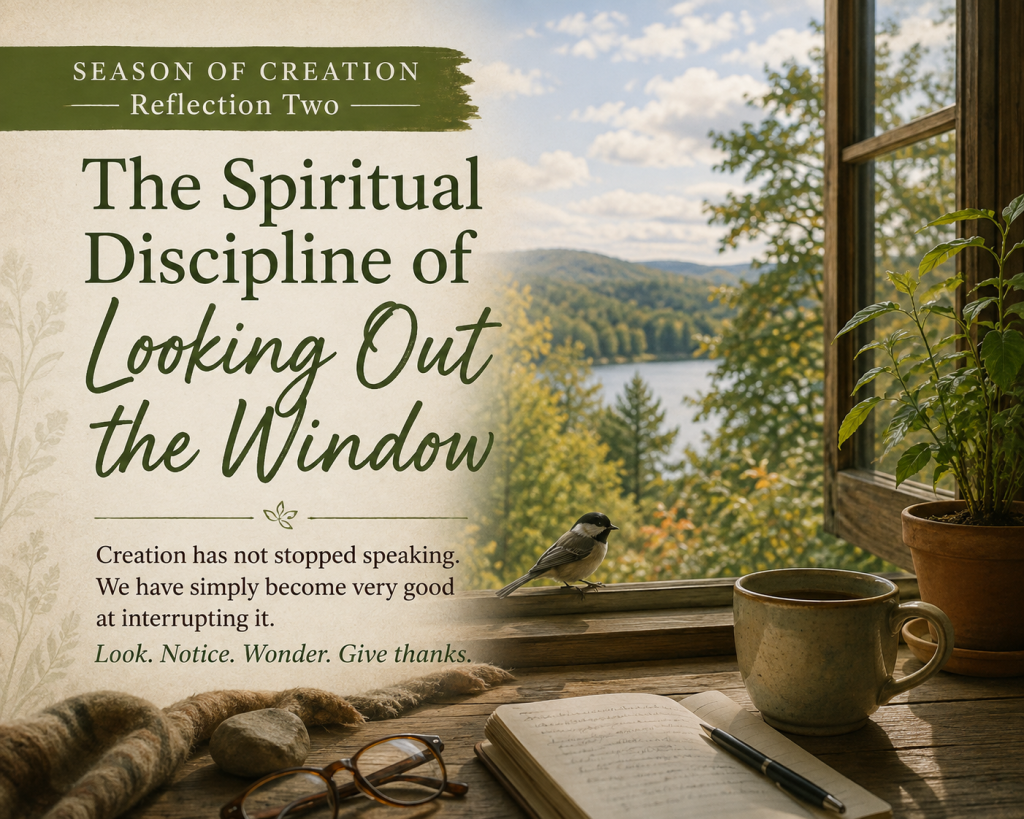
There are few spiritual disciplines more accessible than looking out the window.
It requires no special equipment. There is no registration fee. You do not need a certificate, a retreat leader, or an app that will eventually begin charging you $11.99 a month after a suspiciously generous seven-day free trial.
You simply require a window.
And perhaps the willingness to stop doing something else long enough to look through it.
This may be more difficult than it sounds.
We live in an age of extraordinary attention and remarkably little noticing. We know what someone we went to high school with thirty-seven years ago had for lunch, but we may not know what kind of tree is growing outside our kitchen window.
We can tell you what is trending in California, what someone said in Washington, and what a celebrity wore somewhere in Europe, but we may have completely missed the monarch butterfly that landed ten feet from where we were sitting.
Creation has not stopped speaking.
We have simply become very good at interrupting it.
The Season of Creation invites the Church to recover the ancient spiritual discipline of paying attention.
The Scriptures repeatedly tell us that creation reveals something of God. The heavens declare the glory of God. The earth is the Lord’s. The trees clap their hands. The mountains and hills burst into song.
Biblical creation is remarkably noisy.
Jesus himself seems to have spent a considerable amount of time noticing things.
Consider the lilies.
Look at the birds.
Notice the mustard seed.
Watch the farmer scattering grain.
Observe the fig tree.
Jesus apparently believed that theology could be learned without leaving the neighbourhood.
This is inconvenient for those of us who have accumulated books.
I say this as someone who has accumulated books.
Many books.
Books which I remain convinced contain profound theological insights, provided I can remember which shelf they are on.
But Jesus keeps pointing out the window.
“Consider the lilies.”
In other words: Look.
Before creation becomes something we protect, it must become something we notice.
And that may be one of the great spiritual challenges of our time.
Because it is difficult to love something we never really see.
It is easy to speak abstractly about “the environment.” The environment is enormous. The environment includes glaciers, rainforests, oceans, deserts, polar bears, coral reefs and several creatures living at the bottom of the sea that look as though God designed them late on a Friday afternoon.
But creation is not merely “the environment.”
Creation is the maple tree at the end of the street.
Creation is the spider rebuilding its web after the rain.
Creation is the geese gathering overhead with the unmistakable confidence of creatures who have apparently never had to go through airport security.
Creation is tomatoes ripening in a garden.
Creation is the smell of earth after rain.
Creation is the first cool September morning when you step outside and suddenly realize that summer has begun quietly packing its suitcase.
And creation is also the soil beneath our feet—the soil we rarely think about because it has the unfortunate habit of being underneath everything interesting.
Yet Scripture begins humanity’s story there.
God forms the human creature from the dust of the earth.
The Hebrew words themselves remind us of the relationship: adam from adamah. Humanity from humus. Earth creature from earth.
Our first theological address is not heaven.
It is dirt.
This is wonderfully humbling.
We spend enormous amounts of energy trying to rise above our limitations, establish our importance and distinguish ourselves from everything around us.
And Scripture gently reminds us:
You are soil with opinions.
Beloved soil, certainly.
Spirit-filled soil.
Soil made in the image of God.
But soil nonetheless.
The Season of Creation therefore asks us to remember something Christianity should never have forgotten: we are not spectators standing outside creation.
We belong to it.
The air passing through our lungs was breathed by trees before it reached us.
The water in our bodies has travelled through clouds and rivers and oceans.
The food on our tables began in soil, sunlight, rain and the patient labour of living things.
We are profoundly connected to a world we often treat as scenery.
Perhaps this week our spiritual discipline could be very simple.
Look out the window.
Better still, go outside.
Leave the phone behind for ten minutes. This will initially feel reckless, but civilization will probably survive.
Notice five things.
Not five environmental problems.
Five gifts.
A tree.
A cloud.
A bird.
A flower stubbornly blooming where nobody planted it.
The peculiar smell of September leaves beginning to dry.
And then say something Christians have been saying since the earliest pages of Scripture:
It is good.
Not useful.
Not profitable.
Not convenient.
Good.
There is a profound difference.
For when we begin to see creation as good rather than merely useful, our relationship with it begins to change.
Gratitude grows.
Wonder returns.
Responsibility follows.
And perhaps that is where Christian creation care really begins.
Not first with guilt.
Not first with fear.
Not even first with activism.
But with wonder.
Because the world is not merely a problem God has assigned us to solve.
It is a gift God has invited us to receive.
So sometime today, look out the window.
You may discover that creation has been preaching there all along.
And unlike most preachers, it knows when to stop talking.
Follow along on Instagram @renewablespiritual for more daily reflections on faith, life, and the surprising places where God still loves to meet us.
Companion Prayer
Creator God,
teach us to notice the gifts around us,
to see creation not merely as useful, but as good.
Slow us enough to wonder,
open our eyes to beauty,
and make us faithful caretakers of all you have made.
Amen.