The Season of Creation
There is something slightly suspicious about the way Christians sometimes talk about Creation.
We say that God made the heavens and the earth. We sing about all creatures of our God and King. We read that the heavens declare the glory of God.
Then we finish church, climb into the car, turn on the air conditioning, throw away the coffee cup, complain about the price of tomatoes, and drive home through Creation without giving Creation another thought.
Apparently, the heavens may declare the glory of God, but they are expected to keep the noise down while we are busy.
The Season of Creation invites us to notice again.
And noticing may be one of the most spiritual things we can do.
Genesis begins with God creating—not hurriedly, not accidentally, and certainly not because God needed somewhere convenient to put a Costco.
Light.
Water.
Land.
Plants.
Sun and moon.
Fish and birds.
Animals.
Human beings.
And after each movement of Creation, God looks upon what has been made and calls it good.
Not useful.
Not profitable.
Not developable.
Not good provided somebody can eventually put condominiums on it.
Good.
That little word matters.
Creation possesses value before human beings decide what it is worth.
A forest is good before we calculate the price of its lumber.
A river is good before we determine how much water can be taken from it.
A field is good before we measure its yield.
A bird is good even if it contributes absolutely nothing to the gross domestic product and spends most of Tuesday shouting from the maple tree outside your bedroom window.
Creation is good because God delights in it.
That changes the conversation.
The Christian response to Creation cannot begin simply with the question, “What are we allowed to do with it?”
It begins with the question, “Whose is it?”
Psalm 24 answers rather inconveniently:
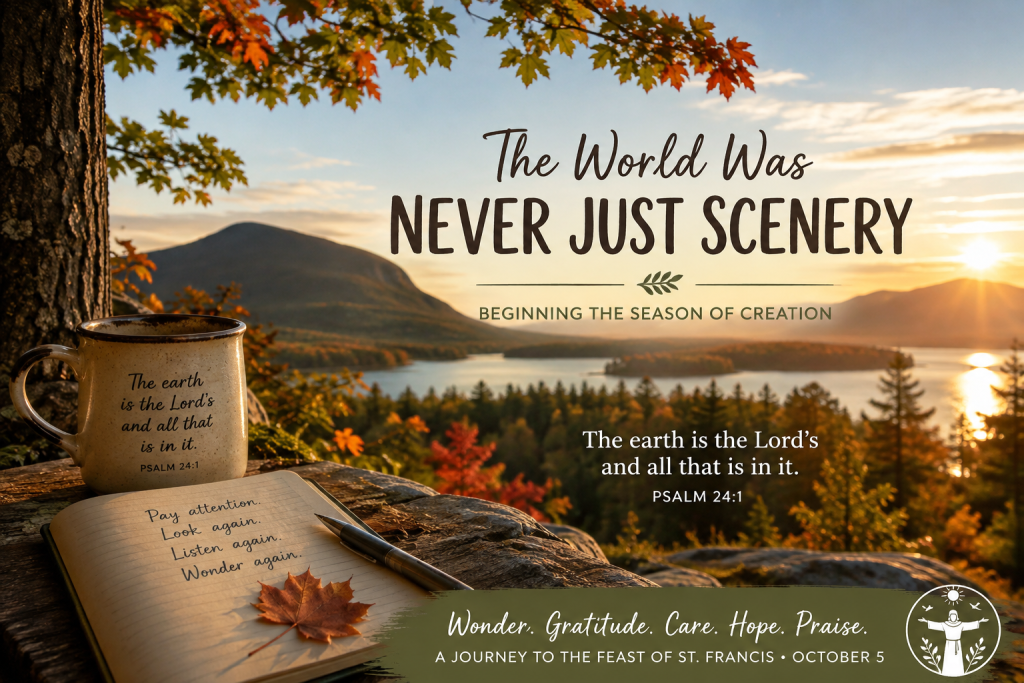
“The earth is the Lord’s and all that is in it.”
Not some of it.
Not the particularly scenic bits.
Not just Algonquin Park, Georgian Bay, the Rockies, and those photographs of Newfoundland that make everyone in Ontario reconsider their life choices.
The earth is the Lord’s.
The ditch beside the highway.
The soil beneath the subdivision.
The wetland someone would rather drain.
The exhausted farmland.
The polluted river.
The backyard tomato plant presently producing seventeen tomatoes simultaneously after doing absolutely nothing for most of July.
All of it.
And so the Season of Creation is not really about introducing something new into Christian faith. It is about recovering something we somehow managed to misplace.
Christians have always believed in God the Creator.
We simply haven’t always behaved as though Creation belonged to God.
There is a difference.
We have sometimes treated the natural world as though God handed humanity the keys and said, “Do whatever you like. I wasn’t particularly attached to it.”
But Genesis says something rather different.
Human beings are placed within Creation.
We come from the earth itself—adamah, the soil—and are given the vocation of tending and keeping what God has made.
We are creatures entrusted with the care of fellow creatures.
That is a considerably humbler job description than “owners of the planet.”
And perhaps humility is exactly where we need to begin.
Because Creation has a remarkable ability to remind us that we are not actually in charge.
Anyone who has planted a garden knows this.
You prepare the soil.
You buy the seeds.
You carefully read the little packet containing instructions apparently written for someone with considerably greater agricultural competence than yourself.
You plant.
You water.
You wait.
And then twelve zucchini appear overnight.
Meanwhile, the expensive heirloom tomatoes you have lovingly nurtured since May develop some mysterious condition known only to horticulturalists and God.
Creation refuses to behave like a machine.
It is alive.
Wild.
Interdependent.
Beautiful.
Occasionally inconvenient.
And filled with a generosity we did not invent.
Jesus understood this.
When Jesus wanted people to understand the Kingdom of God, he continually pointed toward Creation.
Consider the lilies.
Look at the birds.
A farmer went out to sow.
The Kingdom is like a mustard seed.
A vine.
A fig tree.
A field.
Bread.
Wine.
Water.
Jesus apparently believed that Creation was already carrying theological textbooks everywhere we looked.
Perhaps our problem is that we stopped reading them.
So during these weeks of the Season of Creation, I want us to practise noticing again.
Noticing the trees beginning their autumn transformation.
Noticing where our food comes from.
Noticing the astonishing gift of clean water flowing from the tap.
Noticing what we consume.
Noticing what we waste.
Noticing the creatures with whom we share our neighbourhoods.
Noticing the ways climate change is already affecting communities, particularly those who have contributed least to the problem.
Noticing both the beauty of Creation and the wounds we have inflicted upon it.
There will be uncomfortable questions ahead.
There should be.
Repentance is part of Christian discipleship.
But guilt is a poor foundation for love.
Wonder is much better.
Before we ask what must change, perhaps we need to remember what we love.
Walk outside today.
You don’t need to climb a mountain.
You don’t need to paddle into the wilderness.
You don’t even need sensible footwear.
Stand beneath a tree.
Listen to a bird.
Look carefully at a leaf.
Put your hand into garden soil.
Watch clouds moving overhead.
Notice something you usually walk past.
And remember:
You are standing in something God loves.
You are breathing something God made.
You are surrounded by neighbours you did not create.
And somewhere beneath all our schedules, consumption, ambition, anxiety, leaf blowers, lawn fertilizers, reusable shopping bags that we repeatedly forget in the trunk of the car, and good intentions, the ancient song of Creation continues.
“The earth is the Lord’s and all that is in it.”
Perhaps the first act of environmental discipleship is not saving the world.
God has never actually asked us to be the Saviour.
That position has already been filled.
Perhaps our first task is much simpler.
Pay attention.
Look again.
Listen again.
Wonder again.
Because the world was never merely scenery surrounding the human story.
It is Creation.
It belongs to God.
And, astonishingly, God has invited us to help care for it.
Which means the maple tree outside your window is not just landscaping.
It is your neighbour.
And judging by the number of leaves it is preparing to deposit on your lawn, it apparently intends to introduce itself properly.
Follow along on Instagram @renewablespiritual for more daily reflections on faith, life, and the surprising places where God still loves to meet us.
Companion Prayer
Creator God,
open our eyes to the goodness surrounding us.
Teach us to wonder again,
to walk gently upon your earth,
and to care faithfully for all you have made.
May gratitude become attention,
and attention become love.
Amen.