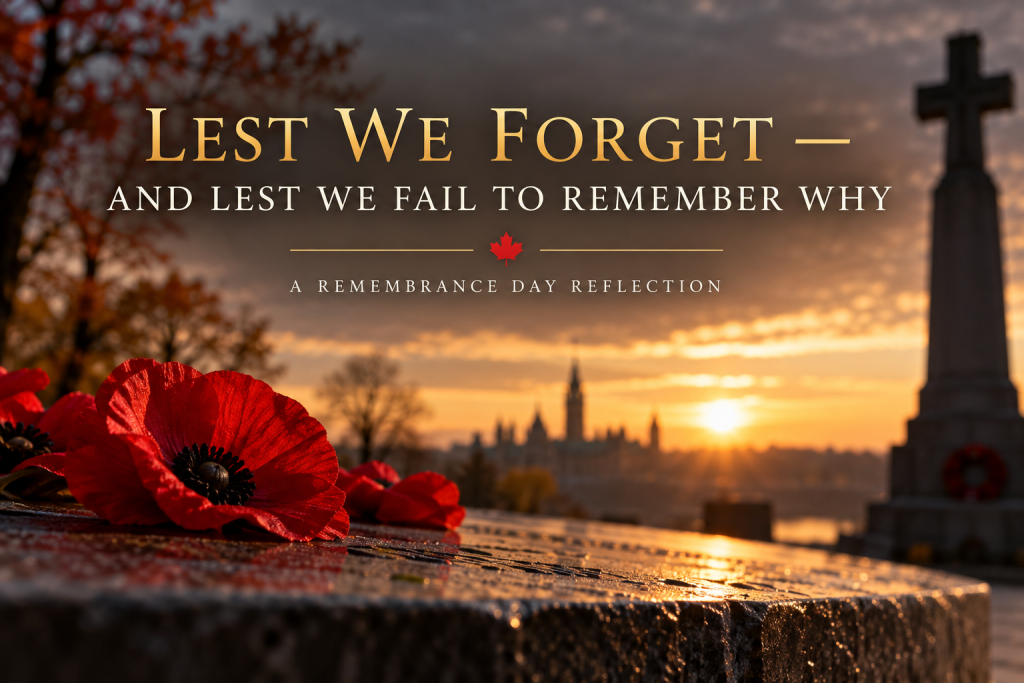
There are days when words should come slowly.
Remembrance Day is one of them.
At the eleventh hour of the eleventh day of the eleventh month, Canadians stop. Bells ring. Wreaths are laid. Heads bow. Names are remembered. The Last Post sounds across cenotaphs and schoolyards, churches and community halls.
And, for two minutes, a nation that is usually rather good at being busy tries to be still.
It is not easy.
Silence rarely is.
Silence has an inconvenient habit of allowing things to catch up with us.
Memory, for example.
Grief.
Gratitude.
Questions we have managed quite successfully to avoid during the other 525,598 minutes of the year.
But today we stop.
We remember.
The People Behind the Numbers
One of the dangers of history is that human beings eventually become statistics.
Battalions. Casualties. Campaigns. Dates on plaques.
But nobody who went to war was a statistic when they left home.
They were sons and daughters, husbands and wives, brothers and sisters, friends and neighbours.
Some were barely old enough to shave.
Some had never travelled very far from home.
Some were frightened.
Some were excited.
Some believed the war would be over quickly.
History has a rather cruel sense of irony about such predictions.
And many did not return.
Others returned carrying wounds that could be seen.
Still others carried wounds that nobody knew how to name.
So today, when we say, “We will remember them,” we are doing something profoundly human.
We are giving people their names back.
We are refusing to allow lives to disappear into numbers.
And that, I think, is something very close to the heart of God.
Because throughout Scripture, God remembers people personally.
God hears the cry of the oppressed.
God remembers the covenant.
God notices the widow.
God sees the stranger.
God knows the names of people the world has forgotten.
Christian remembrance is never merely nostalgia.
It is an act of love.
Remembering Without Glorifying
There is, however, an important distinction we must make.
To honour those who served is not the same thing as glorifying war.
Indeed, I suspect the best way to honour them is to become increasingly suspicious of war.
War is not glorious.
War is mud and fear and separation.
War is telegrams arriving at front doors.
War is empty chairs at kitchen tables.
War is young people carrying memories they should never have had to acquire.
War is mothers waiting.
War is children wondering when someone is coming home.
Sometimes nations face terrible choices. Sometimes people serve because they believe others must be protected from tyranny, aggression, and violence. We can honour courage, sacrifice, duty, and service without pretending that war itself is beautiful.
It is not.
And the Gospel never asks us to make it so.
Jesus says,
“Blessed are the peacemakers.”
Not the peace-wishers.
Not the peace-discussers.
Not even the people who are generally in favour of peace provided it does not interfere too dramatically with Tuesday afternoon.
The peacemakers.
People who actually make peace.
And making peace is considerably harder than admiring it.
The Poppy and the Cross
Every November, we pin a poppy close to our hearts.
It is a small thing.
A fragile red flower.
And perhaps that is appropriate.
Because peace itself can be fragile.
It must be tended.
Protected.
Practised.
Chosen again and again.
For Christians, the poppy inevitably stands in the shadow of another symbol: the cross.
The cross reminds us what human violence can do.
We took the Prince of Peace, stretched out his arms, and nailed them to wood.
And God answered our violence not with greater violence, but with resurrection.
That does not make the cross sentimental.
Quite the opposite.
The cross exposes the terrible machinery of hatred, fear, empire, revenge, and scapegoating.
But Easter declares that none of those things gets the final word.
Death does not.
Violence does not.
War does not.
God does.
And God’s final word is life.
The Responsibility of Memory
There is a danger in Remembrance Day becoming simply a ceremony we repeat.
Stand here.
Lay wreath.
Observe silence.
Sing anthem.
Go home.
Ceremony matters enormously. Ritual carries memory when ordinary language cannot.
But remembrance must become more than ritual.
Because the phrase “Lest we forget” contains a warning.
It does not simply mean:
Do not forget the people who died.
It also means:
Do not forget what hatred can do.
Do not forget what happens when neighbours stop seeing one another as human.
Do not forget what happens when nationalism becomes more important than humanity.
Do not forget what happens when prejudice is given permission to speak loudly.
Do not forget what happens when leaders discover that fear is politically useful.
Do not forget what happens when ordinary people decide that injustice is somebody else’s problem.
History does not usually announce that it is about to repeat itself.
It simply waits for us to stop paying attention.
Two Minutes
And so today we keep silence.
Two minutes.
It is not very long.
Yet within those two minutes there is room for an astonishing amount.
There is room for Vimy and Passchendaele.
For Dieppe and Juno Beach.
For Korea and Afghanistan.
For peacekeeping missions around the world.
For those who served on land, at sea, and in the air.
For medical personnel.
For chaplains.
For families who waited at home.
For those who returned.
For those who did not.
And for those who returned but discovered that some part of them had remained behind.
There is room, too, to remember civilians caught in wars they did not choose.
Children sleeping beneath the sound of aircraft.
Families fleeing homes.
Refugees carrying everything they own.
People praying tonight for the peace we so easily take for granted.
Remembrance must never become so focused on yesterday that we stop noticing who is suffering today.
And Then the Silence Ends
Eventually someone speaks.
The bugle sounds.
The ceremony concludes.
People put their coats back on.
Traffic begins moving again.
Someone inevitably wonders where everyone is going for coffee.
Canada resumes being Canada.
But perhaps we should not leave the silence entirely behind.
Perhaps we should carry something from it with us.
A little more gratitude.
A little less certainty.
A little more compassion.
A little less appetite for division.
A greater willingness to see humanity in people with whom we disagree.
And perhaps a renewed determination to become what Jesus called blessed:
peacemakers.
Because the greatest honour we can offer those who died in war is not simply to remember how they died.
It is to build a world in which fewer people must die that way.
So today we remember.
We remember those who served.
We remember those who sacrificed.
We remember those who grieved.
We remember those who still carry wounds.
And we pray for a world still desperately learning the ways of peace.
At the eleventh hour, we become silent.
And perhaps, in that silence, we may hear again the ancient promise of God:
That swords may yet become ploughshares.
That enemies may yet become neighbours.
That nations may yet learn war no more.
And that the Prince of Peace is still walking among us, quietly asking whether we might follow.
We will remember them.
And God grant that, because we remember them, we may learn to become peacemakers.
Lest we forget.
Follow along on Instagram @renewablespiritual for more daily reflections on faith, life, and the surprising places where God still loves to meet us.
Companion Prayer
God of memory and mercy,
Today we remember.
We remember those who served,
those who sacrificed,
those who returned home carrying wounds seen and unseen,
and those who never returned at all.
We remember families who waited,
communities that grieved,
and generations forever changed by war.
Receive our gratitude,
hold our sorrow,
and guard us from ever confusing the courage of those who served
with the glorification of war itself.
Jesus, Prince of Peace,
teach us again the difficult work of peacemaking.
Where hatred grows, make us reconcilers.
Where fear divides, make us neighbours.
Where prejudice speaks loudly, give us courage to answer with truth.
Where violence seems inevitable, help us imagine another way.
And when we say,
“We will remember them,”
may our remembering become more than words.
May memory become gratitude.
May gratitude become responsibility.
And may responsibility become peace.
Until that promised day
when swords are beaten into ploughshares
and the nations learn war no more.
Amen.