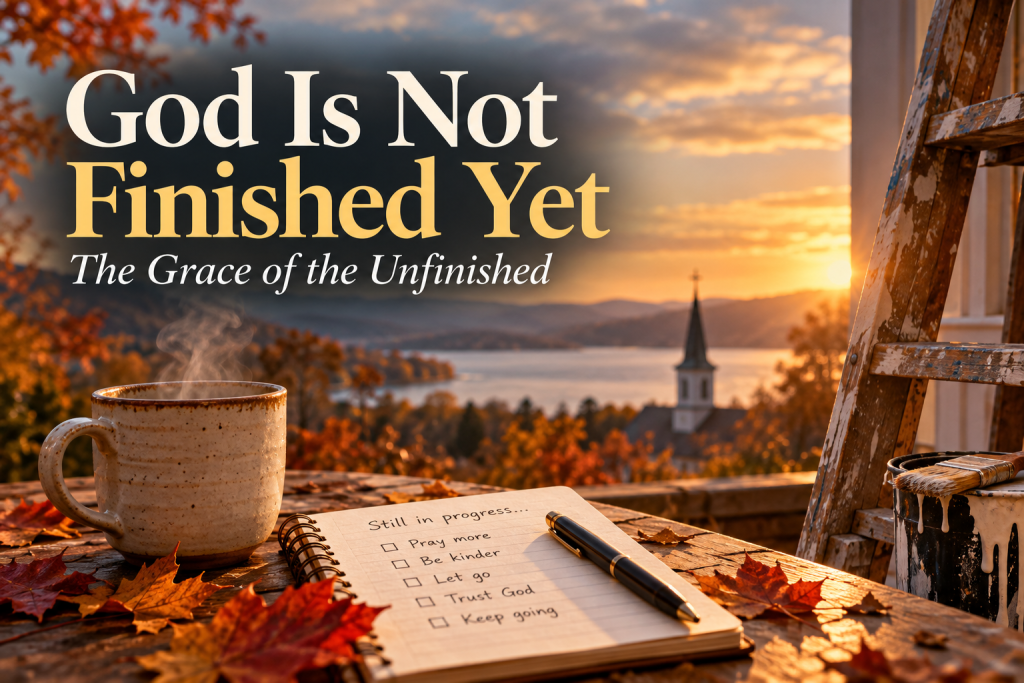
There is something deeply unsettling about an unfinished thing.
An unfinished book sits accusingly on the bedside table.
An unfinished project occupies precisely three times as much space as a finished one.
An unfinished conversation follows us around the house.
And an unfinished renovation, as far as I can tell, becomes a permanent member of the family. Eventually you stop referring to “the room we are renovating” and simply call it “the room with the ladder.”
We prefer things finished.
Completed.
Settled.
Wrapped up neatly with the theological equivalent of a bow.
Perhaps that is one reason this little stretch of the Church year can feel slightly peculiar.
The great celebrations of All Saints and All Souls are behind us. Christ the King waits ahead. Advent is beginning to appear on the horizon, although we are trying very hard not to look directly at it because somebody, somewhere, has already put up Christmas decorations and we do not wish to encourage them.
For the moment, however, we are here.
In between.
And November has a way of making the unfinished things visible.
The leaves have mostly fallen, but winter has not quite arrived. The garden has stopped producing, but the snow has not yet mercifully covered all the jobs we neglected to finish in October. The days grow shorter. The trees stand increasingly bare.
The world itself seems unfinished.
Perhaps that is precisely why this season has something important to teach us.
Because faith is very often the art of living faithfully in the middle of a story whose ending we cannot yet see.
We Are Works in Progress
Christianity sometimes gets presented as though becoming a disciple of Jesus were rather like completing a correspondence course.
Believe the right things.
Say the right prayers.
Learn the appropriate responses.
Receive certificate.
Proceed directly to sainthood.
Unfortunately, actual discipleship appears to have been designed by someone considerably less interested in efficiency.
Jesus calls disciples who misunderstand him repeatedly.
Peter promises extravagant loyalty and then collapses spectacularly.
Thomas wants evidence.
James and John want promotions.
The others argue about who is greatest.
And somehow these are the people Jesus chooses to build the Church.
Which should provide enormous encouragement to every parish council that has ever met.
God apparently has considerable experience working with imperfect committees.
The saints we celebrated only a few days ago were not finished products either.
They were people being formed.
People learning.
People failing.
People beginning again.
People discovering, often slowly and painfully, that holiness is not perfection but availability.
The saints were people who kept allowing God to work on them.
That may be one of the most hopeful truths Christianity offers us:
God does not require us to be finished before God begins using us.
The Trouble with Measuring Progress
We are fond of measuring things.
Attendance.
Income.
Weight.
Steps.
Followers.
Blood pressure.
Golf scores, although in my experience there are certain numbers best entrusted immediately to the mercy of God.
Measurement has its place.
But spiritual growth is notoriously difficult to put on a spreadsheet.
Sometimes we imagine that if we were becoming more faithful, life would gradually become easier.
We would become more patient.
More prayerful.
Less anxious.
More forgiving.
Eventually we would reach some magnificent spiritual plateau where we would greet every inconvenience with serene Christian joy.
Then someone drives forty kilometres an hour in front of us on a perfectly clear road.
And the entire project appears to collapse.
But perhaps spiritual maturity is not the disappearance of struggle.
Perhaps it is learning what to do with the struggle.
Maybe grace does not always prevent impatience from appearing.
Sometimes grace simply teaches us not to hand impatience the steering wheel.
Maybe holiness is not never becoming angry.
Maybe holiness is learning to ask what our anger is trying to protect.
Maybe faith is not possessing absolute certainty.
Maybe faith is learning to walk faithfully even when certainty has gone missing.
The Christian life is not a straight line toward perfection.
It is much more like wandering through IKEA without the little pencil.
There are arrows.
There are signs.
We are fairly certain there is an exit somewhere.
And occasionally we discover that we have returned to exactly the place where we started.
Yet even there, God is working.
Grace Has Patience
One of the great temptations of faith is impatience with ourselves.
We think we should be further along by now.
Surely after all these years I should have learned this lesson.
Surely I should have forgiven this.
Surely I should trust God more.
Surely I should pray better.
Surely I should have become considerably more saintly and at least marginally less irritated by committee meetings.
But grace does not speak the language of “surely by now.”
Grace says:
Come again.
Begin again.
Try again.
Follow again.
Jesus does not seem nearly as surprised by human weakness as we are.
Peter denies him three times.
After the resurrection, Jesus does not hand Peter a performance review.
He makes breakfast.
There is something wonderfully tender about that.
Peter has failed at the most important moment of his life.
And Jesus cooks fish.
Then he asks Peter the question that will rebuild his life:
“Do you love me?”
Not:
“Have you finally sorted yourself out?”
Not:
“Can you guarantee this will never happen again?”
Not even:
“What on earth were you thinking?”
Just:
“Do you love me?”
And then:
“Feed my sheep.”
In other words:
There is still work for you to do.
Your failure is not the ending.
God is not finished yet.
The Kingdom Is Still Coming
Soon the Church will celebrate Christ the King.
We will proclaim that Jesus Christ reigns.
That love has the final word.
That mercy is stronger than vengeance.
That life is stronger than death.
That the kingdoms of this world do not possess ultimate authority.
But anyone paying attention to the news might reasonably ask whether the Kingdom of God has experienced some administrative delays.
War continues.
People hunger.
Creation groans.
Hatred finds microphones.
Cruelty remains profitable.
And humanity continues demonstrating an astonishing ability to invent new technologies while remaining baffled by the ancient instruction to love our neighbour.
The Kingdom is here.
And the Kingdom is coming.
Christian theology has always lived inside that tension.
Already.
Not yet.
Christ reigns.
And still we pray:
“Thy kingdom come.”
That prayer itself acknowledges that the world is unfinished.
There are wounds still waiting for healing.
Relationships waiting for reconciliation.
Systems waiting for justice.
People waiting to be welcomed.
Enemies waiting to become neighbours.
And God invites us into that unfinished work.
Perhaps That Is Enough for Today
There are days when we want to fix everything.
Our lives.
Our families.
Our churches.
Our communities.
The world.
Preferably before supper.
But discipleship is rarely accomplished in dramatic leaps.
Usually it happens through small acts of faithfulness.
One conversation.
One apology.
One meal shared.
One prayer whispered.
One person welcomed.
One injustice challenged.
One frightened neighbour reassured.
One lonely person remembered.
One ordinary act of love.
And then another.
The Kingdom of God seems remarkably fond of small beginnings.
Mustard seeds.
Yeast.
Bread.
Water.
A child in Bethlehem.
Twelve rather confused disciples.
Apparently God has never been overly impressed by scale.
God is interested in faithfulness.
So perhaps the question for this November day is not:
“Why am I not finished yet?”
Perhaps the better question is:
“What is God still forming in me?”
Because the unfinished places may not be evidence of failure.
They may be the very places where grace is still at work.
The rough edges.
The unanswered questions.
The old wounds slowly healing.
The habits we are trying to change.
The relationships we are learning to repair.
The prayers we have not yet learned how to pray.
None of these means God has abandoned the project.
Quite the opposite.
There is still wet paint.
There are tools lying about.
The ladder remains inexplicably in the hallway.
And somewhere, I suspect, heaven has hung a small sign over each of us:
WORK IN PROGRESS.
PLEASE BE PATIENT.
GOD IS NOT FINISHED YET.
And perhaps that is one of the quiet gifts of this in-between season.
We do not have to arrive today.
We only have to keep walking.
Christ the King is coming.
Advent will follow.
Another year of grace will begin.
And the God who has carried us this far will continue doing what God has always done:
calling,
forgiving,
forming,
mending,
loving,
and quietly making all things new.
Including us.
Especially us.
God is not finished yet.
Thanks be to God.
Follow along on Instagram @renewablespiritual for more daily reflections on faith, life, and the surprising places where God still loves to meet us.
Companion Prayer
God of patient grace,
thank you that you do not abandon
what you have begun.
Meet us in the unfinished places of our lives:
the prayers still waiting for words,
the wounds still learning to heal,
the relationships still seeking reconciliation,
and the parts of ourselves
we wish were further along by now.
Give us patience with ourselves
and tenderness toward one another.
When we mistake imperfection for failure,
remind us that your grace is still working.
When we become discouraged,
teach us to begin again.
When the road ahead is unclear,
give us enough faith for the next faithful step.
Shape us slowly into the likeness of Christ,
until your love is made visible in us
and your kingdom comes among us.
For we are your unfinished people,
held by an unfinished story,
journeying toward the day
when you will make all things new.
Through Jesus Christ our Lord.
Amen.