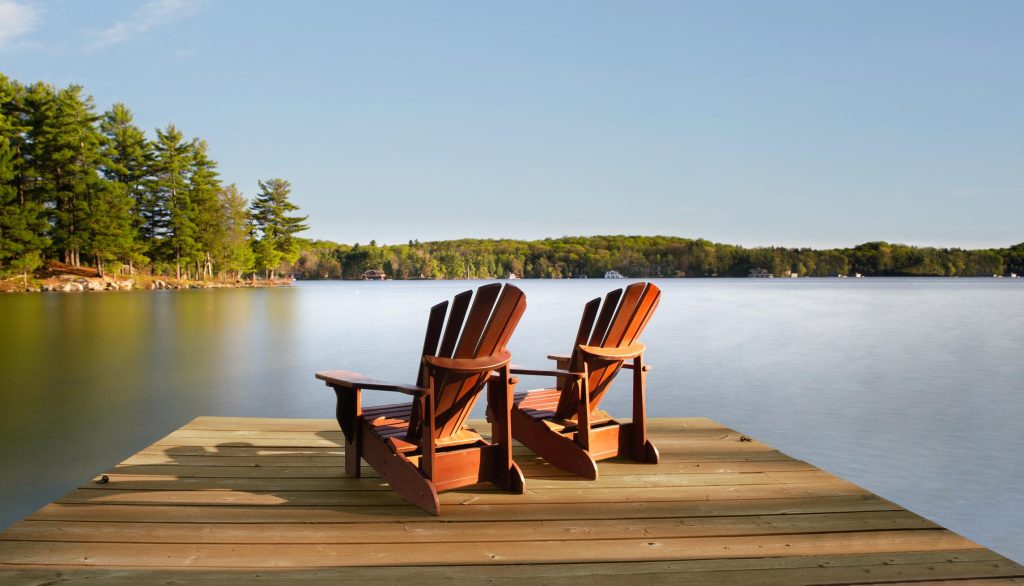
There are few places more conducive to theological reflection than a dock in June.
Now, I realize that seminaries rarely emphasize this.
There are entire libraries devoted to systematic theology, but remarkably little scholarly attention has been given to the spiritual significance of sitting quietly near water with absolutely no urgent plans whatsoever.
This is an oversight.
Because docks possess a kind of holy wisdom.
First of all, they slow people down.
No one rushes dramatically onto a dock.
One arrives differently there.
More slowly.
More thoughtfully.
And eventually one sits.
Preferably with a coffee.
Or a fishing rod.
Or simply the vague but entirely satisfying intention of “watching the lake for a while.”
Now, from a purely practical perspective, this accomplishes very little.
And perhaps that is precisely why it matters so much.
Because summer days in Ordinary Time invite us into a different rhythm.
Not productivity.
Presence.
The water moves gently against the shoreline.
The breeze stirs the trees.
Somewhere in the distance a loon calls with that haunting sound that immediately convinces Canadians they are participating in something deeply spiritual, even if they were previously discussing hotdog buns five minutes earlier.
Creation has a remarkable ability to gather scattered souls back together.
Now, I have long suspected that one of the great tragedies of modern life is that we have forgotten how to simply behold things.
We photograph sunsets instead of watching them.
We narrate experiences instead of inhabiting them.
Even rest now comes with subtle pressure to optimize the experience somehow.
But creation stubbornly resists efficiency.
The lake does not hurry.
The trees are in no rush whatsoever.
The clouds drift overhead without once consulting a schedule.
And slowly—if we remain there long enough—we begin to remember something important.
We are creatures.
Not machines.
We belong to the created world, not merely to calendars and obligations.
This, I think, is why Jesus spent so much time outdoors.
Mountains.
Boats.
Fields.
He taught people to notice things.
Birds.
Seeds.
Lilies.
He seemed entirely confident that creation itself could teach the human heart how to trust God again.
And perhaps it still can.
My sister’s family owns what I consider to be a little piece of paradise.
Years ago, they purchased a woodland property outside the city of Cambridge with a twelve-acre lake at its centre. They built their home there, tucked into the trees beside the water, and I have always loved visiting that place.
In every season there is something to watch there as life quietly unfolds around the lake and through the woods.
But summer may be my favourite.
Often the greatest joy is simply taking a chair down onto the dock—or sitting quietly on the deck beside the house — and observing.
Not accomplishing.
Not planning.
Simply noticing.
There are egrets moving gracefully through the shallows.
Ducks and geese crossing the lake with quiet determination.
And occasionally, if one is lucky, even a swan gliding across the water with the sort of effortless dignity that only swans seem able to achieve.
The woods themselves are alive.
Foxes and coyotes appear unexpectedly along the tree line.
Raccoons conduct their mysterious evening business with considerable seriousness.
White-tailed deer emerge silently from the forest as though stepping directly out of creation itself.
And overhead — if the timing is right — you may catch sight of the resident bald eagle circling above the lake.
There is never a moment there when, if you sit quietly long enough, you will not see something absolutely astonishing.
Something beautiful.
Something that reminds you that creation is still filled with wonder whether we are paying attention to it or not.
And on that dock — or on that deck — I have encountered God many times.
Not in dramatic visions or great revelations.
But in stillness.
In beauty.
In the quiet awareness that the world is overflowing with life and grace and goodness entirely apart from my own effort.
Creation has a way of preaching gently to the soul.
It reminds us that we are not separate from the goodness of the world God has made.
We are part of it.
And perhaps that is why places like this feel so holy.
Because when we finally become still enough to notice creation…
We also become still enough to notice God.
Now, I realize not everyone has access to a dock in June.
Some people must settle for patios.
Or porches.
Or sitting quietly beside an aggressively overachieving tomato plant.
Grace works there too.
The point is not the location.
The point is attentiveness.
The willingness to pause long enough for creation to remind us that the world is still full of beauty that does not depend upon our effort.
And perhaps that is one of the hidden gifts of Ordinary Time.
It teaches us that holiness is often found not in dramatic moments…
…but in quiet awareness.
The sunlight on the water.
The warmth of the air.
The astonishing peace that arrives when we stop trying to accomplish something every moment of the day.
So perhaps this Saturday, God’s invitation is wonderfully simple.
Sit for a while.
Watch the water.
Listen to the birds.
Let creation speak.
And remember that before you were ever productive, successful, efficient, or busy…
You were loved.
The lake already knows this.
The trees have apparently known it all along.
And if you stay long enough on the dock, breathing in the beauty of an ordinary summer day…
You may begin to remember it too.
Alleluia.
Follow along on Instagram @renewablespiritual
Companion Prayer
Creator God,
You speak through water, wind, trees, and sky.
Slow our hurried hearts
until we can hear your voice again
in the beauty of creation.
Teach us to rest,
to notice,
and to delight in the world you have made.
And in the quiet moments of summer,
draw us back to the simple truth
that we are deeply loved by you.
Amen.