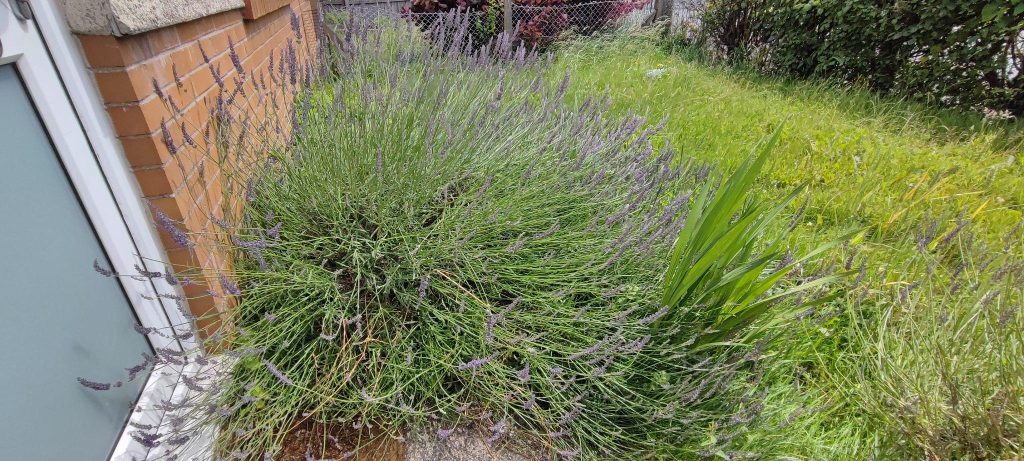
There is a particular moment in early June when one looks at the garden and realizes that something has happened.
Not dramatically.
Not overnight.
But undeniably.
Things have… grown.
The hedge, which only a short time ago seemed entirely manageable, now leans forward with quiet confidence.
The grass has adopted a philosophy of expansion.
And certain plants—whose names we do not know but whose enthusiasm we cannot deny—have taken it upon themselves to explore new territory.
Now, at this point, there are two possible responses.
One may admire the growth.
Or one may reach for the hedge clippers with a sense of purpose that borders on liturgical.
But either way, one thing becomes clear:
Growth changes things.
Which is precisely what the Season after Trinity—this long, green, gloriously ordinary stretch of the Church year—is all about.
Growth.
Not the dramatic, fire-filled moments of Pentecost.
Not the dazzling clarity of Easter morning.
But the steady, persistent, occasionally untidy work of becoming.
And nowhere is this more evident than in the command we hear so often that we are tempted to think we have already mastered it:
“Love your neighbour.”
Now, this sounds quite straightforward.
Until, of course, we remember that neighbours are not theoretical.
They are actual people.
With habits.
With opinions.
With gardening practices that may or may not align with our own.
And in the season of growth, this becomes particularly interesting.
Because growth does not happen in isolation.
It happens in proximity.
Plants grow near one another.
Roots intertwine.
Boundaries blur.
And occasionally, quite without asking permission, something begins to grow where we had not intended it to.
Which is, I suspect, a fairly accurate description of life with neighbours.
We affect one another.
In small ways.
In unexpected ways.
Sometimes in ways that are deeply life-giving…
…and sometimes in ways that require a certain degree of patience and a very well-developed theology of grace.
Now, loving one’s neighbour in such a context is not always easy.
It is, however, where the life of faith becomes real.
Because love, in the Kingdom of God, is not primarily an idea.
It is a practice.
A willingness to engage.
To listen.
To care.
Even when things are not perfectly aligned.
Even when the hedge appears to be advancing with a determination that feels mildly personal.
Now, this does not mean that boundaries disappear.
Even the most enthusiastic gardener understands that some shaping is necessary.
But it does mean that our first response is not control.
It is attention.
We notice.
We respond.
We seek what is good — not only for ourselves, but for those around us.
And in that process, something begins to change.
Not all at once.
Not dramatically.
But steadily.
We grow.
Together.
Which may be the most hopeful thing of all.
Because the command to love our neighbour is not given in a vacuum.
It is given in a world where growth is already happening.
Where God is already at work.
Where the Spirit is quietly shaping a community that is, like any good garden, a little wild, a little unpredictable, and full of life.
So if today finds you looking at the spaces around you — the relationships, the interactions, the small, daily encounters that make up your life—and thinking, “This is not entirely tidy…”
Take heart.
You are in the right place.
Because this is where growth happens.
This is where love takes root.
And this is where, by grace, we begin to discover that even the slightly overgrown parts of life are not beyond God’s care.
In fact…
They may be exactly where He is at work.
Alleluia
Follow along on Instagram @renewablespiritual
Companion Prayer
God of growth,
You tend the garden of our lives
with patience and care.
Teach us to love our neighbours
in the midst of change,
to respond with grace,
and to grow together in your love.
Give us wisdom in shaping what needs tending,
and gentleness in all we do.
And in every part of our lives,
help us to trust that you are at work—
bringing life, even where things feel untidy.
Amen.