When Patience Feels Less Spiritual Than It Sounds

By Thursday of the Third Week of Lent, something remarkable has happened.

We are still here.

Which, given the ambitious intentions of Ash Wednesday, is no small accomplishment.

The early energy has settled into something quieter. The dramatic moments — fig trees inspected, temple tables overturned, wells visited at noon — have given way to something less cinematic and more… ongoing.

And this is where patience enters the picture.

Now, patience sounds like a virtue one ought to admire from a distance. It pairs well with stained glass and hymn tunes. It does not, however, pair well with traffic, delayed emails, unanswered prayers, or that persistent sense that one’s spiritual growth is proceeding at approximately the pace of a reluctant garden snail.

Patience is not glamorous.

The Scriptures around this point in Lent often nudge us toward endurance. Perseverance. Steadiness. Which is to say, keep going.

Not sprinting. Not collapsing dramatically in the dust. Just continuing.

This, I suspect, is where real discipleship lives.

We admire dramatic conversions and heroic sacrifices. But most of the Christian life is composed of small, repeated acts of faithfulness. Pray again. Forgive again. Try again. Listen again.

It is tempting to believe that growth must feel exhilarating in order to count. Lent quietly suggests otherwise.

The gardener does not tug at the fig tree every morning to see if fruit has appeared. The well does not shout encouragement to those drawing water. The temple is restored table by table.

And we are formed, day by day, by patience that does not announce itself.

There is something deeply reassuring about this. God does not seem to panic at the pace of our growth. Divine patience appears considerably greater than ours.

Which is fortunate.

If Lent feels less like a spiritual mountaintop and more like steady walking this week, take heart. Walking is how Jerusalem is reached. Slowly. Persistently. With the occasional pause for breath and perhaps mild theological reflection about footwear.

Patience is not passive. It is trust stretched across time.

And by Thursday of the Third Week of Lent, that may be exactly what is being formed in us — not brilliance, not spectacle, but endurance.

It may not look impressive.

It may look like faith that refuses to quit.

And in the economy of the kingdom, that is more than enough.

Companion Prayer

Steady God,
When growth feels slow
and patience feels thin,
remain with us.

Teach us endurance
without anxiety,
faithfulness
without drama,
and trust
without haste.

Strengthen us
for the long road of love,
and keep us walking
one faithful step at a time.

Amen.

When the Small Things Turn Out to Be the Important Ones

By the Thursday after the Third Sunday of Lent, we are well into what might be called the “ordinary middle” of the season.

Ash Wednesday is a distant memory. The heroic Lenten resolutions we made with great confidence have settled into something more modest — which, if we are honest, may be closer to the pace of actual human holiness.

In other words, Lent has become quietly realistic.

This is often the point in the season when we begin to notice something curious about the Christian life: the small things matter far more than we expected.

We tend to imagine that spiritual growth happens in dramatic moments — powerful prayers, life-changing insights, perhaps a moment of dazzling theological clarity while stirring soup on the stove.

But the Gospel frequently suggests something less dramatic and far more persistent.

The kingdom of God grows slowly.

Seeds. Yeast. Small acts of mercy. Quiet decisions to forgive. The daily choice to keep walking when enthusiasm has taken the afternoon off.

Jesus talks about these things constantly.

A mustard seed becomes a tree. A little yeast lifts an entire loaf. A cup of cold water offered in kindness carries eternal significance.

None of these things are particularly spectacular.

Which may explain why we sometimes overlook them.

We prefer the grand gesture. The sweeping act of faith. The sort of spiritual moment that could be described in an inspiring memoir or at the very least mentioned in a parish newsletter.

But Jesus keeps pointing in a different direction.

Notice the small things.

The quiet kindness you offered without thinking.
The patience you managed to summon in a difficult conversation.
The moment when you chose generosity over irritation.

These moments may feel ordinary.

In the economy of the kingdom, they are not.

By Thursday of Lent 3, it is entirely possible that your spiritual life feels less impressive than you hoped it might. You may not have experienced dazzling revelations or mystical visions.

But you may have done something far more important.

You kept going.

You prayed again.
You tried again.
You forgave again.

The small things are where grace does its finest work.

God is remarkably fond of mustard seeds.

So if today feels unremarkable — if Lent seems to be unfolding quietly rather than dramatically — do not underestimate what is happening.

The kingdom is growing.

Very likely in the places you almost missed.

Companion Prayer

Patient God,
You work through seeds
and small beginnings.

When we overlook the ordinary,
open our eyes.

Teach us to value
quiet kindness,
steady faithfulness,
and small acts of love.

Let your kingdom grow in us
in ways we may not even notice.

And remind us that nothing done in love
is ever small in your sight.

Amen.

When the Journey Feels Longer Than Expected

By the Wednesday after the Third Sunday of Lent, something quietly important has happened.

The enthusiasm of Ash Wednesday has worn off.

The heroic intentions of the first week have softened slightly. The ambitious spiritual goals we wrote down — possibly in very neat handwriting — are now being carried along at a pace that might best be described as realistic.

Which is another way of saying: Lent has settled into ordinary life.

This is often the moment when the journey begins to feel longer than expected.

You may remember the moment well if you have ever set out on a long walk. At the beginning, everything is exciting. The air feels fresh. The path is clear. One strides forward with determination and admirable posture.

But somewhere around the middle, the walk becomes… a walk.

The scenery is still pleasant. The destination still matters. But the muscles have noticed the distance.

Spiritually speaking, this is where many good things happen.

Because faith is rarely formed in dramatic moments alone. It is shaped in the middle stretches — the days when nothing particularly remarkable occurs, yet we continue walking anyway.

The readings around this time in Lent often remind us of this quiet endurance. God’s people wander in the wilderness longer than expected. Wells appear in unlikely places. Jesus speaks about trust, patience, and faithfulness.

In other words, the journey continues.

Now, if we are honest, we are not always fond of the middle of things. We like beginnings because they are hopeful. We like endings because they are satisfying.

The middle is where perseverance lives.

It is also where grace quietly does its work.

You may not feel particularly transformed this Wednesday. You may not notice profound spiritual insight arriving before breakfast. Lent may feel less like a mountaintop and more like a steady path through familiar territory.

Take heart.

This is precisely where discipleship grows.

Jesus does not rush his followers through the road to Jerusalem. He walks it step by step. Conversation by conversation. Day by day.

The kingdom of God is not built on dramatic leaps.

It is built on faithful walking.

Which means that if this Wednesday feels ordinary — if your Lenten journey feels less heroic than originally advertised — you may be exactly where you are meant to be.

Keep walking.

Grace is remarkably fond of the middle of the road.

Companion Prayer

Faithful God,
You walk with us
not only at the beginning
and not only at the end,
but through the long middle of the journey.

When our enthusiasm fades,
give us perseverance.

When the road feels longer than expected,
steady our steps.

Help us trust
that even in ordinary days
your grace is quietly shaping us.

And keep us walking
toward the life you promise.

Amen.

When Jesus Starts Rearranging the Furniture

By the Tuesday after the Third Sunday of Lent, most of us are beginning to suspect that Lent is not merely a seasonal mood — it is a renovation project.

And not the charming sort of renovation involving throw pillows and a fresh coat of paint. No. The Third Sunday often gives us one of those bracing Gospel moments — temple-clearing, table-turning, heart-examining passages where Jesus does not so much adjust as overturn.

Which is disconcerting.

We are quite content to invite Jesus into our lives, provided he agrees to admire the décor. We are less enthusiastic when he begins rearranging the furniture.

The image of Jesus cleansing the temple is not primarily about anger; it is about purpose. The temple had drifted. Commerce had crowded out prayer. Efficiency had overshadowed reverence. What was meant to be a house of prayer had become something busier — and perhaps more profitable.

And so, with a dramatic flair that would make any Anglican nervous, Jesus clears space.

Lent, by the third week, begins to do something similar in us.

We discover that prayer has become perfunctory. That kindness has grown conditional. That busyness has taken up residence where trust once lived. The tables may not be physically overturned, but something shifts.

Now, before we all imagine ourselves as spiritual temples in full-scale demolition, let us be clear: Jesus overturns tables not to destroy the temple, but to restore it.

Reordering is not rejection.

In fact, one of the great mercies of Lent is that God does not abandon what has grown cluttered. God reclaims it.

There is something profoundly hopeful in this. The presence of disruption means the presence of care. Indifference would be quieter.

If you are feeling slightly unsettled this Lent — if old assumptions are wobbling, if habits are being questioned, if prayer feels less decorative and more demanding — take heart.

The Lord who rearranges also restores.

And while we may protest mildly at the relocation of certain cherished habits, we may also find that the cleared space allows for something better: deeper prayer, cleaner motives, quieter trust.

The temple was always meant for God’s presence. Our hearts are no different.

And sometimes, in order to make room for prayer, a few tables must be moved.

Preferably with warning. Though, as Scripture suggests, this is not always how it happens.

Companion Prayer

Holy Lord,
You desire a house of prayer
within us.

Where clutter crowds out trust,
clear space.
Where habit replaces reverence,
restore purpose.

Reorder what has drifted.
Renew what has grown dull.
And make our hearts
fit places for your presence.

With patience and mercy,
rearrange us for love.
Amen.

When the Fig Tree Gets a Second Chance (And So Do We)

There is something deeply unsettling about the Third Sunday of Lent.

By now we are well into the season. The enthusiasm of early Lent has been replaced by something more realistic. Our noble intentions have either settled into habit or quietly negotiated new terms. (“I did mean to give up sweets, but I did not specify which sweets.”)

And then comes that Gospel image of the fig tree.

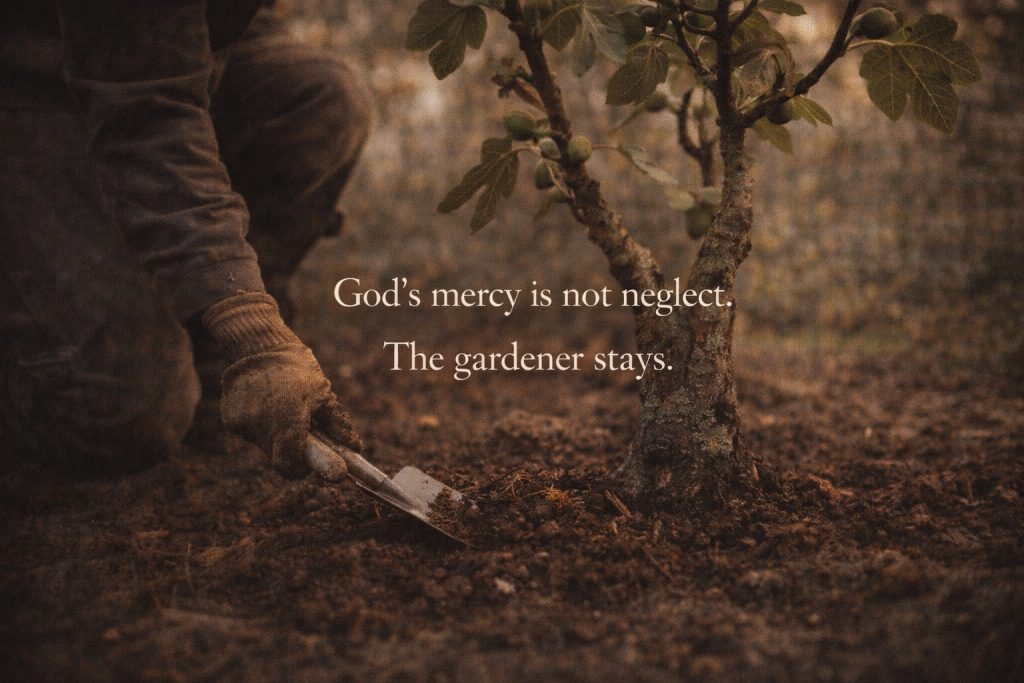
You remember the story. A fig tree that has not borne fruit. A gardener who asks for one more year. A little digging. A little manure. (The Church, you will notice, does not shy away from agricultural metaphors involving manure. Lent is nothing if not earthy.)

The question hovering over the scene is not subtle: what is growing in your life?

Now, before we all begin measuring ourselves like anxious horticulturalists, let us pause.

The fig tree is not cut down. Not yet.

There is patience in this parable. There is mercy in the soil. There is time given — not because fruit does not matter, but because growth cannot be rushed.

Monday after the Third Sunday of Lent feels like that extra year.

We are not finished. We are not condemned. We are not uprooted. We are simply invited to allow God to tend the soil again.

This is both comforting and mildly alarming.

Comforting, because we are not judged by one unproductive season. Alarming, because the gardener does not walk away. He digs. He fertilizes. He expects something to change.

Lent, by this point, has usually moved beyond dramatic gestures. It has become quieter. More interior. We are less concerned with what we have given up and more aware of what needs to grow.

Patience is not indifference. God’s mercy is not neglect. The gardener stays.

Perhaps the most hopeful thing in the whole story is that the fig tree does not fix itself. It is tended.

The Christian life is not a self-improvement project conducted under divine supervision. It is a relationship in which God works the soil of our lives — loosening hardened places, enriching depleted ground, trusting that fruit will come.

Sometimes the digging is uncomfortable. Sometimes the fertilizer smells suspiciously like humility. But the intent is life.

If you are feeling less than fruitful this Lent, take heart. You have not been abandoned. The gardener is still at work.

And growth, as anyone who has ever tried to coax tomatoes out of a Canadian spring can attest, requires patience, persistence, and a certain tolerance for mud.

Companion Prayer

Patient Gardener,
You do not abandon what you plant.

When we feel barren or weary,
tend the soil of our hearts.
Loosen what has grown hard.
Nourish what has grown thin.

Give us time to grow,
grace to trust your work,
and courage to bear fruit
in due season.

Stay with us,
and make us fruitful in love.
Amen

When the Road Gets Personal

There is something about the Second Sunday of Lent that feels less like poetry and more like commitment.

Lent 1 let us admire the wilderness from a respectable distance. Lent 2, however, leans in a little closer and asks an uncomfortable question: Are you actually going somewhere, or are you simply attending religious events along the way?

In many of our Gospel readings for this Sunday, Jesus turns his face toward Jerusalem. Which is to say, he stops sampling spiritual experiences and starts walking toward consequence.

This is not, you will notice, an especially marketable strategy.

Jerusalem represents confrontation, vulnerability, and love that refuses to retreat. It is where good intentions become costly obedience. It is where faith grows up.

We are often quite happy with a faith that inspires us. We are somewhat less enthusiastic about a faith that redirects us. Inspiration is warm and agreeable. Redirection can require rearranging furniture—spiritually speaking—and most of us have just got things the way we like them.

Second Sunday of Lent gently suggests that following Jesus is not merely about comfort, insight, or the pleasant glow of being spiritually aware. It is about direction.

And direction is personal.

To set one’s face toward Jerusalem is not about grim determination. It is about clarity. It is the quiet, steady decision that love will have the final word, even when it is inconvenient. Even when it is misunderstood. Even when it is not applauded.

Now, before we all become excessively heroic, let us remember something important: Jesus does not set our faces toward Jerusalem with a shove. He invites. He walks ahead. He waits when we lag behind examining the hedgerows.

He is patient with our pacing.

The Church, bless her, sometimes makes Lent sound like a spiritual boot camp. But the Second Sunday of Lent feels less like drill sergeant and more like steady companion. It asks: What is shaping your life? What are you moving toward? What are you willing to trust?

It may not look dramatic. It may look like choosing reconciliation over resentment. Integrity over convenience. Prayer over distraction. Kindness when irritation would be easier.

It may look, in fact, quite ordinary.

The great secret of Lent is that the road to Jerusalem is paved with very small decisions made faithfully over time. The spectacular moments are rare. The steady ones matter most.

So this Sunday, do not panic if you do not feel especially brave. Courage is not loud. It is directional.

And if, somewhere along the way, you pause to consider whether perhaps Galilee had a nicer climate, take heart. The Lord who turns toward Jerusalem also walks beside those who hesitate.

Faith eventually becomes direction.

And direction, over time, becomes love.

Companion Prayer

Steadfast Lord,
You set your face toward love
and did not turn away.

In this season of Lent,
clarify our direction.
Where we wander, gently guide us.
Where we hesitate, patiently wait for us.

Give us courage for small obediences,
faith for long roads,
and trust that you walk beside us
every step toward Jerusalem.

Keep our hearts steady
and our love sincere.
Amen.

Resting in the Middle of the Climb

By Saturday, the week has taken its toll.

Lent is not dramatic now. It is simply present.

There is a temptation to evaluate. To measure. To grade our spiritual effort like a performance review. Fortunately, God does not appear to use spreadsheets.

The covenant rests not on our perfection but on God’s faithfulness.

Saturday invites rest in the middle of the climb. Not abandonment of the journey — but trust within it.

You have walked this week. Imperfectly, perhaps. But faithfully enough.

Before Lent 3 arrives with fresh demands, pause.

Receive mercy. Breathe. Begin again.

Companion Prayer

Faithful God,
You sustain what you begin.

Receive this week —
its effort and its imperfection.

Let us rest in your covenant,
trust in your patience,
and rise tomorrow renewed.

Hold us in your mercy
as we continue the climb.
Amen.

What We Lay Down Makes Room for Love

Fridays in Lent are less about deprivation and more about clarity.

When we lay something down — a habit, a comfort, a distraction — we discover what remains.

Often, what remains is space.

Space to pray without hurry. Space to listen without interruption. Space to love without calculation.

Restraint is not misery. It is spaciousness.

We lay things down not because they are evil, but because they are heavy. And sometimes we have been carrying more than we need.

The curious freedom of Lent is that choosing less can feel like receiving more.

And if, while fasting, we discuss recipes with suspicious enthusiasm, God’s mercy appears undiminished.

Companion Prayer

Generous Lord,
Teach us to lay down
what we do not need.

Make space within us
for compassion,
for listening,
for love.

May simplicity
draw us closer to you.
Amen.

The Long Obedience in the Same Direction

There is something quietly heroic about persistence.

Not dramatic heroism — no orchestral music required — but the steady refusal to turn back.

The Christian life is less a sprint and more a long obedience in the same direction. It involves repetition. Returning. Continuing.

Lent can feel repetitive. Pray again. Reflect again. Resist again. Forgive again.

But repetition is not failure. It is formation.

God works slowly. Roots deepen out of sight. Character is shaped through habits we almost overlook.

If nothing exciting has happened in your spiritual life this week, take comfort. Most growth is unspectacular.

The oak tree does not apologise for taking time.

Companion Prayer

Steady God,
Strengthen us for long obedience.

When faith feels ordinary,
make it durable.
When the road stretches ahead,
give us endurance.

Keep us walking
in the direction of love.
Amen.

When Faith Feels Exposed

There is a point in Lent when the layers begin to thin.

We discover habits we did not notice. Attachments we assumed were harmless. Motivations that are less noble than advertised.

Exposure is uncomfortable.

We prefer spiritual sweaters — layered, soft, and forgiving. Lent gently removes them.

But exposure is not humiliation. It is invitation.

Covenant requires honesty. God does not need our polished version; God desires our real one. The part that is impatient. The part that is anxious. The part that wonders if this whole journey is worth it.

Faith grows not by hiding our vulnerability, but by bringing it into the light.

God has seen worse. And stayed.

If Lent feels revealing this week, that may be grace at work.

Companion Prayer

Merciful God,
You see us as we are
and remain.

When we feel exposed,
cover us with your mercy.
When we confront our frailty,
remind us of your steadfast love.

Let honesty become healing
and vulnerability become trust.
Amen.