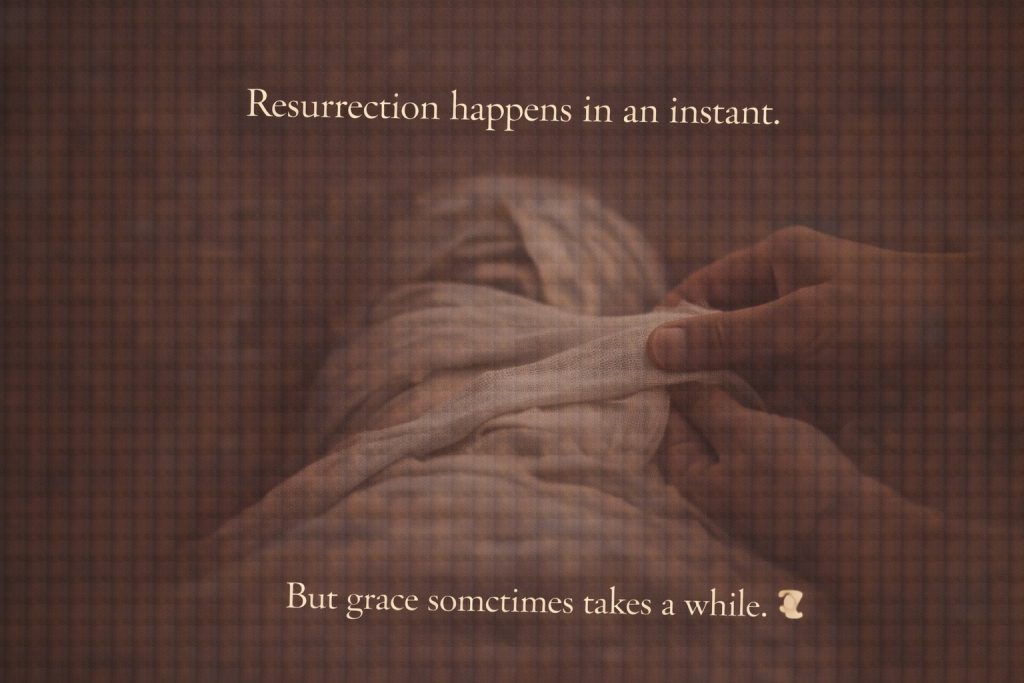
When the Grave Clothes Come Off (Slowly)

Yesterday we stood outside a tomb.

Lazarus was called out. The stone was rolled away. The air was thick with astonishment and possibly a lingering reminder that four days is not an insignificant amount of time.

Resurrection, we declared, has the final word.

And then Monday arrived.

Which is to say, Lazarus still had to take off the grave clothes.

There is a small but significant detail in the Gospel story. When Lazarus emerges, he is alive — gloriously, unmistakably alive — but still wrapped in burial cloths. Jesus does not personally unwrap him. He turns to the community and says, “Unbind him, and let him go.”

Resurrection begins in an instant.

Freedom unfolds more gradually.

The Monday after the Fifth Sunday of Lent feels like that.

We have heard the promise. We believe in life. We affirm that stones can be moved. And yet we discover that even when new life has begun, old wrappings remain.

Habits. Fears. Patterns. Ways of thinking that belonged to the tomb.

It would be rather convenient if spiritual renewal came pre-packaged and wrinkle-free. One dramatic prayer, and suddenly we are entirely transformed, our anxieties neatly folded away, our patience flawless, our temper saintly.

But resurrection, like most divine gifts, invites participation.

Lazarus must walk out. The community must help unwrap. Life is given; growth continues.

This is, in many ways, deeply reassuring.

Because by Monday, we may have already noticed that despite yesterday’s triumphant Gospel, we are still slightly impatient in traffic. Still prone to worry. Still attached to certain predictable irritations.

We are alive in Christ — and occasionally tangled.

The Christian life is not about denying the grave clothes. It is about letting them be removed.

Some of them fall away easily. Others cling stubbornly, like spiritual duct tape.

The grace of God does not shame us for this. It invites community. It invites honesty. It invites patience with the process.

“Unbind him,” Jesus says.

Not, “Explain why he is still wrapped.”

The Monday after resurrection reminds us that salvation is both event and journey. New life has begun. Now comes the steady work of walking into it.

And if you find yourself halfway unwrapped this week — grateful for life but slightly constrained by old patterns — take heart.

The tomb is behind you.

The unbinding takes time.

And Christ is not alarmed by the pace.

Companion Prayer

Lord of Life,
You call us out of sealed places
into new beginnings.

When old habits cling
and fear lingers,
help us trust your patience.

Give us courage to step forward,
humility to accept help,
and grace to grow into freedom.

Unbind what still holds us.
Strengthen what is newly alive.

And keep us walking
in the light of resurrection.

Amen.

When the Stone Is Still in the Way

By the Fifth Sunday of Lent, we are no longer dabbling in spiritual housekeeping.

We are standing outside a tomb.

The Gospel often gives us Lazarus at this point in the season. Which is to say, things have become unmistakably serious. There is grief. There is delay. There is a stone firmly lodged in place. And there is Jesus, arriving four days later than anyone would have preferred.

It is a scene that tests faith.

Mary and Martha are not subtle about it. “Lord, if you had been here…” Which is the polite biblical way of saying, “We had a timeline.”

The Fifth Sunday of Lent is about resurrection, yes. But before it is about resurrection, it is about waiting. It is about standing before what feels immovable and discovering that hope is not tidy.

There is something profoundly human in this story.

We are quite comfortable with minor inconveniences. Lent has already asked us to examine our thirst, practice patience, forgive generously, and remain steady. All admirable spiritual exercises.

But now we are confronted with something that feels final.

A sealed tomb.

The Christian life does not avoid such moments. It names them.

We all have stones in our lives — griefs we did not choose, disappointments we did not anticipate, situations that seem immovable despite our prayers.

And here is where the humour must tread gently.

Because if you have ever attempted to move a large stone — or even rearrange a modest piece of furniture without assistance — you will know that optimism alone is insufficient.

Jesus stands before the tomb and says, “Take away the stone.”

Martha, ever practical, objects. “Lord, there is a stench.”

The Gospel is refreshingly honest about the odour.

Resurrection does not bypass decay. It confronts it.

The Fifth Sunday of Lent reminds us that hope is not denial. It is trust in the presence of God even when the stone is still very much in place.

Jesus does not scold Martha for her realism. He invites her to trust beyond it.

“Did I not tell you that if you believed, you would see the glory of God?”

Notice the order. Belief precedes sight.

Which is inconvenient for those of us who prefer proof before commitment.

Lazarus is called out of the tomb not because the sisters have mastered optimism, but because Jesus is life.

And perhaps this Sunday asks us not whether we can move the stone ourselves, but whether we are willing to let Christ speak into the place that feels sealed.

Resurrection may not yet be visible. The stone may still appear heavy. The circumstances may not have shifted.

But Jesus stands there nonetheless.

And that changes everything.

By the Fifth Sunday of Lent, the Church is already leaning toward Holy Week. The shadow of the cross is longer. The air is heavier.

And yet this Gospel insists: death does not have the final word.

Not then.
Not now.
Not ever.

If you are standing before something that feels immovable this Lent, take heart.

The One who weeps at the tomb also calls life out of it.

And stones, however stubborn, are not eternal.

Companion Prayer

Lord of Life,
You stand beside our sealed places
and do not turn away.

When grief feels heavy
and hope feels distant,
remain with us.

Give us courage
to trust beyond what we see,
and faith to believe
that your voice is stronger than death.

Roll away what binds us.
Call us into new life.
And hold us steady
as we wait for resurrection.

Amen.

When You Discover Grace Has a Long Memory

By the Saturday after the Fourth Sunday of Lent, the week has settled into something reflective.

Sunday rejoiced.
Monday trusted that mercy still held.
Thursday admired quiet faithfulness.
Friday wrestled with costly forgiveness.

And now Saturday sits calmly in the corner like a wise parishioner who has seen this all before.

There is something about this particular Saturday that invites a kind of spiritual exhale. We are far enough into Lent to know we are not sprinting. We are close enough to Holy Week to sense that deeper waters are ahead.

It is a day for remembering.

And remembering, as Scripture repeatedly shows us, is no small spiritual discipline.

Israel is told again and again: Remember what the Lord has done. Remember the wilderness. Remember the deliverance. Remember the covenant.

We, on the other hand, have a rather selective memory.

We remember our failures vividly.
We remember awkward conversations in impressive detail.
We remember what someone said in 2007 with archival clarity.

What we struggle to remember is grace.

We forget how many times we have been forgiven. We forget how often God has steadied us. We forget that the very air we breathe is sustained mercy.

Saturday after the Fourth Sunday of Lent is a quiet invitation to recall not our shortcomings, but God’s faithfulness.

Grace has a long memory.

It remembers the promise when we forget it.
It remembers the covenant when we doubt it.
It remembers who we are becoming when we grow impatient.

There is something profoundly hopeful in this.

We often imagine that our spiritual progress depends on our ability to remember God. In truth, it depends far more on God remembering us.

And God does.

This Saturday might be less about striving and more about gratitude. Less about evaluating the week and more about noticing where grace has already been at work.

Perhaps you were more patient than expected.
Perhaps you forgave — however awkwardly.
Perhaps you simply kept walking.

These are not small things.

The Christian life is not a race toward perfection. It is a steady remembering of mercy.

And if you find yourself tempted to rehearse your deficiencies this weekend, consider instead rehearsing God’s faithfulness.

You may find it considerably more encouraging.

Lent is not only about repentance. It is about learning to see clearly — and one of the clearest truths is this:

You are remembered.
You are held.
You are being carried farther than you realise.

Even on an unremarkable Saturday in March.

Companion Prayer

Faithful God,
When our memory fails,
let yours hold us.

Help us remember
your mercy more clearly
than our mistakes.

Teach us gratitude
for quiet growth,
for steady patience,
for forgiveness begun.

As we continue this Lenten road,
anchor us in the certainty
that you do not forget your children.

Amen.

When Mercy Costs More Than We Expected

By the Friday after the Fourth Sunday of Lent, the rose-coloured warmth of Sunday has faded into something sterner.

We rejoiced. We were welcomed home. We were assured that grace runs toward us rather than away from us.

And now Friday has arrived — with its quiet, unavoidable question:

If mercy has been given to you, what will you do with it?

There is something about Fridays in Lent that resists sentimentality. The cross hovers in the background. Forgiveness is no longer theoretical. It has weight.

It is one thing to receive mercy from God. It is another to extend it to someone who has been consistently, creatively irritating.

The prodigal son is easy to love when he is fictional. The person who slighted us at the last meeting is less so.

And yet the Gospel rhythm insists: mercy received must become mercy practiced.

This is where Lent moves from reflection to rearrangement.

Mercy costs.

It costs pride. It costs the delicious satisfaction of rehearsing grievances. It costs the tidy narrative in which we are unquestionably right.

Forgiveness is not amnesia. It is not approval. It is not pretending that nothing happened.

It is releasing the right to keep charging interest on the debt.

And if we are honest, we rather enjoy charging interest.

Resentment feels powerful. It feels like control. It feels like justice being privately administered.

Mercy feels vulnerable.

Which is precisely why it resembles the cross.

The Father runs to the son on Sunday. On Friday, we remember what it takes for love to run toward us in the first place.

Grace is not cheap. It is generous.

The mercy that welcomes us home is the same mercy that asks us to open the door for someone else.

Perhaps this Friday is less about dramatic gestures and more about quiet decisions. The decision not to repeat the story yet again. The decision to pray for someone we would prefer to avoid. The decision to loosen our grip on an old offense.

It may not feel triumphant.

It may feel like surrender.

But in the kingdom of God, surrender to mercy is strength.

And if we stumble awkwardly into forgiveness — offering it with trembling hands rather than serene composure — take comfort.

God’s mercy toward us was never dependent on our elegance.

It was dependent on love.

Companion Prayer

Merciful Lord,
You have forgiven us more
than we can measure.

When mercy feels costly,
strengthen us.
When pride resists release,
soften us.

Teach us to forgive
as we have been forgiven —
not perfectly,
but honestly.

Let your cross
reshape our hearts,
that love may be stronger
than resentment.

Amen.

St. Joseph and the Quiet Art of Not Needing Attention

March 19 has a way of slipping into Lent quietly.

No table-turning. No running fathers. No dramatic speeches from wells. Instead, the Church pauses to remember a man who says almost nothing at all.

St. Joseph.

Now, in an age that rewards visibility, branding, and a robust online presence, Joseph’s curriculum vitae is rather thin. He does not preach. He does not perform miracles. He does not write epistles. He barely speaks.

In fact, Scripture records not a single word from him.

And yet.

He listens. He obeys. He protects. He stays.

There is something profoundly comforting about a saint whose holiness consists largely of steadiness.

Joseph receives news that would send most of us into prolonged theological negotiation. An angel appears in a dream and suggests that his entire life plan requires revision. He responds not with a strategic committee, nor with a public statement, but with obedience.

He simply does what is asked.

There is a quiet strength in that. A maturity. A groundedness that does not require applause.

Lent, by this point, has already taught us repentance, mercy, patience, and forgiveness. Joseph adds something subtler: faithfulness without fanfare.

The Christian life is not always dramatic. Often it is carpentry. Showing up. Providing. Protecting. Remaining steady when circumstances wobble.

Joseph does not demand recognition for raising the Son of God. He does not insert himself into the spotlight. He is content to stand just off-stage, holding things together.

And that may be precisely the kind of holiness Lent needs to remind us of.

Not everything that matters is loud.

There are people in every parish — perhaps in every home — who quietly sustain the life of others. They fix what breaks. They absorb worry. They pray without announcement. They act when necessary and retreat when attention grows excessive.

Joseph is their patron saint.

March 19, sitting comfortably in the middle of Lent, reminds us that obedience does not always feel heroic. Sometimes it feels like getting up, going to work, and trusting that God is present in the ordinary.

Holiness is often built from wood and nails.

And while we may not receive angelic dreams (or if we do, we sensibly seek confirmation), we are invited into that same quiet trust.

To do what love requires.
To protect what God entrusts.
To remain steady when life shifts.

Joseph teaches us that greatness in the kingdom may look remarkably unremarkable.

And perhaps that is a relief.

Companion Prayer

Faithful God,
You call us not always to spectacle,
but to steadiness.

Teach us the quiet courage of Joseph —
to listen,
to obey,
to protect,
to remain.

When our lives change without warning,
anchor us in trust.
When obedience feels ordinary,
remind us that you are present in it.

Make us faithful in small things,
content to serve without applause,
and steady in your love.

Amen.

The Day after the Party (And why Grace Still Stands)

The Fourth Sunday of Lent has just smiled at us.

There was rejoicing. Perhaps rose-coloured vestments. A prodigal son welcomed home. A father running with what can only be described as undignified enthusiasm. Music. Mercy. A feast.

And then comes Monday.

The balloons — metaphorically speaking — have drifted toward the ceiling. The cake has been eaten. The liturgical joy lingers faintly in the air like incense that refuses to leave politely.

But Monday has arrived with its emails.

This, I suspect, is one of the most honest days in the Lenten calendar.

Because while Sunday proclaimed that grace throws a party, Monday reminds us that grace also washes the dishes.

The story of the prodigal son is breathtaking in its generosity. The father runs. The robe is placed. The ring is given. The feast is declared without requiring a probationary period or a brief seminar on “Responsible Sonship.”

It is magnificent.

But the younger son still wakes up the next morning.

And one cannot help but wonder what that felt like.

Did he wake early, slightly disoriented, unsure whether the celebration had been real? Did he quietly step outside to see whether the robe was still his? Did he half-expect someone to clear their throat and mention repayment terms?

Grace on Sunday is glorious.

Grace on Monday is steadier.

Monday after the Fourth Sunday of Lent asks a quieter question: Do you believe the mercy proclaimed yesterday still holds today?

We are strangely comfortable with momentary grace. We struggle with sustained grace.

We understand the emotional swell of forgiveness. We are less certain how to inhabit it long term. We tend to assume that at some point, God will become more measured, more cautious, more… administrative.

But the father in the parable does not hold a follow-up meeting.

The robe remains. The ring remains. The relationship remains.

Lent has been teaching us repentance, patience, forgiveness, thirst, and endurance. The Fourth Sunday reminded us that all of it rests on mercy.

Monday asks whether we trust that mercy in ordinary light.

There is something profoundly comforting in this: grace is not seasonal. It does not expire with the liturgical colour change. It does not evaporate when the music fades.

It stands.

Perhaps this Monday is less about striving and more about receiving. Less about proving and more about dwelling. Less about dramatic return and more about learning to live as someone already welcomed home.

Which, if we are honest, may require more humility than the repentance did.

Because repentance feels active.

Being loved feels exposed.

And so, on this quiet Monday, the invitation is simple: stay.

Stay in the house. Stay at the table. Stay in the mercy you did not earn.

The feast may not be visible today.

But the Father is no less glad you are here.

Companion Prayer

Gracious Father,
When the music fades
and the ordinary day returns,
help us trust that your mercy remains.

Keep us from slipping back
into fear or self-doubt.
Teach us to live as those
already welcomed home.

Let your grace steady us
in the light of Monday,
and remind us
that your love does not expire.

Amen.

When Forgiveness Feels More Spiritual in Theory Than in Practice

By Friday of the Third Week of Lent, we have reached that delicate point in the season where the themes are no longer abstract.

The fig tree has been inspected.
The temple has been rearranged.
The well has revealed our thirst.
Patience has been requested.

And now — quite unfairly — forgiveness appears.

Forgiveness, you will agree, is a splendid theological concept. It sounds magnificent in hymns. It is admirable in sermons. It is almost heroic when applied to other people.

It becomes considerably more complicated when it involves someone who has annoyed us on purpose.

Friday in Lent has a way of tightening the focus. It asks not merely whether we believe in mercy, but whether we are prepared to practice it.

And here is where we begin negotiating.

We are quite willing to forgive, provided the other party demonstrates adequate remorse, a measurable improvement in character, and perhaps submits a written apology for our review.

Jesus, inconveniently, does not appear to require such documentation.

The Gospel rhythms around this week often lean toward repentance, mercy, and the extraordinary generosity of God. But divine generosity has a way of spilling over into our lives. We are invited not merely to receive forgiveness, but to extend it.

Which feels far less tidy.

Forgiveness is not forgetfulness. It is not pretending nothing happened. It is not approving what harmed us. It is releasing the right to keep collecting interest on the debt.

And that, if we are honest, can feel like surrender.

Friday reminds us that the cross is not only about God forgiving us; it is about God reshaping how we forgive one another. It is about loosening our grip on resentment — not because it was insignificant, but because it no longer needs to control us.

The irony is that unforgiveness is far more exhausting than mercy.

Resentment requires maintenance. It must be revisited. Rehearsed. Polished for future reference. It demands careful storage.

Forgiveness, though costly, is lighter.

By the third week of Lent, we may begin to notice where we are carrying weight we no longer need. Old injuries. Old narratives. Old disappointments.

This is not an invitation to deny pain. It is an invitation to place it somewhere safer than our own clenched hands.

God’s mercy toward us is not theoretical. It is lived. Practiced. Repeated.

And if we are to walk toward Jerusalem, we cannot carry everything with us.

Friday asks gently: what would it mean to forgive — not dramatically, not publicly, but honestly?

It may not look impressive. It may look like a quiet decision not to rehearse the grievance again. It may look like a prayer for someone we would rather avoid.

It may look like grace practiced awkwardly.

Which, if we are being entirely Anglican about it, is often how holiness begins.

Companion Prayer

Merciful Lord,
You forgive us more fully
than we understand.

Where resentment has taken root,
soften us.
Where we cling to old injuries,
loosen our grip.

Teach us mercy
that is honest,
courageous,
and freeing.

Help us to release
what no longer gives life,
and to walk lightly
toward your cross.

Amen.

When the Well Is Deeper Than You Thought

By Wednesday of the Third Week of Lent, something curious begins to happen.

We have been digging. Clearing. Rearranging. The fig tree has been tended. The tables have been overturned. And now we find ourselves, rather unexpectedly, standing beside a well.

The Church often places before us, around this point in Lent, the story of Jesus and the Samaritan woman. It is a conversation that begins politely enough and ends somewhere altogether more profound.

It begins with thirst.

And thirst, if we are honest, is not always something we enjoy admitting.

The Samaritan woman arrives at the well at midday — not the fashionable hour for water collection. Noon suggests avoidance. It suggests a desire not to be seen. Which, in a small town, is an entirely understandable instinct.

Jesus meets her there.

Lent, by the third week, has a way of bringing us to the well at noon. The respectable spiritual energy of earlier days gives way to something more honest. We begin to notice what we are actually thirsty for.

Approval. Certainty. Control. A sense that we are doing faith correctly.

Jesus, inconveniently, asks for water — and then begins speaking about living water. About a depth that goes beyond surface solutions. About thirst that is not merely physical but existential.

Now, this is where the humour gently creeps in.

Because most of us are quite content with manageable thirst. We prefer hydration strategies that do not require personal revelation. “Just tell me how much prayer per day,” we say, “and I shall schedule it between emails.”

But Jesus does not offer a hydration plan. He offers transformation.

“Those who drink of this water will be thirsty again,” he says. Which is a remarkable understatement about the human condition.

The well is deeper than we thought.

Lent, especially in its middle weeks, asks us to consider what we have been drawing from. Where we have gone for relief. Which wells we have trusted.

Some of them are shallow.

The remarkable thing about the story is not that the woman is questioned. It is that she is known — and not dismissed. Jesus names her story without shaming it. He exposes thirst without condemning it.

The result is not humiliation. It is joy.

She leaves her water jar behind. Which may be the most hopeful detail in the entire Gospel. When you have found living water, you do not cling quite so tightly to old containers.

If Lent feels revealing this week, take heart. You are not alone at the well. The One who asks for water also gives it.

And if you discover that your spiritual bucket has a crack in it — welcome to the human race.

Grace, fortunately, is not stored in buckets.

Companion Prayer

Living Water,
You meet us at the wells
we return to again and again.

You know our thirst
before we name it.
You see our story
without turning away.

Draw us deeper.
Quench what cannot be satisfied
by surface solutions.

Give us courage
to leave old jars behind
and trust the water you give.

Stay with us at the well.
Amen.

When Lent Smiles Back (And We’re Not Quite Sure What To Do About It)

The Fourth Sunday of Lent arrives like an unexpected shaft of sunlight through the nave.

We have been trudging — faithfully, nobly, occasionally heroically — through the purple landscape. There has been introspection. Repentance. Soil turning. Table rearranging. Thirst examining. Forgiveness attempting.

And then, quite suddenly, the Church does something suspicious.

It lightens.

Historically, this Sunday has even been given a softer name — Laetare — meaning “Rejoice.” Which feels slightly like being told to smile in the middle of a fasting regimen.

“Rejoice,” says the liturgy.

“We were repenting,” we reply cautiously.

The Fourth Sunday of Lent is that curious pause in the middle of the season when grace peeks through the seriousness. The vestments may shift toward rose. The readings lean toward mercy. The tone softens.

It is as if the Church, knowing our tendencies, whispers, “Do not confuse repentance with gloom.”

We are very capable of becoming solemn about Lent. Earnest. Measured. Possibly even competitive. (“I have given up sugar.” “Oh? I have given up joy.”)

But the Gospel stories that often accompany this Sunday — prodigal sons, gracious fathers, abundant mercy — remind us that the end of repentance is not self-criticism. It is reconciliation.

The father in the parable does not stand on the porch with a clipboard. He runs. He embraces. He throws a party that would make most parish committees deeply anxious about catering costs.

And here is the scandal: the celebration happens before the son has proven anything.

The Fourth Sunday of Lent interrupts our spiritual accounting.

It reminds us that grace precedes improvement.

We are halfway through Lent, and perhaps halfway through our patience as well. We may feel as though we have been trying quite hard to be appropriately reflective. And then the Church insists on joy.

Not superficial cheerfulness. Not forced optimism. But joy rooted in mercy.

This is the Sunday that says: you are not trudging toward an angry God. You are walking toward a feast.

It is a relief, frankly.

Because by now some of us have begun quietly calculating whether we are doing Lent correctly. Whether we are sufficiently serious. Whether we have repented at an acceptable pace.

And the Gospel replies: Come inside. The music has started.

The Fourth Sunday of Lent does not cancel the journey. It reminds us why we are walking.

We are not becoming holier in order to earn love. We are being drawn home by it.

If you find yourself smiling slightly this Sunday and wondering whether that is allowed — it is.

Lent, it turns out, is not opposed to joy.

It simply insists that joy be rooted in grace.

Companion Prayer

Gracious Father,
You run toward us
before we are ready.

In this season of repentance,
remind us of mercy.
In our seriousness,
restore our joy.

Keep us from mistaking
discipline for despair.
Draw us home
to the feast of your love.

Rejoicing in your grace,
may we walk the rest of this road
with lighter hearts.

Amen.

When You Realize Lent Is Not in a Hurry

By Saturday of the Third Week of Lent, something slightly embarrassing becomes apparent.

Lent is not moving at the pace we had in mind.

We began, if you recall, with admirable clarity. There were intentions. Possibly colour-coded. There may even have been a notebook. Some of us approached Ash Wednesday as though it were a spiritual fiscal year. “This,” we declared, “shall be the quarter in which noticeable sanctification occurs.”

And yet here we are.

The fig tree is still growing at fig-tree speed.
The temple is tidier, but not immaculate.
The well is deep.
Patience is required.
Forgiveness is complicated.

And Lent, maddeningly, is not in a hurry.

Saturday has a peculiar stillness to it. It is not as solemn as Friday, nor as triumphant as Sunday. It sits in between — reflective, unhurried, quietly observant.

It is the day when you realize that growth cannot be bullied.

There is something profoundly Anglican about this. We are not a sprinting people. We are liturgical walkers. We circle the same prayers. We return to the same psalms. We rehearse the same confession. We trust that repetition is not stagnation but formation.

Lent 3’s Saturday reminds us that the Christian life is not an emergency renovation. It is a long obedience in ordinary time — even when that time is technically purple.

God does not rush fruit.
God does not panic at slow change.
God does not check the calendar and sigh dramatically.

If we are honest, most of our spiritual anxiety comes from comparing our progress to some imaginary standard. Someone, somewhere, is surely doing Lent better than we are. They are calmer. Kinder. More contemplative. Possibly gluten-free.

Meanwhile, we are simply trying to remember what we gave up.

Saturday gently removes the scoreboard.

You are not behind.
You are becoming.

The gardener is still tending. The well is still deep. The road still leads toward Jerusalem — and no one has required you to run.

There is mercy in this.

Growth in God’s kingdom is more like roots than fireworks. It happens beneath the surface. Quietly. Persistently. Often unnoticed until one day fruit appears and you can hardly remember when the soil was turned.

If Lent feels slower than expected, consider the possibility that slowness is part of the grace.

Saturday invites you to rest inside the season, not strive against it.

You are not manufacturing holiness. You are being formed by it.

And that, thankfully, takes time.

Companion Prayer

Unhurried God,
You are never anxious
about our becoming.

When we measure ourselves too quickly,
slow us.
When we compare our growth,
steady us.

Teach us to trust
the quiet work of grace —
rooted, patient, unseen.

Keep us faithful in the middle,
content to grow
at the pace of your love.

Amen.