Advent Reflections — Week One: Hope
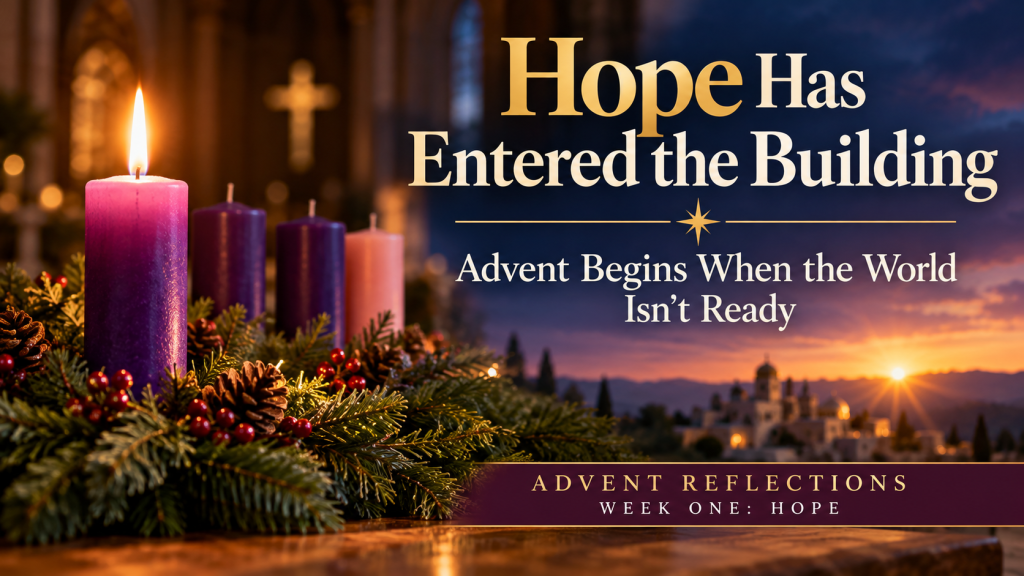
There is something wonderfully peculiar about the Church.
While the rest of the world is rushing toward Christmas, decorating trees, purchasing gifts, and wondering whether the credit card company might be persuaded to observe a season of forgiveness, the Church quietly announces that a new year has begun.
Not with champagne.
Not with fireworks.
Not even with a particularly enthusiastic rendition of Auld Lang Syne.
But with a candle.
One small flame, flickering against the darkness.
And with a single, rather audacious word.
Hope.
Today is the First Sunday of Advent, the beginning of a new Christian year. And once again, the Church invites us to begin not with certainty, not with accomplishment, and certainly not with the confident declaration that we have finally managed to get our lives properly organized.
We begin with hope.
Which, when you think about it, is a rather remarkable place to start.
Because hope is not something the world seems particularly well stocked with these days.
And yet, here we are.
The Church’s Peculiar Sense of Timing
I have always found it amusing that the Christian year begins just as the secular world is becoming increasingly convinced that the year has gone on quite long enough.
By late November, many of us are tired.
The days are shorter. The darkness arrives with an enthusiasm normally reserved for municipal tax notices. The weather has begun its annual campaign to convince Canadians that moving to the Caribbean might be a legitimate spiritual calling.
And somewhere, someone is already playing Christmas music with the relentless determination of a person who has never had to work in retail.
Into all this, the Church announces:
“Happy New Year!”
One can almost hear the collective response.
“Already? Couldn’t we have a little rest first?”
But perhaps that is precisely the point.
The Christian year does not begin when everything is perfect. It begins when the days are dark, when the world is weary, and when the future remains uncertain.
It begins with the promise that God is not finished with us yet.
And that, my friends, is the beginning of hope.
Hope Is Not Optimism Wearing Its Sunday Best
We sometimes confuse hope with optimism.
Optimism is the cheerful conviction that things will probably work out rather nicely.
It is the sort of confidence that allows someone to begin assembling a complicated piece of furniture without reading the instructions, believing that the six leftover screws are merely the manufacturer’s thoughtful contribution to future household repairs.
Hope is something different.
Christian hope does not insist that everything will turn out exactly as we would like.
It does not deny suffering, dismiss disappointment, or pretend that the world’s troubles can be solved with a sufficiently inspirational refrigerator magnet.
Hope looks directly at the brokenness of the world and says:
“Even here, God is at work.”
That is a much more demanding declaration.
And a much more courageous one.
The prophet Isaiah gives us one of Advent’s most beautiful visions:
“They shall beat their swords into plowshares, and their spears into pruning hooks.” (Isaiah 2:4)
Imagine that.
Weapons transformed into tools for growing food.
Instruments of destruction turned into instruments of life.
A world where nations no longer train themselves for war, but learn instead the far more difficult art of living together in peace.
Isaiah was not describing the international situation as it appeared in the morning newspaper.
He was describing God’s future.
And inviting God’s people to begin living toward it.
That is what hope does.
It allows us to see beyond what is, toward what God promises can be.
The Trouble with Waiting
Of course, Advent has another rather inconvenient theme.
Waiting.
And waiting is not something at which modern society excels.
We live in a world where a webpage taking more than three seconds to load is regarded as a personal affront, where supper can arrive at the front door without anyone having to put on shoes, and where we become genuinely concerned if someone has read our message but failed to respond within the time required to boil an egg.
Advent, however, refuses to be hurried.
It asks us to wait.
Not passively.
Not helplessly.
But attentively.
The Gospel for this First Sunday of Advent, Matthew 24:36–44, calls us to remain awake, to be ready, and to recognize that God’s coming does not necessarily follow our carefully prepared schedules.
Jesus reminds us that we do not know the day or the hour.
Which is probably just as well.
If we did, someone would undoubtedly organize a committee, establish a five-year strategic plan, and request that the Second Coming be postponed until after the annual parish bazaar.
But Jesus is not asking us to become experts in predicting the future.
He is asking us to become people who are awake to the present.
To notice where God is already moving.
To recognize grace when it appears in unexpected places.
To live today as though the Kingdom of God really is drawing near.
Because it is.
Hope Has Hands and Feet
One of the great dangers of religious language is that we can make hope sound rather lovely without allowing it to change anything.
We can speak beautifully about peace while nurturing resentment.
We can pray earnestly for justice while remaining comfortably indifferent to injustice.
We can sing about God’s love for the world while carefully deciding which parts of the world we would prefer God to love from a considerable distance.
But Advent hope is not merely something we feel.
It is something we practise.
When we feed someone who is hungry, hope takes on flesh.
When we welcome someone who feels excluded, hope opens a door.
When we forgive, reconcile, listen, or stand beside someone who has been forgotten, hope becomes visible.
When a parish opens its doors to neighbours, when volunteers prepare a meal, when a community garden produces food for people who need it, when someone quietly sits beside a grieving friend without trying to explain away their sorrow, the Kingdom of God becomes a little easier to recognize.
None of these things will make the evening news.
They rarely do.
The evening news seems rather more interested in informing us that everything is going terribly wrong, preferably accompanied by dramatic music and a weather forecast suggesting that matters will deteriorate further by Thursday.
But the Kingdom of God has never depended upon favourable headlines.
It grows quietly.
Like a seed.
Like yeast in bread.
Like a candle flame that refuses to surrender to the darkness.
Hope is not simply believing that God will one day make all things new. It is choosing to live today as though that promise is already beginning to come true.
And that is precisely what Advent invites us to do.
Between the Promise and the Fulfilment
There is a wonderful tension at the heart of Advent.
We remember that Christ has come.
We proclaim that Christ will come again.
And we discover that Christ is coming among us even now.
Theologians sometimes describe this as living between the already and the not yet of God’s Kingdom.
God’s reign has already broken into human history through Jesus Christ.
And yet its fullness remains ahead of us.
Peace has been promised, but wars continue.
Justice has been proclaimed, but injustice persists.
Death has been defeated through the resurrection, but grief still visits our homes.
We live between the promise and its fulfilment.
And that can be a difficult place to live.
It would be considerably more convenient if God simply completed the whole enterprise at once, rather like a competent contractor who arrives on Monday morning and has everything finished by Friday afternoon.
Although, having observed a few renovation projects over the years, I suspect even that analogy requires a considerable act of faith.
But the Kingdom does not arrive according to our timetable.
It unfolds through the patient, persistent, transforming love of God.
And astonishingly, God invites us to participate.
We are not merely spectators waiting for heaven to arrive.
We are disciples called to bear witness to heaven’s presence here and now.
We are called to become signs of the future God has promised.
Not because we are particularly impressive.
Not because we have everything figured out.
But because grace has a remarkable habit of accomplishing extraordinary things through remarkably ordinary people.
Which should provide considerable encouragement to the Church.
We have always had an abundance of ordinary people.
Lighting the First Candle
Today, in churches and homes around the world, the first candle of the Advent wreath is lit.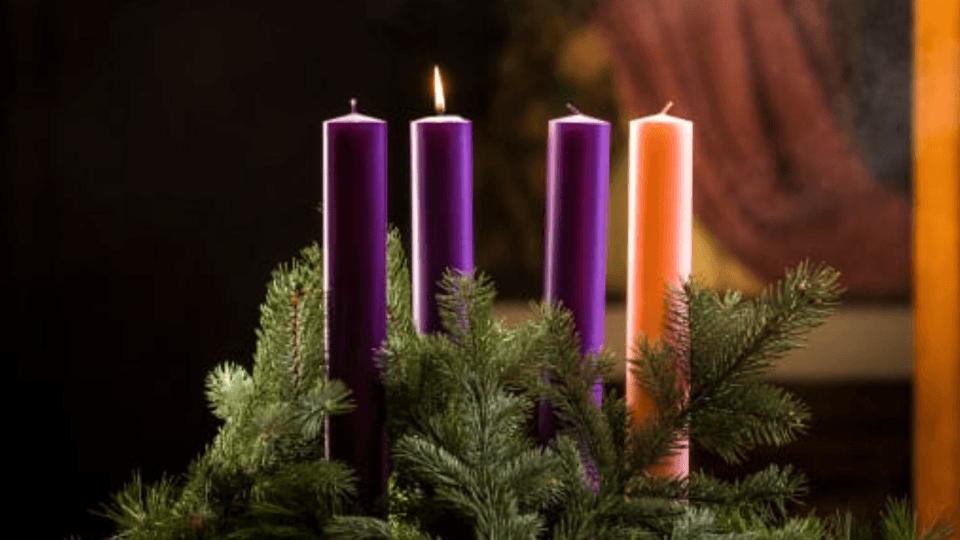
One flame.
Small.
Vulnerable.
Almost absurdly inadequate when compared with the darkness surrounding it.
And yet, darkness cannot extinguish light simply by being dark.
That is the astonishing thing about a candle.
It does not need to illuminate the entire world to make a difference.
It simply needs to burn.
Perhaps that is a useful image for the beginning of this new Christian year.
We do not need to solve every problem before Christmas.
We do not need to repair every broken relationship by Tuesday.
We do not need to become perfectly patient, endlessly generous, and entirely free from irritation at people who stop suddenly in the middle of the grocery aisle.
Although Advent might provide an excellent opportunity to begin working on that last one.
We simply need to begin.
One act of kindness.
One honest prayer.
One moment of forgiveness.
One courageous decision to do what is right.
One small flame of hope offered to a world that desperately needs its light.
And perhaps, by God’s grace, another flame will be kindled nearby.
And another.
And another.
Until what began as one small light becomes something beautiful.
A New Year, A New Beginning
So here we are.
The First Sunday of Advent.
A new Christian year.
A new journey toward Bethlehem.
And a fresh invitation to discover that the God who came among us in the humility of a manger is still coming among us in the ordinary circumstances of our lives.
This week, as we begin our Advent journey, I want us to spend some time reflecting upon hope.
Not the shallow optimism that insists everything is fine.
Not the sentimental reassurance that difficulties will somehow disappear.
But the deep, stubborn, resurrection-shaped hope that declares God’s love is stronger than despair, God’s mercy is greater than our failures, and God’s future is not limited by the brokenness of our present.
It is the hope that kept the prophets speaking.
The hope that sustained Mary when she said yes to an uncertain future.
The hope that carried the first disciples beyond the darkness of Good Friday.
And the hope that continues to sustain the Church, even when the Church occasionally seems determined to make the whole business considerably more complicated than Jesus intended.
This Advent, we will not pretend the darkness is unreal.
We will simply refuse to believe that darkness gets the final word.
Because it doesn’t.
Christ has come.
Christ is coming.
Christ will come again.
And in that promise, we find the courage to begin another year.
So light the candle.
Open your heart.
Look for the signs of God’s Kingdom in the people and places around you.
And if the world seems particularly dark today, remember that even the smallest flame can remind us of a promise that has never been withdrawn.
The future belongs not to fear, but to the God who is making all things new.
Happy New Year, my friends.
And welcome to Advent.
Hope has entered the building.
And, thanks be to God, it has no intention of leaving.
Follow along on Instagram @renewablespiritual for more daily reflections on faith, life, and the surprising places where God still loves to meet us.
Companion Prayer
God of hope and new beginnings,
As we light the first candle of Advent, awaken within us the courage to believe that your promises are still unfolding.
When the world seems dark, help us become bearers of your light. When fear overwhelms us, remind us that your love has not abandoned us. And when we grow impatient waiting for your Kingdom, teach us to recognize the quiet ways it is already breaking into our lives.
May our hope become more than words. Let it take shape in kindness, generosity, forgiveness, and the courage to love as Jesus loves.
Come, Lord Jesus. Kindle your hope within us, and make us instruments of your coming Kingdom.
Amen.