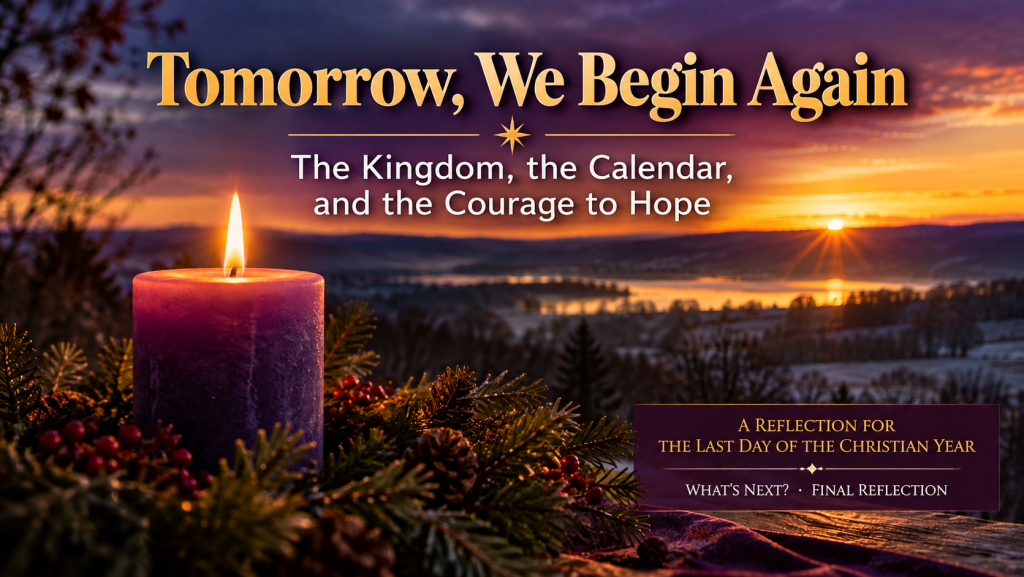
Saturday, November 28, 2026 — The Last Day of the Christian Year
The Final Reflection in the Series: “What’s Next? Living in the Present Yet Future Kingdom”
There is something wonderfully peculiar about the Christian Church.
We spend an entire year making our way through the great story of salvation. We begin with anticipation, move through the wonder of Christmas, stumble into the wilderness of Lent, stand bewildered at the foot of the Cross, rejoice at an empty tomb, and spend the long green season after Pentecost trying to work out what on earth we are supposed to do with all of it.
Then, just when we seem to have arrived somewhere, the Church announces that the year is over.
And tomorrow, we begin again.
It is rather like spending twelve months climbing a mountain, arriving at the summit, and discovering that the Church has thoughtfully arranged another mountain just beyond it.
One might reasonably ask whether the Church has ever considered a nice, quiet holiday.
But perhaps that is precisely the point.
Because the Christian life is not a journey toward a destination where we can finally unpack our bags, put our feet up, and announce that we have successfully completed the business of being faithful.
It is a continual invitation to begin again.
And tomorrow, on the First Sunday of Advent, we do exactly that.
The End That Is Really a Beginning
Today is the final day of the Christian year.
Last Sunday, we celebrated Christ the King. We proclaimed that Jesus Christ is Lord of all creation, that his Kingdom is not merely some distant heavenly arrangement, and that his reign is already breaking into the world through mercy, justice, forgiveness, and love.
Throughout this past week, we have been asking a deceptively simple question:
What’s next?
If Christ is King, what does that mean for Monday morning?
If the Kingdom of God is already among us, why does the world still look so remarkably unlike it?
If Jesus has already conquered sin and death, why do cruelty, fear, division, and suffering still seem to enjoy such an enthusiastic following?
These are not small questions.
They are the questions that arise when we take the Gospel seriously enough to notice the distance between God’s promises and the world as we presently experience it.
And here, on the threshold of Advent, the Church offers us a remarkable answer.
We wait.
Now, I appreciate that this may not sound especially impressive.
After all, waiting is hardly an activity that enjoys widespread popularity.
We wait in traffic. We wait in grocery store queues. We wait for medical appointments. We wait for the kettle to boil, although modern humanity has become so impatient that even the kettle is now expected to perform its duties with the urgency of a fire brigade.
And if the internet takes more than three seconds to load, we begin to suspect that civilization itself is collapsing.
Yet Advent begins by inviting us to wait.
Not because God has forgotten us.
Not because the Kingdom has been postponed indefinitely.
But because Christian waiting is not passive resignation. It is active, courageous hope.
The Kingdom Is Here. The Kingdom Is Coming.
There is a tension at the very heart of Christian faith.
Jesus announces that the Kingdom of God has come near.
He heals the sick, welcomes the excluded, forgives sinners, feeds the hungry, and challenges the powers that have mistaken their temporary authority for eternal importance.
In him, God’s future breaks into the present.
And yet, Jesus also teaches his disciples to pray:
“Your kingdom come. Your will be done, on earth as it is in heaven.”
Why pray for a Kingdom that has already arrived?
Because the Kingdom is both present and future.
It has begun, but it has not yet reached its fullness.
God’s new creation has been inaugurated in Christ, but the world still awaits its complete transformation.
Theologians call this the already and the not yet.
It is a wonderfully useful phrase, although it does sound rather like the answer one receives from a contractor when asking whether the renovations are finished.
“Is the kitchen complete?”
“Already, and not yet.”
“Can we use the sink?”
“That depends upon your understanding of eschatology.”
Nevertheless, the phrase captures something essential.
We live between promise and fulfilment.
Between resurrection and restoration.
Between the first coming of Christ and the day when God’s purposes for creation are brought to completion.
And this is not a problem to be solved.
It is the very place where Christian discipleship happens.
Advent Does Not Ask Us to Escape the World
One of the great temptations of religious life is to imagine that faith is primarily concerned with getting us out of this world and safely into the next.
Under this arrangement, the earth becomes little more than a rather troublesome waiting room, and salvation is understood as our eventual departure from the premises.
But the Gospel tells a much richer story.
God does not abandon creation.
God enters it.
The Word becomes flesh.
The eternal takes up residence among the ordinary.
The Creator comes among the created, not to declare the whole enterprise a failure, but to redeem, renew, and restore it.
And Advent invites us to remember that the God who came to us in Bethlehem is the same God who continues to come among us now, and who will come again in glory.
That means our waiting cannot be an excuse for doing nothing.
We cannot simply sit comfortably in the pews, sing a few hymns about the coming Kingdom, and then return home to behave as though the world belongs to whoever shouts the loudest.
Although, judging by certain public conversations, a surprising number of people seem convinced that volume is a spiritual gift.
The Kingdom calls us to something better.
If we believe that God’s future is one of justice, then we must practise justice now.
If we believe that God’s future is one of reconciliation, then we must become people who seek reconciliation now.
If we believe that God’s future is one in which the hungry are fed, the stranger is welcomed, and the vulnerable are protected, then those realities must begin to take shape in our own communities.
We do not create the Kingdom through our own efforts.
That is God’s work.
But by grace, we are invited to participate in what God is already doing.
We do not wait for God’s Kingdom by standing still. We wait by living today as though God’s promised tomorrow is already beginning.
The Strange Courage of Beginning Again
There is another reason I find this particular day so moving.
The Church year ends without pretending that everything has been resolved.
There are prayers we have offered whose answers remain hidden.
There are relationships still in need of healing.
There are griefs that have not disappeared.
There are injustices that continue to wound our communities and our world.
There are moments when our faith has been strong, and others when it has been little more than a candle struggling against a determined November wind.
And still, tomorrow, the Church begins again.
Not because we have managed to get everything right.
Not because we have finally become the people we ought to be.
But because God’s faithfulness is greater than our failures.
There is profound grace in that.
The Church does not begin its new year with a declaration of human achievement.
It begins with longing.
With watchfulness.
With the ancient cry of God’s people:
Come, Lord Jesus.
It is not the triumphant announcement of people who have mastered the spiritual life.
It is the prayer of people who know how much they still need God.
And perhaps that is the most honest place from which any new beginning can emerge.
A New Year Without the Usual Resolutions
Tomorrow begins a new Christian year.
There will be no fireworks at midnight, no great countdown on television, and probably very few people wearing novelty hats bearing the words “Happy Advent.”
This is a considerable oversight in the religious merchandise industry.
Nevertheless, Advent offers something far more substantial than another round of resolutions destined to expire before the Christmas decorations have been taken down.
It invites us into a different way of measuring time.
The world measures time by productivity, deadlines, accomplishments, and the relentless advance of the calendar.
The Church measures time by the unfolding mystery of God’s love.
We begin not with what we intend to accomplish, but with what God has promised.
We begin not by celebrating our own importance, but by watching for the One who comes among us in humility.
We begin not with certainty about everything that lies ahead, but with trust in the One who holds the future.
And perhaps that is a resolution worth making.
Not that we shall become perfect Christians by the second Sunday of Advent.
Experience suggests that this would be an ambitious timetable.
But that we shall become more attentive.
More merciful.
More generous.
More willing to recognize Christ in the neighbour we find inconvenient, the stranger we do not understand, and the person whose opinions cause us to contemplate a lengthy retreat into the wilderness.
Perhaps especially that last one.
Because the Kingdom is not simply something we are waiting to see.
It is something we are called to reveal.
The Light Is Already on the Horizon
As I think about these days between Christ the King and Advent, I find myself returning to the image of a dark November morning.
The trees have largely surrendered their leaves.
The air has acquired that unmistakable Canadian sharpness that reminds us winter is no longer merely considering its options.
The fields are resting.
The gardens are quiet.
And the light comes slowly.
But it comes.
Before the sun rises, there is a subtle change along the horizon.
The darkness has not yet disappeared.
The day has not fully arrived.
But something is happening.
The light is coming.
That, it seems to me, is Advent.
We do not deny the darkness.
We do not pretend that suffering is imaginary, that injustice is insignificant, or that the brokenness of our world can be repaired by a sufficiently cheerful seasonal greeting.
We look honestly at the world.
And then we look toward the horizon.
Because we believe that God has not finished with creation.
We believe that the resurrection of Jesus Christ is the beginning of a new creation, not simply a remarkable event safely confined to the past.
We believe that love will have the final word.
Not because human history has given us overwhelming evidence of our own ability to arrange such an outcome.
Quite the opposite, in fact.
But because the future belongs to God.
And the God who came among us in Jesus Christ has already shown us what that future looks like.
It looks like mercy.
It looks like justice.
It looks like reconciliation.
It looks like a table where there is room for everyone.
It looks like a garden where life rises from what appeared to be dead.
It looks like a Kingdom whose King wears a crown of thorns before he wears the crown of glory.
And it looks like ordinary people, in ordinary places, learning to love with extraordinary faithfulness.
So, What’s Next?
For six days, we have been asking that question.
What comes after Christ the King?
What comes after our declaration that Jesus is Lord?
What comes after the great proclamation that God’s Kingdom is already among us, even while we await its fullness?
The answer, I think, is both wonderfully simple and wonderfully demanding.
We begin again.
We begin again in prayer.
We begin again in compassion.
We begin again in the work of reconciliation.
We begin again in the daily practice of justice, kindness, humility, and love.
We begin again when yesterday’s efforts have fallen short.
We begin again when the world seems determined to move in precisely the wrong direction.
We begin again because God’s grace has not run out, God’s promises have not expired, and God’s Kingdom has not been cancelled due to insufficient public interest.
Tomorrow, we shall light the first candle of Advent.
It will be a small flame.
It will not illuminate the entire world.
It will not resolve every conflict, heal every wound, or answer every question.
But it will be a sign.
A sign that darkness is not the end of the story.
A sign that hope is not foolishness.
A sign that the God who came among us has not stopped coming.
And perhaps that is enough for the beginning of a new year.
Not a complete map of the future.
Not a guarantee that the road will be easy.
Simply a candle, a promise, and the courage to take the next faithful step.
For the Kingdom is already here.
The Kingdom is still coming.
And tomorrow, by the grace of God, we begin again.
The Christian year does not end because God’s story is finished. It ends so that we may discover, once more, that God’s story is still being written — and that, by grace, we have been invited to take part.
And so, as this Christian year draws to its close, may we carry forward not simply the memories of what has been, but the hope of what God is still bringing into being.
May we have the courage to live the Kingdom today.
May we have the patience to wait for its fullness tomorrow.
And may we never lose the holy wonder of discovering that, with God, every ending can become the beginning of something new.
Tomorrow is Advent.
Tomorrow is a new year.
Tomorrow, we begin again.
Thanks be to God.
Amen.
Follow along on Instagram @renewablespiritual for more daily reflections on faith, life, and the surprising places where God still loves to meet us.
Companion Prayer
Faithful and ever-present God,
As one Christian year draws to its close and another prepares to begin, we give thanks for your unfailing grace.
Forgive us for the times we have lost sight of your Kingdom, grown impatient with your promises, or forgotten that hope is an act of faith.
Teach us to wait with courage, to love with generosity, and to live today in the light of your promised tomorrow.
As we prepare to light the first candle of Advent, renew our hearts, strengthen our faith, and remind us that your story is far from finished.
Come, Lord Jesus.
And help us begin again.
Amen.