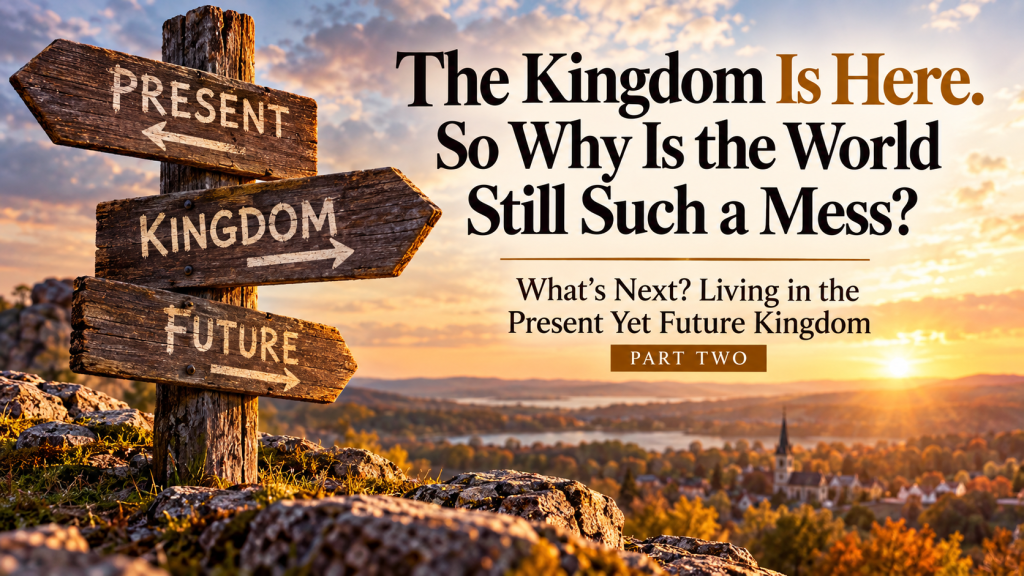
What’s Next? Living in the Present Yet Future Kingdom — Part Two Tuesday, November 24, 2026
There is a rather awkward problem with the Kingdom of God.
Jesus announced that it had come near. He healed the sick, welcomed the outcast, forgave sinners, challenged the powerful, and assured his followers that God’s reign was already breaking into the world.
And yet, two thousand years later, one cannot help noticing that the world has not entirely received the memorandum.
Wars continue. Poverty persists. Neighbours quarrel over property lines. Politicians promise salvation at election time, only to discover shortly afterwards that salvation is considerably more complicated than their campaign literature suggested.
And somewhere, even as I write, a church committee is spending forty-five minutes debating whether the Christmas decorations should be put up before or after the final hymn.
Surely, if the Kingdom of God has arrived, we might reasonably expect things to be a little further along by now.
But perhaps the problem is not with the Kingdom.
Perhaps the problem is with our expectations.
The Trouble with Wanting Everything Finished
We have just celebrated Christ the King Sunday. We have proclaimed that Jesus Christ reigns over all creation. We have sung the hymns, offered the prayers, and declared that his Kingdom will have no end.
And now, here we are on Tuesday.
The dishes still need washing. The bills still need paying. Someone has misplaced the church keys. The news remains deeply unsettling.
If Christ is King, why does so much of life appear to be operating without adult supervision?
It is a perfectly reasonable question.
In fact, it is one of the great theological questions of Christianity.
We proclaim a Kingdom that has already begun but has not yet reached its fullness. We live between the victory of Christ’s resurrection and the final renewal of all creation.
Theologians call this inaugurated eschatology, which is a splendid expression guaranteed to bring most dinner-party conversations to a swift and merciful conclusion.
I prefer to think of it this way:
God has begun something extraordinary, and we have been invited to live as though it is already true, even while the world is still catching up.
This is the tension of the Christian life.
The Kingdom is already here.
The Kingdom is still coming.
And somehow, mysteriously and wonderfully, we are called to live in both realities at once.
Jesus Never Promised an Instant Renovation
I have occasionally watched home renovation programmes in which a dilapidated house is transformed into a magnificent residence in approximately forty-two minutes, allowing for commercial interruptions.
Walls disappear. Kitchens emerge. Bathrooms become luxurious sanctuaries. The owners return, gasp dramatically, and declare that their lives have been changed forever.
What the programme seldom shows is the six months of paperwork, the unexpected plumbing problems, the contractor who has vanished to another job, and the discovery that the electrical system was apparently installed by a man with a screwdriver and an optimistic disposition.
The Kingdom of God is not a forty-two-minute renovation programme.
Jesus knew that.
He spoke of mustard seeds, yeast, wheat growing quietly in the fields, and treasure hidden beneath the soil.
These are not images of instantaneous transformation.
They are images of patience, growth, discovery, and the extraordinary possibilities hidden within ordinary things.
A mustard seed does not become a tree because someone stands over it shouting encouragement.
Yeast does not transform the dough by issuing a strategic planning document.
And wheat does not grow more quickly because the farmer has scheduled a special meeting to discuss its progress.
Growth happens through processes that are often quiet, hidden, and beyond our immediate control.
The Kingdom grows in much the same way.
It begins in small acts of mercy.
It takes root in unexpected forgiveness.
It spreads through hospitality, compassion, justice, generosity, and love.
And quite often, it grows in places where nobody thought to look.
The Kingdom Is Not Waiting for Better People
One of the more remarkable features of Jesus’ ministry is the company he kept.
He did not assemble a team of exceptionally accomplished religious professionals with impeccable credentials and carefully polished public reputations.
He called fishermen.
He welcomed tax collectors.
He ate with sinners.
He entrusted the future of his mission to people who frequently misunderstood what he was saying, argued about who was most important, and occasionally demonstrated the spiritual insight of a turnip.
Peter, for example, managed to confess Jesus as the Messiah and then, almost immediately, attempt to correct Jesus’ understanding of what being the Messiah actually meant.
It was an impressive achievement.
Yet these were the people through whom the Kingdom began to spread.
That ought to give us considerable hope.
Because the Kingdom of God does not depend upon our perfection.
It depends upon God’s grace.
And grace has an extraordinary capacity to work through imperfect people.
Indeed, if God waited until the Church had everything sorted out before beginning the work of the Kingdom, we might still be standing on the shores of Galilee discussing the minutes of the first disciples’ meeting.
Instead, Jesus calls ordinary people to extraordinary faithfulness.
People like you.
People like me.
People who sometimes get things wrong, lose patience, make poor decisions, and discover that loving our neighbours is considerably easier in theory than when the neighbours are actually present.
Nevertheless, we are invited to participate.
Not because we are particularly impressive.
But because God is astonishingly generous.
Living as Citizens of Tomorrow, Today
Here is where the theology becomes wonderfully practical.
If the Kingdom of God is already present, even though its fullness remains ahead of us, then Christians are called to live according to the values of that coming Kingdom now.
We are, in a sense, citizens of tomorrow living in today.
That means we do not wait for perfect circumstances before practising love.
We do not wait for a peaceful world before becoming peacemakers.
We do not wait for universal justice before standing alongside those who are treated unjustly.
We do not wait until everyone agrees with us before offering hospitality.
And we certainly do not wait until the Church has become entirely respectable before sharing the Good News.
That last requirement would postpone the mission indefinitely.
Instead, we become signs of the Kingdom in the middle of the world as it actually is.
When someone is hungry, we feed them.
When someone is lonely, we make room.
When someone is grieving, we sit beside them.
When someone has been wounded by the Church, we listen with humility rather than immediately reaching for an explanation.
When reconciliation seems impossible, we resist the temptation to declare it hopeless.
These are not merely nice things for Christians to do.
They are glimpses of God’s future breaking into the present.
Every act of genuine love becomes a small announcement that the world does not belong forever to cruelty, division, fear, or despair.
It belongs to God.
And God is not finished with it.
Hope Is Not the Same as Optimism
There is an important distinction here.
Optimism is the belief that things will probably turn out well.
Christian hope is the conviction that God’s faithfulness remains trustworthy even when things appear to be going rather badly.
Optimism looks at the evidence and says, “I think everything will be fine.”
Christian hope looks at the cross and the empty tomb and says, “Even here, God is at work.”
That is a much deeper claim.
It does not require us to pretend that suffering is insignificant.
It does not ask us to ignore injustice or minimize grief.
It does not suggest that every tragedy has some convenient explanation hidden in the divine filing cabinet.
Christian hope takes suffering seriously precisely because God takes suffering seriously.
The resurrection does not erase the wounds of Good Friday.
The risen Christ still bears them.
And yet those wounds no longer have the final word.
That is the heart of our hope.
The Kingdom is not simply the promise that things will eventually improve.
It is the assurance that God’s love, revealed in Jesus Christ, is stronger than everything that seeks to destroy life.
Even death itself.
The Holy Work of Small Beginnings
I sometimes wonder whether we miss the Kingdom because we are looking for something much more dramatic.
We expect trumpets, thunder, spectacular signs, and perhaps a suitably impressive announcement from heaven.
Instead, the Kingdom often arrives quietly.
In a community supper where strangers become neighbours.
In a garden where vegetables are grown not merely for those who planted them, but for people whose names the gardeners may never know.
In a hospital room where someone offers a prayer with trembling hands.
In a conversation where one person finally finds the courage to say, “I’m sorry.”
In a church where a child is welcomed, a question is taken seriously, or someone who has felt excluded discovers that there is room for them after all.
None of these moments is likely to make the evening news.
They are not particularly spectacular.
But neither was a baby born in Bethlehem.
And look what God did with that.
Perhaps we have become so accustomed to measuring success by size, influence, wealth, and public recognition that we have forgotten how differently God measures things.
The Kingdom does not always announce itself with great fanfare.
Sometimes it arrives carrying a casserole.
Sometimes it arrives with a listening ear.
Sometimes it arrives with a bag of groceries, a warm coat, or an invitation to sit at the table.
And sometimes it arrives through the simple, stubborn decision to keep loving when the world insists that love is foolish.
These are not insignificant things.
They are the beginnings of a new creation.
So, What’s Next?
As we move through these few days between Christ the King and Advent, the Church gives us a remarkable opportunity.
We have proclaimed that Christ reigns.
Soon we will begin waiting once more for his coming.
But in between those two great declarations lies a question that cannot be avoided:
What difference does the reign of Christ make to the way we live on an ordinary Tuesday?
That, I think, is where the Kingdom becomes real.
Not simply in our theology, important though theology certainly is.
Not merely in our worship, beautiful and necessary though worship remains.
But in the way we treat the people God places before us.
The Kingdom becomes visible when our faith moves from proclamation to practice.
When we stop asking only whether God is doing something about the world’s suffering and begin asking how God might be calling us to participate in the answer.
When we recognize that following Jesus is not a matter of standing around admiring the Kingdom from a safe distance.
It is a matter of entering into its life.
Of becoming, through grace, the people we have been called to be.
And yes, we will make mistakes.
We will grow impatient.
We will occasionally confuse our own preferences with the will of Almighty God, a temptation to which Christians have demonstrated remarkable susceptibility for approximately two thousand years.
But the invitation remains.
The Kingdom is here.
The Kingdom is coming.
And today, in this ordinary, imperfect, occasionally bewildering world, we are invited to live as though the promises of Jesus are true.
Because they are.
A Kingdom Still Becoming
There is something wonderfully liberating about realizing that we are not responsible for completing the Kingdom of God.
That is God’s work.
We are not the architects of salvation.
We are not the managers of eternity.
And despite what some church committees may occasionally suggest, the future of the universe does not depend upon the successful completion of our five-year strategic plan.
We are disciples.
We are witnesses.
We are participants in a story much larger than ourselves.
Our task is not to finish what God has begun.
Our task is to be faithful within it.
To plant seeds whose harvest we may never see.
To practise mercy even when mercy seems in short supply.
To choose hope when cynicism would be easier.
To love because we have first been loved.
And to trust that the God who raised Jesus from the dead is still at work bringing life out of places where life seems impossible.
The world is not yet what God intends it to be.
Neither is the Church.
Neither, for that matter, are you or I.
But that is not the end of the story.
It is precisely why the story continues.
So, on this Tuesday between Christ the King and Advent, perhaps our calling is not to solve every problem, settle every argument, or transform the entire world before lunchtime.
Perhaps it is simply to ask:
Where might the Kingdom of God become a little more visible through me today?
And then to act upon the answer.
Because the Kingdom of God is not merely a future we are waiting to enter. It is a future God is already inviting us to practise.
One act of love.
One moment of grace.
One ordinary Tuesday at a time.
And if, along the way, we could manage to conduct a church committee meeting without arguing about the Christmas decorations, that would surely be a small but unmistakable sign that the Kingdom is drawing near.
Although, admittedly, we must not expect too many miracles all at once.
Follow along on Instagram @renewablespiritual for more daily reflections on faith, life, and the surprising places where God still loves to meet us.
Companion Prayer
Gracious and loving God,
You have promised us a Kingdom of justice, mercy, peace, and love, yet we so often struggle to recognize its presence in our imperfect world.
Open our eyes to the quiet ways your Kingdom is growing around us. Give us courage to plant seeds of kindness, patience to nurture reconciliation, and faith to trust that even our smallest acts of love matter.
Help us to live today as citizens of your promised tomorrow, remembering that we are not called to complete your Kingdom, but to participate faithfully in its coming.
Through Jesus Christ, our risen and reigning Lord.
Amen.