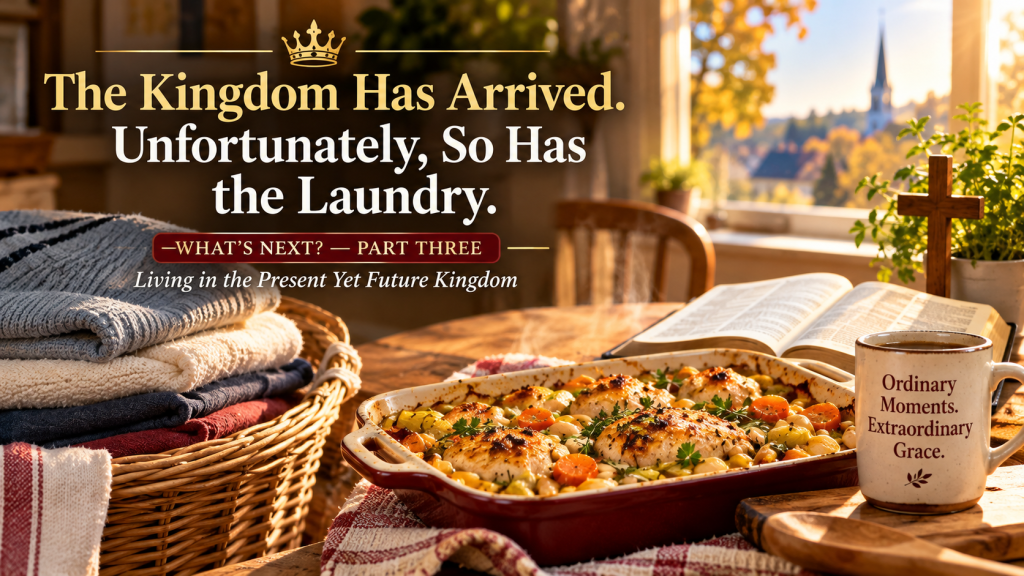
What’s Next? Living in the Present Yet Future Kingdom — Part Three
There is something wonderfully inconvenient about the Kingdom of God.
We have just celebrated Christ the King Sunday. We have proclaimed that Jesus Christ reigns over all creation, that his Kingdom has no end, and that one day every knee shall bow and every tongue confess that he is Lord.
It was magnificent. The hymns were glorious. The prayers were stirring. The Church was dressed for the occasion.
And then Monday arrived.
The dishes still needed washing. The bills still needed paying. Someone had left a rather unpleasant message on social media. The car made a noise that sounded suspiciously expensive. And the laundry, which had apparently been observing Christ the King Sunday with the rest of us, returned to its customary state of rebellion.
One might reasonably ask, “If Christ is King, shouldn’t things look a little different?”
It is an excellent question.
It is also, I suspect, precisely the question Jesus wants us to ask.
Because the Kingdom of God is not simply something we celebrate on Sunday. It is something we are called to inhabit on Monday, Tuesday, Wednesday, and every other day when life seems determined to remain stubbornly ordinary.
And that, dear friends, is where things become interesting.
A Kingdom That Refuses to Behave Like a Kingdom
Throughout the Gospels, Jesus speaks constantly about the Kingdom of God.
He tells us it is near. He tells us it is among us. He tells us to seek it first. He compares it to mustard seeds, yeast, buried treasure, and fishing nets.
Rather peculiar comparisons, when you think about it.
Most earthly kingdoms prefer to be compared to mighty fortresses, magnificent armies, and impressive palaces. Jesus compares his Kingdom to something a woman puts into bread dough.
Imagine the bewilderment of a Roman official receiving intelligence reports about this emerging Kingdom.
“Your Excellency, we have discovered the central strategy of this dangerous revolutionary movement.”
“Excellent! What is it?”
“Apparently, sir, they intend to behave like yeast.”
“Yeast?”
“Yes, sir. And there is also considerable discussion about mustard seeds.”
Rome, I suspect, would have found the whole business deeply unsettling.
And rightly so.
Because Jesus was announcing a Kingdom that would transform the world, not through the familiar instruments of domination, but through the seemingly insignificant practices of mercy, forgiveness, generosity, humility, and love.
It would begin quietly.
It would grow unexpectedly.
And it would turn the world’s understanding of power upside down.
The Kingdom would arrive, not with a conquering army, but with a child in a manger.
Not with a throne of gold, but with a cross.
Not through the destruction of enemies, but through the astonishing declaration that even enemies are to be loved.
No wonder people found Jesus difficult to understand.
We still do.
The Trouble With Wanting Everything Finished
I suspect that one of our greatest difficulties with the Kingdom of God is that we would rather it arrived fully assembled.
Preferably with instructions.
And a warranty.
We are, after all, a people who appreciate completion.
We like projects that have definite beginnings and endings. We enjoy crossing things off lists. We find great satisfaction in finishing a job, stepping back, and declaring, “There. That’s done.”
The Kingdom of God refuses to cooperate.
It is already here, Jesus tells us.
And yet we continue to pray, “Thy Kingdom come.”
Christ has conquered sin and death.
And yet suffering remains.
The resurrection has inaugurated God’s new creation.
And yet the world continues to groan beneath the weight of injustice, violence, poverty, and grief.
Christian theology has a name for this curious condition.
We call it the already and the not yet.
The Kingdom has already broken into history through the life, death, and resurrection of Jesus Christ.
But its fullness has not yet been revealed.
We live between the decisive victory and its final completion.
It is rather like watching the sun rise on a November morning in Ontario.
There is that extraordinary moment when the first light breaks across the horizon. The darkness has begun to retreat. The promise of daylight is unmistakable.
But the world is not yet fully illuminated.
There are still shadows.
There is still cold.
And, being November in Ontario, there is a reasonable possibility that the sun will disappear behind clouds for the next eleven days.
Nevertheless, the dawn has begun.
And once the dawn has begun, the darkness no longer has the final word.
That is the Christian hope.
Not that everything is already as it should be.
But that, because of Christ, everything is moving toward what God has promised it shall become.
The Kingdom Begins in the Smallest Places
Here is where our theology becomes wonderfully practical.
If the Kingdom of God is already present, even though its fullness remains ahead of us, then our task is not simply to wait for it.
Our task is to live as though it is true.
And that can be considerably more demanding than singing about it.
It means that when the world encourages us to retaliate, we choose forgiveness.
When society teaches us to measure human worth by wealth, productivity, or social standing, we insist that every person bears the image of God.
When fear tells us to build higher walls, the Gospel invites us to build longer tables.
When cynicism assures us that nothing will ever change, Christian hope quietly rolls up its sleeves and gets to work.
None of these actions will make tomorrow’s headlines.
A neighbour bringing soup to someone who is ill is unlikely to attract international attention.
A parish welcoming someone who has felt excluded elsewhere will probably not appear on the evening news.
A person choosing to listen rather than argue, to forgive rather than retaliate, or to share rather than accumulate will rarely receive a standing ovation.
And yet these are precisely the places where the Kingdom becomes visible.
Not because our actions create God’s Kingdom. That is God’s work, accomplished through Christ and brought to fulfilment by God’s grace.
But because our actions can bear witness to the Kingdom that has already begun.
They are signs of the future breaking into the present.
Small glimpses of the world as God intends it to be.
And sometimes those glimpses are enough to keep hope alive.
We Are Not Called to Manage the Kingdom
There is, of course, a danger here.
Christians can become so enthusiastic about building the Kingdom that we begin to imagine ourselves its chief executive officers.
We develop strategic plans, establish committees, prepare reports, and create organizational charts.
Before long, someone proposes a subcommittee to examine whether the Kingdom is proceeding according to schedule.
I have spent enough years in the Church to assure you that this is not entirely beyond the realm of possibility.
And while good planning and faithful stewardship have their place, the Kingdom of God is not ultimately a human achievement.
We do not manufacture it.
We do not control it.
We cannot accelerate its arrival through sufficiently impressive ecclesiastical administration.
The Kingdom belongs to God.
Our calling is to participate in what God is already doing.
That distinction matters enormously.
Because if the Kingdom depends entirely upon our efforts, then every failure becomes catastrophic.
Every setback becomes evidence that hope is misplaced.
Every disappointment becomes another reason to surrender to despair.
But if the Kingdom belongs to God, then we are free to be faithful without imagining that we must be successful by the world’s measurements.
We can plant seeds without demanding to see the harvest.
We can work for justice without pretending that injustice will disappear overnight.
We can practice reconciliation even when relationships remain painfully complicated.
We can offer kindness without knowing whether it will be returned.
And we can keep going, not because we are certain of our own effectiveness, but because we trust the faithfulness of God.
The resurrection, after all, is God’s declaration that even the cross was not the end of the story.
And if God can bring life out of a tomb, I suspect God can manage the occasional setback at a parish council meeting.
The Laundry Is Holy Ground, Too
Which brings us back to the laundry.
One of the great temptations of Christian life is to divide the world into sacred and ordinary places.
Church is sacred.
Prayer is sacred.
The Eucharist is sacred.
But the kitchen, the grocery store, the workplace, the hospital waiting room, and the seemingly endless demands of everyday life are somehow less significant.
Yet the Incarnation challenges that division.
In Jesus Christ, God entered the ordinary world.
God embraced human flesh, human relationships, human labour, human suffering, and human joy.
Jesus spent far more of his earthly life in the ordinary rhythms of family and work than in the dramatic moments recorded in the Gospels.
The Son of God knew what it meant to live among people who had meals to prepare, responsibilities to fulfil, neighbours to tolerate, and probably the occasional household disagreement about whose turn it was to tidy up.
The Incarnation tells us that ordinary human life is not beneath God’s attention.
It is precisely where God has chosen to meet us.
And so the Kingdom is not something we encounter only when we kneel at the altar.
It is something we carry with us when we rise from our knees.
Into our homes.
Into our relationships.
Into our workplaces.
Into our communities.
Even into the laundry room.
Especially, perhaps, into the laundry room, where patience, humility, and perseverance are regularly tested in ways that would challenge the spiritual maturity of several desert fathers.
The question is not whether every ordinary task feels sacred.
Most do not.
The question is whether we are willing to allow the love of Christ to shape the way we undertake them.
Because a life formed by the Kingdom is not necessarily a life filled with extraordinary events.
It is an ordinary life increasingly transformed by extraordinary grace.
Living Toward a Future We Cannot Yet See
As we approach Advent, this becomes particularly important.
In just a few days, the Church will begin a new liturgical year.
We will light the first candle on the Advent wreath.
We will hear the ancient promises of prophets.
We will be invited once again to watch, wait, prepare, and hope.
But before we enter that season, these few days offer us a valuable opportunity to ask what it means to live between Christ’s victory and Christ’s promised coming.
And perhaps the answer is simpler than we imagine.
We live faithfully in the present because we trust God’s future.
We practice mercy because we believe mercy belongs to the final shape of creation.
We seek justice because we believe injustice does not have the last word.
We work for peace because we believe the Prince of Peace reigns.
We love because love is not merely a pleasant Christian sentiment.
Love is the very character of the Kingdom.
And we refuse to surrender to despair because the future is not ultimately held in the hands of those who wield the greatest power, possess the greatest wealth, or command the loudest voices.
The future belongs to God.
That does not mean we become passive.
Quite the opposite.
Christian hope is not an excuse to sit comfortably while the world suffers.
It is the reason we get up and do something.
Not because we believe we can save the world through our own efforts.
But because we believe the world has already been claimed by the One who can.
So, What’s Next?
Perhaps, on this third day of our journey through the space between Christ the King and Advent, we can begin with a modest proposal.
Tomorrow morning, when you wake up, resist the temptation to ask only, “What do I have to get done today?”
Ask another question.
“Where might the Kingdom of God become visible through me today?”
Perhaps it will be through a conversation you have been avoiding.
Perhaps through an apology you have been reluctant to offer.
Perhaps through an act of generosity no one else will ever know about.
Perhaps through the decision to treat someone with dignity when the world has given you every excuse to do otherwise.
Perhaps through a moment of prayer when you would rather surrender to worry.
Or perhaps through something as ordinary as preparing a meal, visiting a neighbour, or listening patiently to someone who desperately needs to be heard.
The Kingdom may not arrive with trumpets.
It may arrive with a casserole.
It may not announce itself through a great public spectacle.
It may reveal itself through a quiet act of compassion.
It may not look like the triumph we expected.
It may look remarkably like Jesus.
And that, of course, is the point.
We live in the already and the not yet.
The dawn has broken, even while shadows remain.
The King has come, and the King will come again.
And between those two great declarations of Christian faith, there is a life to be lived.
A neighbour to be loved.
A world to be served.
And, regrettably, a load of laundry waiting to be folded.
But perhaps even that can become an act of love.
After all, the Kingdom of God does not wait for ordinary life to become extraordinary. It makes ordinary life the place where extraordinary grace begins to shine.
And that is more than enough reason to get up tomorrow morning and begin again.
Even if the washing machine is making that dreadful noise.
Follow along on Instagram @renewablespiritual for more daily reflections on faith, life, and the surprising places where God still loves to meet us.
Companion Prayer
Gracious and loving God,
You have promised us a Kingdom of justice, mercy, peace, and love, and through Jesus Christ you have already begun to make all things new.
Open our eyes to recognize your presence in the ordinary moments of our lives.
Teach us to see opportunities for kindness in our daily routines, invitations to forgiveness in our relationships, and glimpses of your Kingdom in the smallest acts of love.
When the world seems slow to change, give us patience. When the shadows linger, renew our hope. And when the demands of everyday life overwhelm us, remind us that no act of love is ever wasted in your Kingdom.
May our ordinary lives become extraordinary witnesses to your grace.
Through Jesus Christ, our risen and reigning Lord.
Amen.