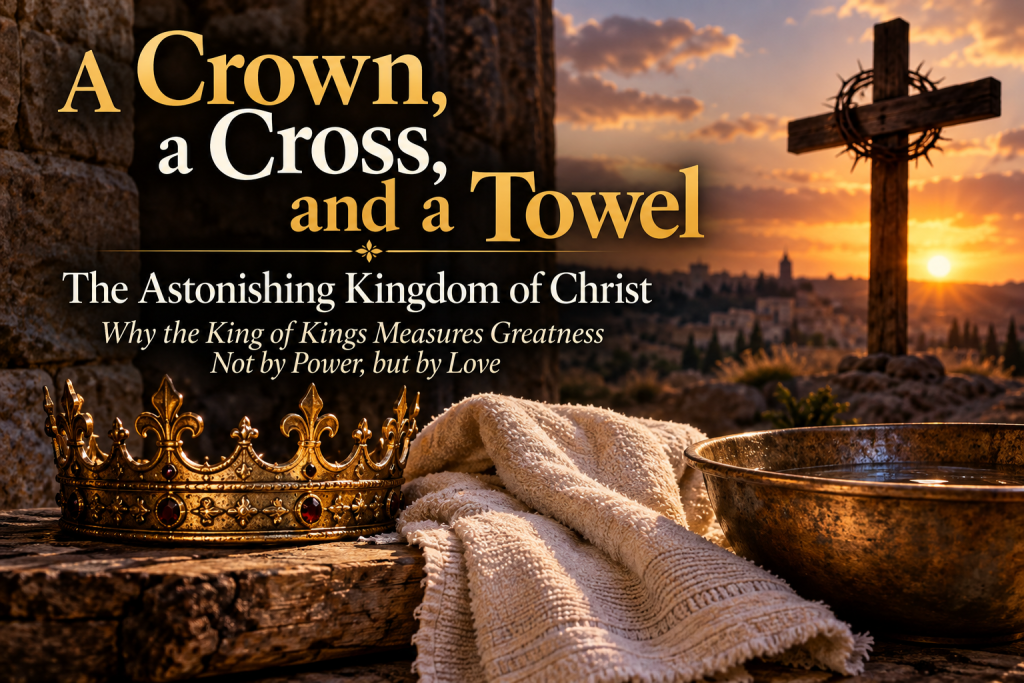
When the Lord of Heaven Comes Down to Get His Hands Dirty
There is something wonderfully inconvenient about Jesus Christ.
Just when we think we have managed to arrange Christianity into a respectable system of beliefs, ceremonies, and reasonably comfortable pews, Jesus appears in the middle of it all and starts moving the furniture.
He has an alarming habit of doing that.
Tomorrow, the Church will celebrate the Reign of Christ, or Christ the King Sunday, that magnificent conclusion to the Christian year when we proclaim that Jesus Christ is Lord of all creation.
It is a splendid occasion. The hymns are majestic. The theological language is glorious. The imagery is full of crowns, thrones, trumpets, and heavenly splendour.
And then, just as we are getting comfortably settled into the royal pageantry, someone reads the Gospel.
And there is Jesus.
Hanging on a cross.
It is rather like arriving at Buckingham Palace for a coronation and discovering that the monarch has slipped out the servants’ entrance to help an elderly neighbour carry her groceries home.
One feels that someone in the royal household has misunderstood the programme.
Except, of course, that this is precisely the programme.
And it has been God’s programme all along.
A Kingdom That Does Not Understand Protocol
We human beings have always been rather fond of kings and kingdoms, provided, of course, that we are not the ones expected to pay for the palace renovations.
We like our leaders to look important. We expect power to announce itself with a certain amount of ceremony. We want authority to be visible, preferably accompanied by impressive architecture and someone standing nearby holding a very large ceremonial object.
Even in the Church, we have occasionally confused the grandeur of the Gospel with the grandeur of the institution.
I say this as an Anglican priest who has spent a good many years wearing elaborate robes, processing solemnly through churches, and occasionally trying to remember which end of the procession I was supposed to be in.
There is nothing inherently wrong with ceremony. Beauty can lift the soul toward heaven. Sacred spaces can remind us that we belong to something larger than ourselves.
But the trouble begins when we start believing that God is more interested in the procession than in the people watching it.
Jesus never seems terribly concerned about protocol.
He touches lepers.
He eats with sinners.
He speaks with people whom respectable society has decided are best avoided.
He welcomes children when the disciples would prefer a little peace and quiet.
And he washes feet.
Imagine that for a moment.
The One whom Christians confess as Lord of heaven and earth kneels on the floor with a basin of water and a towel.
No trumpet fanfare.
No ceremonial sword.
No throne.
Just God, on his knees, attending to tired and dusty feet.
One suspects that the heavenly department responsible for royal etiquette had a very difficult time keeping up.
The Crown Nobody Wanted
As we approach Christ the King Sunday, the Church invites us to contemplate one of the most extraordinary reversals in all of human history.
The King of Kings is crowned with thorns.
His throne is a cross.
His royal attendants are soldiers who mock him.
His public proclamation of kingship is nailed above his head as an accusation.
And yet, in that terrible and holy moment, something astonishing happens.
Jesus does not respond to cruelty with greater cruelty.
He does not summon armies.
He does not threaten revenge.
He does not insist upon his rights.
Instead, he prays for forgiveness.
And when a dying criminal turns toward him with a desperate plea to be remembered, Jesus offers him the promise of paradise.
Here is the heart of the Christian proclamation.
The reign of Christ is not established through the humiliation of enemies, but through the astonishing mercy of God.
The cross does not make suffering good, nor does it suggest that injustice should simply be endured. Rather, it reveals a love that enters the very worst of human cruelty without surrendering to its logic.
The world says that power is the ability to make others suffer.
Jesus reveals that divine power is the freedom to love, even when love is costly.
And that changes everything.
The Trouble with a King Who Serves
There is, however, a rather awkward consequence to all of this.
If Jesus is our King, and if his kingship is expressed through humility, compassion, forgiveness, and service, then those of us who claim to follow him may be expected to behave in a similar fashion.
This is where Christianity becomes distinctly less comfortable.
It is one thing to sing, Crown Him with Many Crowns, at the top of our lungs.
It is quite another to discover that following the crowned Christ might involve forgiving someone who has hurt us, welcoming someone we find difficult, or helping a person who cannot possibly repay the favour.
Most of us would prefer a kingdom in which the King handles the difficult people while we concentrate on the hymns.
Unfortunately, Jesus seems to have other ideas.
He insists that greatness is found in service.
He tells us that the first must become last.
He reminds us that whatever we do for the least of his brothers and sisters, we do for him.
And just when we begin to think we have grasped the idea, he places another person in our path who requires patience, compassion, and perhaps a considerable amount of prayer.
It is an extraordinarily inefficient system, at least by worldly standards.
But then again, the Kingdom of God has never been particularly interested in efficiency.
It is interested in love.
And love, as anyone who has ever raised a child, cared for an ageing parent, served a parish, or tried to organize a church committee will tell you, is seldom efficient.
Love takes time.
Love interrupts schedules.
Love asks us to listen when we would rather speak.
Love sometimes requires us to surrender the delicious satisfaction of being right.
And occasionally, love means attending a meeting that could have been an email.
The Kingdom of God is not for the fainthearted.
Where the King Is Found
One of the great temptations of religious life is to imagine that Christ is most readily encountered in the extraordinary.
We look for him in magnificent worship, powerful spiritual experiences, beautiful cathedrals, and moments when heaven seems especially close.
And certainly, Christ can be encountered in all these places.
But the Gospel continually directs our attention somewhere else.
To the hungry.
To the lonely.
To the stranger.
To the sick.
To the prisoner.
To those who have been forgotten by the world.
The King whom we worship in the sanctuary is also the Christ who waits to meet us beyond its doors.
He is present in the person sitting alone at the community supper.
He is present in the neighbour who needs someone to listen.
He is present in the frightened child, the exhausted caregiver, the grieving widow, and the person who has quietly begun to wonder whether anyone would notice if they disappeared.
And sometimes he is present in the person who irritates us most.
I have always felt that last possibility demonstrates a rather mischievous dimension to divine grace.
Surely God could have arranged for all the people through whom we encounter Christ to be agreeable, punctual, and generally supportive of our opinions.
But apparently, sanctification requires a more challenging cast of characters.
The King does not remain safely confined to the places where we expect to find him.
He goes out into the world.
And he invites us to follow.
The Throne Is Not Empty
There is something deeply reassuring about proclaiming Christ as King at the end of the Church year.
We live in a world that often seems to be governed by anxiety, ambition, division, and fear.
We watch nations struggle for power.
We see communities fractured by suspicion.
We encounter people who have become convinced that kindness is weakness and mercy is foolishness.
Sometimes the sheer weight of it all can leave us wondering whether the world has lost its way entirely.
Christ the King Sunday does not pretend that these struggles are imaginary.
Nor does it promise that faithful people will somehow be spared the pain of living in a broken world.
Instead, it makes a far more profound declaration.
The final word over creation does not belong to cruelty.
It does not belong to violence.
It does not belong to fear.
The final word belongs to Jesus Christ, whose authority is revealed not in the power to crush his enemies, but in the love that refuses to abandon them.
That is why the cross can become the throne of our King.
Not because suffering is glorious.
Not because injustice is acceptable.
But because even there, at the place where human hatred seems to have accomplished its worst, the mercy of God is still at work.
And resurrection will reveal that hatred has not won.
The King Who Comes Looking for Us
Tomorrow, we will stand at the end of another Church year.
Advent waits just beyond the horizon, ready to begin the story again.
But before we turn toward Bethlehem, before we begin watching and waiting for the coming of Christ, the Church asks us to look once more at the King who has already come among us.
And what a King he is.
A King who refuses to remain distant.
A King who steps down from every throne we construct for him whenever that throne becomes an excuse for avoiding the suffering of the world.
A King who kneels to wash feet.
A King who stretches out his arms upon a cross.
A King who forgives.
A King who remembers the forgotten.
A King who refuses to abandon us, even when we have made a spectacular mess of things.
And perhaps that is the most astonishing truth of all.
We spend so much of our religious lives trying to find our way to God.
We build churches, compose prayers, study Scripture, sing hymns, and develop elaborate theological explanations of how the human soul might approach the divine.
These are good and holy endeavours.
But the Gospel tells us that, long before we began searching for God, God had already come searching for us.
Not with an army.
Not with a royal proclamation.
Not with an impressive entourage of celestial officials carrying clipboards and checking credentials.
But in Jesus Christ.
Walking dusty roads.
Sharing meals.
Healing wounds.
Offering mercy.
And calling ordinary people to participate in an extraordinary kingdom.
The King has come down from his throne.
Not because he has surrendered his authority.
But because love is the very nature of his authority.
And tomorrow, when we proclaim Christ as King, perhaps we might remember that his kingdom does not begin when everyone finally bows before him.
It becomes visible whenever someone chooses to love as he loves.
Whenever mercy triumphs over resentment.
Whenever a stranger is welcomed.
Whenever the hungry are fed.
Whenever forgiveness opens a door that bitterness had nailed shut.
Whenever someone discovers that they are not forgotten.
There, in those ordinary and often unnoticed moments, the reign of Christ breaks into the world.
And the King is among his people.
Not demanding that we polish his crown.
But inviting us to take up a towel, kneel beside him, and help wash the feet of the world.
For the King who refuses to stay on his throne has never stopped making room for us in his kingdom.
And thanks be to God, he has never required us to arrive wearing a crown of our own.
Only a willingness to love.
Amen.
Follow along on Instagram @renewablespiritual for more daily reflections on faith, life, and the surprising places where God still loves to meet us.
Companion Prayer
Lord Jesus Christ, our humble and glorious King, teach us to recognize your crown in the cross, your authority in mercy, and your presence in those we are called to serve. Free us from the desire for power and prestige, and give us hearts willing to kneel, hands ready to help, and lives shaped by your extraordinary love. May your kingdom come through us, one small act of grace at a time. Amen.