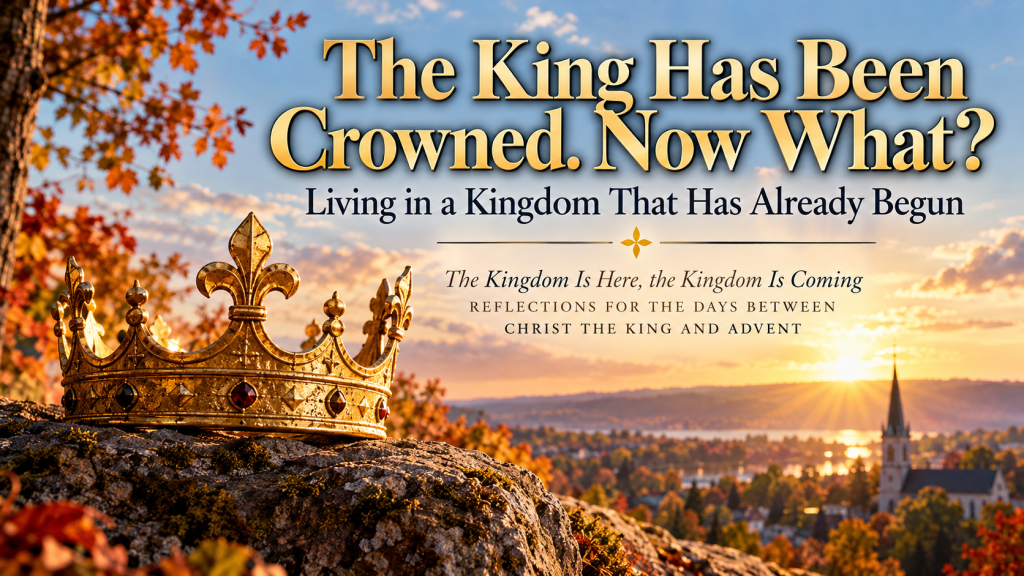
The Kingdom Is Here, the Kingdom Is Coming — Reflections for the Days Between Christ the King and Advent
There is something wonderfully peculiar about the Church calendar.
Yesterday, we crowned a King.
We sang the hymns, proclaimed the sovereignty of Christ, celebrated a Kingdom without end, and reminded ourselves that Jesus Christ is Lord of all creation. Depending upon the musical enthusiasm of the congregation, we may even have shaken the rafters a little.
And today?
Well, today is Monday.
The bins still need to go out. The hydro bill has arrived. Someone has misplaced the church keys, the parish photocopier is making a noise resembling a small agricultural implement, and the world appears not to have received the announcement that Christ is King.
One might reasonably have expected a little more visible improvement by now.
After all, if Christ is King, shouldn’t things look rather different?
Shouldn’t the nations have stopped quarrelling? Shouldn’t the hungry be fed, the lonely embraced, the poor lifted up, and the powerful finally discover that humility is not a contagious disease?
At the very least, shouldn’t parish council meetings have become shorter?
Apparently not.
And therein lies one of the great mysteries, and perhaps one of the greatest challenges, of Christian discipleship.
We proclaim a Kingdom that has already begun, while living in a world that frequently behaves as though it has never heard of it.
So what comes next?
That is the question I want us to explore during these curious days between Christ the King Sunday and the beginning of Advent.
Because yesterday’s proclamation was not the conclusion of our Christian responsibility.
It was the beginning of another chapter.
The Trouble with Crowning Jesus
I suspect that one of the dangers of Christ the King Sunday is that we can become so enthusiastic about declaring Jesus to be King that we forget to ask what his kingship actually requires of us.
We rather enjoy the language of majesty.
Crowns. Thrones. Trumpets. Glory.
There is something reassuring about the thought of Christ reigning over all creation, particularly when the evening news makes one wonder whether anybody is actually in charge.
But the difficulty begins when we remember what kind of King Jesus is.
This is a King who washes feet.
A King who welcomes children.
A King who eats with people respectable society would rather avoid.
A King who touches lepers, forgives enemies, challenges religious hypocrisy, and seems remarkably uninterested in the usual privileges of power.
Indeed, when we finally encounter him wearing a crown, it is made of thorns.
His throne is a cross.
His royal proclamation is forgiveness.
And his victory is revealed through self-giving love.
Frankly, by the standards of most earthly monarchies, Jesus would have been considered a spectacular failure at royal public relations.
No palace.
No military parade.
No royal treasury.
Not even a reasonably competent advance team to prevent him from being arrested.
Yet this is precisely the point.
The Kingdom of God does not operate according to the rules of the kingdoms we have invented for ourselves.
It does not advance through intimidation, domination, or the accumulation of influence.
It advances through mercy.
Through justice.
Through forgiveness.
Through the quiet, stubborn, sometimes thoroughly inconvenient practice of love.
And if we have proclaimed Christ as our King, then we have also committed ourselves to living according to the values of his Kingdom.
That is where things become interesting.
And occasionally uncomfortable.
Already Here, But Not Yet Complete
Christian theology has a wonderful way of describing the Kingdom of God.
It is already, but not yet.
Which sounds rather like the response one receives when asking a contractor when the renovations will be finished.
“Well, the work has begun.”
“Yes, but when will it be completed?”
“Ah. That’s a rather more complicated question.”
The Kingdom of God has already broken into human history through the life, death, and resurrection of Jesus Christ.
In him, God’s future has entered our present.
The resurrection declares that death does not have the final word.
The cross reveals that love is stronger than hatred.
The ministry of Jesus shows us what life looks like when God’s purposes are taken seriously.
And yet we know that the world remains unfinished.
There is still violence.
Still poverty.
Still injustice.
Still grief.
Still the painful divisions that separate families, communities, churches, and nations.
We live between the promise and its fulfilment.
Between the first light of dawn and the full brightness of morning.
Between what God has begun and what God will one day bring to completion.
And this is not a theological inconvenience to be explained away.
It is the very place where Christian discipleship happens.
We are called to live today as citizens of the world God is bringing into being tomorrow.
That is a rather extraordinary calling.
It means that we do not wait until the Kingdom is fully revealed before beginning to practise its values.
We begin now.
The Kingdom Begins in Ordinary Places
One of the most persistent misunderstandings about the Kingdom of God is that it must always arrive accompanied by something spectacular.
We expect trumpets.
We expect thunder.
We expect an announcement sufficiently dramatic to interrupt the regular television programming.
But Jesus seemed rather fond of comparing the Kingdom to very ordinary things.
A mustard seed.
A little yeast.
A farmer scattering seed.
A treasure hidden in a field.
A meal shared around a table.
Not exactly the imagery one would expect from someone announcing the arrival of an eternal Kingdom.
Yet perhaps Jesus understood something we frequently forget.
God’s Kingdom often grows most powerfully in places that the world considers insignificant.
It begins when someone chooses forgiveness rather than revenge.
When a neighbour notices the elderly person who has not been seen for several days.
When a congregation opens its doors to feed people without asking whether they deserve to be fed.
When a family makes room for reconciliation.
When someone speaks truth in the face of injustice, even when silence would be considerably more convenient.
When a person who has been wounded discovers the courage to love again.
These moments may never make the headlines.
There may be no brass band.
No royal proclamation.
No commemorative plaque.
But the Kingdom is there.
Quietly taking root.
And sometimes I think we underestimate the significance of these small acts because we have become accustomed to measuring importance by size.
Jesus, however, had a rather different measuring system.
He seemed to believe that a cup of cold water could matter eternally.
That welcoming a stranger could become an encounter with God.
That feeding the hungry could be an act of devotion to the King himself.
Imagine that.
The eternal Kingdom of God revealed through a bowl of soup.
There are entire theological libraries that have struggled to communicate what a good church supper can occasionally demonstrate in an evening.
We Are Not Waiting for Permission
Here is something worth considering as we stand at the edge of another Christian year.
We sometimes speak about the Kingdom of God as though it were an event we are waiting to attend.
We imagine that one day God will finally put everything right, and until then our task is simply to remain reasonably well behaved, attend worship, and avoid making too much of a nuisance of ourselves.
But Jesus never described discipleship as passive waiting.
He called people to follow.
To serve.
To forgive.
To seek justice.
To love their neighbours.
To care for the vulnerable.
To proclaim good news to the poor.
To become peacemakers.
Not eventually.
Now.
We are not responsible for completing the Kingdom of God. That remains God’s work, and I, for one, am deeply grateful that the Almighty has not delegated the entire enterprise to a committee.
But we are responsible for bearing witness to it.
We are called to become living signs of the future God has promised.
And that means our faith must be more than something we believe.
It must become something we practise.
In our homes.
In our workplaces.
In our communities.
In our churches.
In the way we speak about those with whom we disagree.
In the way we use our resources.
In the way we treat people who cannot offer us anything in return.
In the way we respond when compassion becomes costly.
Because the credibility of our proclamation that Christ is King depends, at least in part, upon whether anyone can see the values of his Kingdom reflected in the lives of those who claim to follow him.
And that is a rather sobering thought.
Particularly before one’s second cup of morning coffee.
Living Toward God’s Tomorrow
Over these next few days, as the Church moves toward the beginning of Advent, I want us to consider what it means to live faithfully in this remarkable space between promise and fulfilment.
How do we practise hope when the world seems determined to cultivate despair?
How do we become people of peace in a culture increasingly addicted to conflict?
How do we live generously in a society that constantly tells us there will never be enough?
How do we pursue reconciliation when division has become almost fashionable?
How do we remain attentive to God’s presence when life is crowded with noise, anxiety, and distraction?
And perhaps most importantly, how do we stop treating the Kingdom of God as a beautiful theological idea and begin allowing it to shape the ordinary decisions of our lives?
These are not merely questions for theologians.
They are questions for anyone who has ever prayed, “Your kingdom come, your will be done, on earth as it is in heaven.”
Because those words are not simply a request that God do something wonderful someday.
They are also an invitation for God to begin doing something wonderful through us today.
Every time we pray the Lord’s Prayer, we are asking God to transform the world.
And, rather inconveniently, we are offering ourselves as part of the answer.
One suspects that Jesus knew precisely what he was doing when he taught us those words.
The Monday After the Coronation
So here we are.
The hymns of Christ the King Sunday have faded.
The vestments have been put away.
The candles have been extinguished.
The Church stands on the threshold of Advent, preparing once again to watch, to wait, and to welcome the coming of Christ.
But before we begin looking toward Bethlehem, perhaps we need to ask what yesterday’s celebration means for today’s responsibilities.
If Christ is King, then love must become our way of life.
If Christ is King, then mercy cannot remain an occasional gesture.
If Christ is King, then justice matters.
If Christ is King, then the stranger is our neighbour, the poor are our concern, and reconciliation is never entirely beyond hope.
If Christ is King, then the Church must be more than a place where we admire the teachings of Jesus.
It must become a community where those teachings take flesh.
Not perfectly.
Good heavens, no.
Anyone who has spent more than fifteen minutes involved in parish life knows that perfection is not presently among our most conspicuous achievements.
But faithfully.
Patiently.
Courageously.
With humility enough to admit our failures and grace enough to begin again.
Because the Kingdom is not built upon our perfection.
It is revealed through God’s faithfulness.
And God, thank heaven, has never required flawless people before beginning something extraordinary.
So perhaps the question for this Monday is not simply, “What comes next?”
Perhaps the better question is:
“If Christ really is my King, what will I do differently today?”
Will I be more patient?
More generous?
More forgiving?
More attentive to the person standing quietly at the margins?
Will I make room for peace where resentment has taken up residence?
Will I choose hope when cynicism would be easier?
Will I become, even in some small way, a sign of the Kingdom that is already here and still coming?
Because the King has been proclaimed.
The Kingdom has begun.
And tomorrow’s world is already breaking into today.
The question is whether we are willing to live as though we believe it.
After all, a coronation is a splendid occasion.
But eventually the guests go home, the decorations come down, and somebody has to get on with the business of the Kingdom.
And, my friends, that somebody includes us.
The King has been crowned. Now comes the living.
Amen.
Follow along on Instagram @renewablespiritual for more daily reflections on faith, life, and the surprising places where God still loves to meet us.
Companion Prayer
Lord Jesus Christ,
our King and our servant,
you have proclaimed a Kingdom of mercy, justice, peace, and love.
Teach us to live today as citizens of the world you are bringing into being.
Where there is division, make us instruments of reconciliation. Where there is suffering, give us compassionate hearts. Where there is despair, help us become bearers of hope.
Save us from merely admiring your Kingdom when you have called us to live its values.
May our words reveal your grace, our actions reflect your love, and our ordinary lives become signs of your extraordinary promise.
For yours is the Kingdom, already among us and still coming in glory.
Amen.