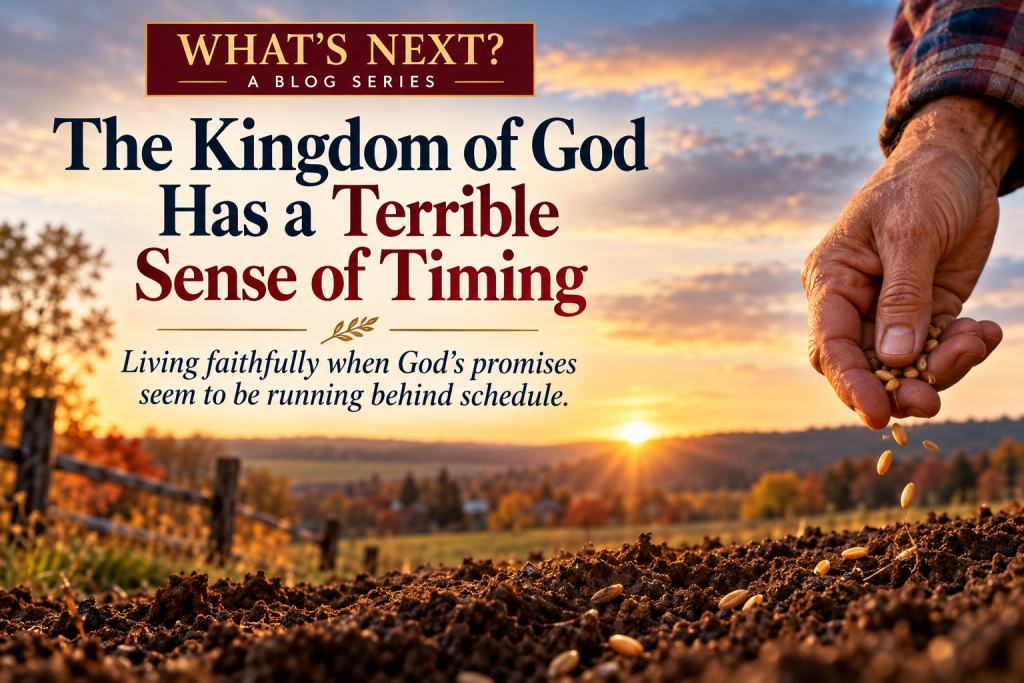
Living faithfully when God’s promises seem to be running behind schedule
There is a particular kind of frustration that comes from waiting for something that you have been assured is on its way.
Anyone who has ever waited for a tradesperson to arrive between eight in the morning and sometime before the Second Coming will know precisely what I mean.
You arrange your day. You make yourself available. You resist the temptation to begin anything that might require your attention elsewhere. And then, somewhere around four o’clock, you receive a cheerful telephone call explaining that there has been a slight delay.
Apparently, the word slight has a rather different meaning in the trades than it does in the rest of the English language.
I sometimes wonder whether the disciples felt something similar about the Kingdom of God.
Jesus had announced that the Kingdom was at hand. He had spoken of God’s reign breaking into the world. He had healed the sick, welcomed the outcast, forgiven sinners, and demonstrated that the old arrangements of power and privilege were being turned upside down.
Everything suggested that something extraordinary had begun.
And then Jesus was crucified.
And then, gloriously, he rose again.
And then he ascended into heaven.
And the disciples were left standing there, looking upwards, presumably wondering whether there might be a more detailed timetable available.
Two thousand years later, we are still waiting.
And, if we are being entirely candid, some of us are beginning to suspect that the heavenly scheduling department might benefit from a new computer system.
But perhaps the problem is not God’s timing.
Perhaps the problem is our understanding of what it means to wait.
The Kingdom Is Here. The Kingdom Is Coming. Both Are True.
One of the great theological tensions of Christianity is that we live between two extraordinary truths.
The Kingdom of God has already arrived in Jesus Christ.
And the Kingdom of God has not yet arrived in all its fullness.
Theologians call this the already and the not yet.
It is a wonderfully elegant expression for something that can be remarkably inconvenient to live with.
We believe that Christ has conquered death, and yet we still stand beside graves.
We believe that God’s peace has entered the world, and yet wars continue.
We proclaim that love is stronger than hatred, and yet hatred remains distressingly energetic.
We believe that justice belongs to God, and yet injustice seems to have secured a remarkably long-term lease on the premises.
The Kingdom has begun, but the world has not yet become what God intends it to be.
And that is precisely where we find ourselves living.
Not in the finished Kingdom.
Not in a world abandoned by God.
But in the middle of God’s ongoing work of redemption.
The difficulty, of course, is that most of us would prefer a completed project.
We like ribbon cuttings, grand openings, and the satisfaction of declaring that something is finally finished.
God, however, appears to be considerably more interested in transformation than in ceremonial completion.
And transformation takes time.
Particularly when human beings are involved.
We Are Not Waiting for God to Start Working
Here is something I think we Christians occasionally forget.
The fact that the Kingdom has not yet come in its fullness does not mean that God is sitting somewhere in heaven, waiting for the appropriate moment to begin.
God is already at work.
God is at work in the quiet courage of someone who chooses forgiveness when resentment would be easier.
God is at work in the hands of volunteers preparing a meal for neighbours who might otherwise eat alone.
God is at work when a frightened child discovers that someone will listen.
God is at work when a community refuses to surrender to division.
God is at work when people choose truth over convenience, compassion over indifference, and generosity over the comfortable accumulation of more than they need.
These are not merely pleasant human activities.
They are signs of the Kingdom.
Small, imperfect, sometimes barely noticeable signs.
But signs nonetheless.
Jesus compared the Kingdom to a mustard seed, a little yeast working through dough, and treasure hidden in a field.
None of these images suggests an enormous public relations campaign.
There are no brass bands, no elaborate banners, and certainly no committee tasked with selecting an appropriate commemorative plaque.
Instead, Jesus describes something that begins quietly and grows in ways that are not always immediately visible.
Which is both reassuring and rather annoying.
Because we would very much like to see the results.
Preferably by Thursday.
Faithfulness Is Not the Same as Immediate Success
One of the more dangerous habits we have developed in modern life is the assumption that anything worthwhile ought to produce measurable results almost immediately.
We want our efforts to be effective.
We want our investments to show returns.
We want our good intentions to produce visible improvements.
And, if possible, we would like a graph demonstrating steady upward progress.
Churches are certainly not immune to this temptation.
We count attendance, calculate budgets, measure participation, and examine statistics with the intensity of accountants attempting to locate a missing receipt.
There is nothing inherently wrong with responsible planning or careful stewardship.
But the Kingdom of God cannot be reduced to a quarterly performance report.
Some of the most important things God accomplishes in human lives will never appear in an annual report.
The lonely person who discovers friendship.
The grieving person who finds enough courage to face another morning.
The estranged family members who begin speaking again.
The exhausted caregiver who realizes that someone sees their sacrifice.
The person who has spent years believing themselves unworthy of love and finally begins to believe otherwise.
These things matter enormously.
But they are not always easy to count.
And sometimes they take years.
The Apostle Paul reminds the Galatians, “So let us not grow weary in doing what is right, for we will reap at harvest time, if we do not give up.” (Galatians 6:9)
Notice that Paul does not promise an immediate harvest.
He does not suggest that every act of kindness will be rewarded by Friday afternoon.
He simply tells us not to give up.
Because faithfulness matters even when the results remain hidden.
And because the harvest ultimately belongs to God.
The Difference Between Waiting and Doing Nothing
There is, of course, a significant difference between Christian waiting and simply sitting about hoping that God will eventually sort everything out.
I have occasionally encountered the theological equivalent of someone watching a leaking roof and announcing that the Lord will provide.
The Lord may indeed provide.
But it is entirely possible that the Lord has already provided a ladder, a hammer, and someone who knows how to use them.
Christian hope is not an excuse for inactivity.
It is the very reason we act.
We feed the hungry not because we imagine that one meal will eliminate hunger from the world, but because hunger has no rightful place in God’s Kingdom.
We work for peace not because we expect to resolve every conflict, but because reconciliation belongs to God’s future.
We welcome strangers not because hospitality is always convenient, but because there are no strangers at God’s table.
We care for creation not because our individual efforts can reverse every environmental injury, but because the earth belongs to God and has been entrusted to our care.
We practice mercy because mercy is the language of the Kingdom.
We practice generosity because abundance, not scarcity, is the promise of God’s reign.
We practice forgiveness because Christ has shown us that the future need not remain imprisoned by the past.
In other words, we do not wait for the Kingdom by withdrawing from the world.
We wait for the Kingdom by living as though its promises are already true.
Because, in Christ, they are.
Even if their fullness remains ahead of us.
A Kingdom That Grows While We Are Not Looking
There is a lovely little parable in Mark’s Gospel that does not always receive the attention it deserves.
Jesus says that the Kingdom of God is like someone scattering seed upon the ground.
The farmer sleeps and rises, night and day, and the seed sprouts and grows.
And then Jesus adds a wonderful observation:
“The earth produces of itself.” (Mark 4:28)
The farmer does not fully understand how it happens.
The farmer certainly cannot command the seed to grow faster.
The farmer can prepare the soil, scatter the seed, and tend the field.
But the mystery of growth lies beyond the farmer’s control.
I find that enormously comforting.
Particularly as someone who has spent much of his life in ministry.
There are sermons I have preached that I thought were rather good and which apparently had approximately the same lasting impact as a weather forecast from three weeks earlier.
And there have been conversations I barely remember that someone has later described as life-changing.
God has a remarkable habit of accomplishing important things without first seeking our approval of the method.
Sometimes the seed grows while we are sleeping.
Sometimes grace is working in places we cannot see.
Sometimes the most significant transformation begins long before anyone recognizes what is happening.
And sometimes we are simply called to be faithful gardeners.
Planting.
Watering.
Encouraging.
Trusting.
And resisting the temptation to dig up the seeds every twenty minutes to check whether they are making satisfactory progress.
The Last Days Before Advent
Here we are, then, on November 26.
Christ the King Sunday is behind us.
The First Sunday of Advent is just ahead.
The old Christian year has nearly run its course, and the new one is preparing to begin.
There is something wonderfully appropriate about spending these final days considering what it means to live in a Kingdom that is both present and still coming.
Because Advent will soon remind us that waiting is not an unfortunate interruption in the Christian life.
Waiting is part of the Christian life.
We wait for Christ.
We wait for justice.
We wait for healing.
We wait for the restoration of creation.
We wait for the day when every tear will be wiped away and death will be no more.
But we do not wait without hope.
And we do not wait without purpose.
Every act of compassion is a declaration that God’s future has already begun.
Every effort toward reconciliation is a refusal to allow division to have the final word.
Every moment of generosity is a small rebellion against the idea that selfishness is inevitable.
Every prayer for peace is an affirmation that violence does not possess ultimate authority.
And every time we choose love when fear would be easier, we participate in the life of the Kingdom.
Not perfectly.
Not completely.
But genuinely.
So, What’s Next?
Perhaps the question we ought to ask is not, “When will God finally finish the Kingdom?”
Perhaps the better question is, “What part of God’s Kingdom is asking to be lived through me today?”
It might be something quite small.
A telephone call that should have been made weeks ago.
A neighbour who needs a little kindness.
A difficult apology.
A willingness to listen rather than immediately offer an opinion.
An act of generosity that nobody else will ever know about.
A decision to keep working for something good, even when progress seems painfully slow.
None of these actions will make the evening news.
Most will not attract applause.
Some may not even be noticed.
But the Kingdom of God has never depended upon applause.
It depends upon the faithfulness of God.
And God, astonishingly, invites us to participate.
So perhaps we can stop worrying quite so much about the heavenly timetable.
The Kingdom is not late.
The Kingdom is growing.
Christ has already begun the work.
The Spirit continues to breathe life into places that seem barren.
And the future remains securely in God’s hands.
Our task is not to force the harvest.
Our task is to keep planting.
To keep loving.
To keep hoping.
To keep showing up.
Because the Kingdom of God is not merely something we are waiting to enter someday.
It is something we are being invited to live today.
And when the fullness of that Kingdom finally comes, I suspect we shall discover that many of the smallest acts of love were considerably more important than we ever imagined.
Although, given the divine approach to scheduling, I would not recommend trying to book a precise arrival time.
God seems quite determined to keep that particular appointment to himself.
And perhaps that is just as well.
After all, we have work to do in the meantime.
The Kingdom is already here. The Kingdom is still coming. And between those two great truths lies the extraordinary privilege of living faithfully today.
Follow along on Instagram @renewablespiritual for more daily reflections on faith, life, and the surprising places where God still loves to meet us.
Companion Prayer
Gracious God,
You have planted the seeds of your Kingdom among us, even when we cannot see them growing.
Give us patience when your promises seem distant, courage when the work feels unfinished, and faithfulness when our efforts seem small.
Teach us to trust your timing without neglecting the work you have entrusted to our hands.
May we plant kindness, nurture reconciliation, practise mercy, and live today as citizens of your coming Kingdom.
And when we grow impatient, remind us that your grace is always at work, even while we sleep.
Through Jesus Christ, our King and our hope.
Amen.