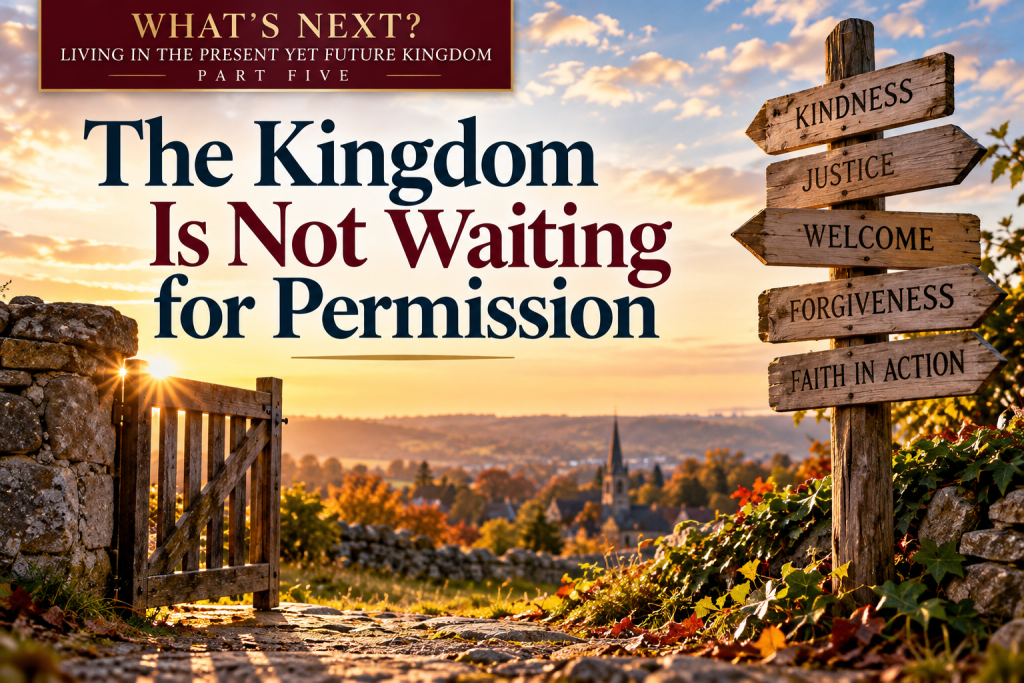
What’s Next? Living in the Present Yet Future Kingdom — Part Five Friday, November 27, 2026
There is a particular kind of human being who cannot begin anything without first obtaining permission.
You know the sort.
They will stand before a perfectly obvious task, perhaps a chair that needs moving or a lightbulb that needs changing, and immediately establish a committee to determine whether the matter falls within their jurisdiction. The committee will appoint a chairperson, who will recommend a feasibility study, which will eventually conclude that the chair should have been moved six months earlier.
By which time, of course, someone has tripped over it.
The Church, I regret to say, has occasionally demonstrated a remarkable talent for this sort of thing.
We have committees, councils, synods, working groups, advisory bodies, and occasionally advisory bodies established to advise other advisory bodies. I have spent enough years in ordained ministry to know that the Anglican Church can produce a forty-page report on the importance of simplicity, complete with appendices, footnotes, and a motion to receive it.
And yet, somewhere beneath our well-organized ecclesiastical enthusiasm, there remains a rather inconvenient truth.
Jesus never told us to wait until everything was properly arranged before we began living the Kingdom of God.
In fact, he seemed rather determined that we should begin immediately.
And that, I think, is worth considering as we approach the end of another Christian year.
The Curious Business of Living Between Two Sundays
Last Sunday, we celebrated Christ the King.
We proclaimed that Jesus Christ reigns over all creation, that his authority is greater than every earthly power, and that his Kingdom is not merely a pleasant religious idea but the ultimate reality toward which history is moving.
It was a magnificent proclamation.
There were hymns. There were prayers. There may even have been a procession, depending upon the enthusiasm of the clergy and the availability of people willing to carry things.
And then Monday arrived.
The dishes still needed washing. The bills still needed paying. Someone was still angry with someone else. The news continued to provide compelling evidence that humanity has not yet entirely mastered the art of loving its neighbour.
And we were left with the rather practical question:
If Christ is King, why does the world still look so remarkably unlike his Kingdom?
That question sits at the heart of these days between Christ the King Sunday and Advent.
We have proclaimed the reign of Christ.
We are preparing to enter a season of waiting for Christ.
But what exactly are we supposed to do in the meantime?
The answer, I suspect, is both simpler and considerably more demanding than we might wish.
We are supposed to live as though what we proclaimed on Sunday is actually true.
Not eventually.
Not once the world improves.
Not when everyone agrees.
Now.
The Kingdom Has Already Begun
One of the great theological tensions of Christianity is what scholars sometimes call the already and not yet of the Kingdom of God.
The Kingdom has already broken into human history through the life, death, and resurrection of Jesus Christ.
And yet its fullness remains ahead of us.
We live between promise and fulfilment.
Between resurrection and restoration.
Between the first coming of Christ and the glorious completion of all things in him.
But here is the important part.
The fact that the Kingdom has not yet arrived in its fullness does not mean that it is absent.
Jesus said, in Luke’s Gospel, that the Kingdom of God is among us.
He did not say that it was safely stored in heaven awaiting a convenient delivery date.
Nor did he suggest that we should spend the intervening centuries admiring the packaging.
The Kingdom is already at work wherever the character of Christ becomes visible in human life.
Where mercy interrupts cruelty.
Where forgiveness breaks the cycle of resentment.
Where the hungry are fed.
Where the lonely are welcomed.
Where justice is pursued without abandoning compassion.
Where the dignity of another human being is defended, even when doing so is inconvenient, unpopular, or unlikely to earn us an invitation to the next neighbourhood barbecue.
These are not merely nice things Christians do while waiting for the real Kingdom to arrive.
They are signs that the Kingdom has already begun.
And we have been invited to participate in its unfolding.
Jesus Was Not Particularly Interested in Our Excuses
There is something wonderfully unsettling about the ministry of Jesus.
He had an extraordinary ability to turn ordinary encounters into moments of divine possibility.
A hungry crowd became an opportunity for abundance.
A despised tax collector became a dinner companion.
A Samaritan woman became a witness.
A frightened group of disciples became the beginnings of a worldwide movement.
Jesus did not wait for ideal circumstances.
He worked with the people and circumstances before him.
This is especially inconvenient for those of us who prefer to have everything organized before taking the first step.
I confess that I rather like a plan.
After more than three decades of priestly ministry, I have developed a healthy appreciation for calendars, schedules, agendas, and the occasional strategically placed reminder.
But I have also learned that some of the most important moments of ministry have occurred when the carefully prepared schedule was interrupted.
A conversation that took longer than expected.
A person who appeared at the church door.
A telephone call that could not wait.
A hospital visit that became something far more significant than anyone anticipated.
An unexpected opportunity to offer kindness when kindness was desperately needed.
These moments rarely announce themselves as important.
They certainly do not arrive with a printed agenda.
And yet, looking back, I often discover that God was doing something quite extraordinary in what appeared at the time to be an ordinary interruption.
Perhaps this is one of the great challenges of living in the present Kingdom.
We must learn to recognize that God is not simply waiting for us at the end of history.
God is meeting us in the middle of Tuesday afternoon.
Usually when we are busy doing something else.
We Are Not Called to Build Heaven by Ourselves
Now, before anyone rushes out to reorganize civilization before lunch, a word of caution.
Christians are not responsible for manufacturing the Kingdom of God.
That would be an astonishingly ambitious assignment, particularly for a species that still struggles to agree on the proper way to load a dishwasher.
The Kingdom belongs to God.
Its ultimate fulfilment is God’s work, not ours.
We do not redeem the world through our own efforts. Christ has accomplished what we could never accomplish for ourselves.
But grace does not render us spectators.
It makes us participants.
The Apostle Paul describes us as God’s coworkers.
Not God’s replacements.
Not God’s supervisors.
And certainly not God’s consultants, presenting the Almighty with a five-year strategic plan and a modest invoice for professional services.
We are coworkers.
People invited to participate in the work of love that God has already begun.
That distinction matters.
If we believe the Kingdom depends entirely upon us, we will eventually become exhausted, anxious, and perhaps a little insufferable.
But if we believe that God is already at work, then our calling becomes one of faithful cooperation.
We look for where grace is moving.
And we join in.
Sometimes that means doing something dramatic.
More often, it means doing something small with extraordinary faithfulness.
The Revolution of Ordinary Kindness
I sometimes wonder whether we underestimate the revolutionary potential of ordinary Christian kindness.
We live in a culture that tends to measure significance through visibility.
Bigger audiences.
Greater influence.
More impressive achievements.
If something cannot be photographed, posted, shared, or converted into a measurable outcome, we are tempted to assume that it does not matter very much.
But the Kingdom of God operates according to a rather different accounting system.
A meal shared with someone who is lonely may carry more eternal significance than a thousand impressive speeches.
A quiet act of forgiveness may accomplish more for the healing of the world than an entire afternoon of righteous argument.
A child who discovers that the Church is a place where they are genuinely loved may carry that experience throughout a lifetime.
A community garden that feeds hungry neighbours may preach a more convincing sermon about God’s abundance than anything delivered from a pulpit.
And I say that as someone who has spent a considerable portion of his life standing in pulpits.
There is a certain occupational humility required in admitting that a tomato may occasionally be a better preacher than a priest.
But there it is.
The Kingdom does not always arrive with trumpets.
Sometimes it arrives in a casserole dish.
Sometimes in a hospital waiting room.
Sometimes in a conversation across a kitchen table.
Sometimes through the simple decision to treat another human being with dignity when the rest of the world seems determined to do otherwise.
These moments matter because they reveal something of the world God intends.
They offer a glimpse of the future breaking into the present.
Waiting Is Not the Same as Doing Nothing
In two days, we will enter Advent.
We will light the first candle.
We will hear again the ancient promises.
We will speak of watching, waiting, preparing, and hoping.
And there is a danger that we will misunderstand the whole business.
We may imagine that Christian waiting is a passive activity.
Something like sitting in a railway station, watching the clock, and wondering whether the train has been delayed.
But biblical waiting is never merely passive.
The prophets did not call God’s people to sit quietly until justice appeared.
They called them to practise justice.
John the Baptist did not tell the crowds to admire the possibility of repentance.
He told them to bear fruit worthy of repentance.
Jesus did not instruct his disciples to wait until the Kingdom was complete before loving their enemies, feeding the hungry, or caring for the vulnerable.
He told them to begin.
Advent waiting, properly understood, is active preparation.
It is the discipline of shaping our lives around the future God has promised.
We do not know when the fullness of the Kingdom will come.
But we know enough about its character to begin living toward it.
And that makes all the difference.
What Would Change If We Actually Believed It?
Here is a question worth carrying into the final days of this Christian year.
What would change in our lives if we genuinely believed that the Kingdom of God is already among us?
Not simply as a doctrine.
Not merely as something we affirm in the Creed.
But as a reality that shapes our ordinary decisions.
Would we be more generous with our time?
More patient with difficult people?
More courageous in confronting injustice?
More willing to forgive?
More attentive to those who are usually overlooked?
Would our churches become less concerned with preserving themselves and more committed to revealing Christ?
Would we measure success less by attendance figures, bank balances, and the condition of the church roof, and more by the depth of our love and the breadth of our welcome?
Mind you, the church roof still matters.
A congregation may be spiritually overflowing with grace, but if rainwater is dripping directly into the organ console, someone really ought to telephone the property committee.
Faithfulness does not require us to abandon common sense.
It requires us to remember what common sense is supposed to serve.
Our buildings, budgets, programmes, and traditions are not the Kingdom.
They are tools through which we may participate in its work.
And when we forget that distinction, we risk spending so much time maintaining the machinery of the Church that we lose sight of the mission of Christ.
The Kingdom Begins Again Tomorrow Morning
Perhaps the most encouraging truth about the present yet future Kingdom is that we do not have to wait for some extraordinary spiritual experience before participating in it.
We can begin tomorrow morning.
We can begin with the first person we encounter.
With the conversation we have been avoiding.
With the neighbour who needs help.
With the stranger who needs welcome.
With the person whose opinions we find almost impossibly irritating.
Indeed, especially with that person.
It is relatively easy to love humanity in the abstract.
Humanity, considered as a general concept, can be quite agreeable.
It is individual human beings who complicate matters.
They have opinions.
They make demands.
They interrupt our schedules.
They sometimes insist upon parking in precisely the place where we intended to park.
And yet these are the very people among whom Christ calls us to live his Kingdom.
Not an imaginary collection of perfectly agreeable neighbours.
These neighbours.
These families.
These communities.
This world.
With all its beauty, confusion, woundedness, and astonishing capacity for grace.
No Permission Required
As we approach Advent, perhaps we should resist the temptation to treat the Kingdom of God as something that begins only when the future finally arrives.
Christ has already been raised.
The Spirit has already been poured out.
The Church has already been commissioned.
The invitation has already been given.
We do not need to wait for another committee meeting to decide whether mercy is appropriate.
We do not need a formal motion before extending forgiveness.
We do not need permission to welcome the stranger, feed the hungry, speak truth, practise kindness, or love our neighbours.
These are not optional extras to the Christian life.
They are the life of the Kingdom taking shape among us.
And perhaps that is the great gift of these strange days between Christ the King and Advent.
They remind us that the future belongs to God, but the present has been entrusted to us.
Not so that we might control it.
Not so that we might perfect it through our own wisdom.
But so that we might fill it, as best we can, with the love of Christ.
The Kingdom is coming.
The Kingdom is already here.
And between those two glorious truths lies the whole adventure of Christian discipleship.
So tomorrow morning, when the sun rises and the ordinary business of life begins again, remember this:
We are not waiting for permission to live the Kingdom of God. We have already been given the invitation.
The question is whether we will accept it.
And if you happen to notice a chair sitting inconveniently in the middle of the hallway, for heaven’s sake, move it.
There is no need to establish a committee.
God’s Kingdom has work to do.
And so do we.
Follow along on Instagram @renewablespiritual for more daily reflections on faith, life, and the surprising places where God still loves to meet us.
Companion Prayer
Gracious and loving God,
You have already begun your Kingdom among us, yet we so often hesitate to live as though it were true.
Give us courage to act with compassion, generosity to serve without hesitation, and wisdom to recognize your presence in the ordinary moments of our lives.
Free us from the need for perfect circumstances, and teach us to become willing partners in your work of mercy, justice, and reconciliation.
May our lives reveal something of your coming Kingdom, not someday, but today.
Through Jesus Christ, our risen and reigning Lord.
Amen.