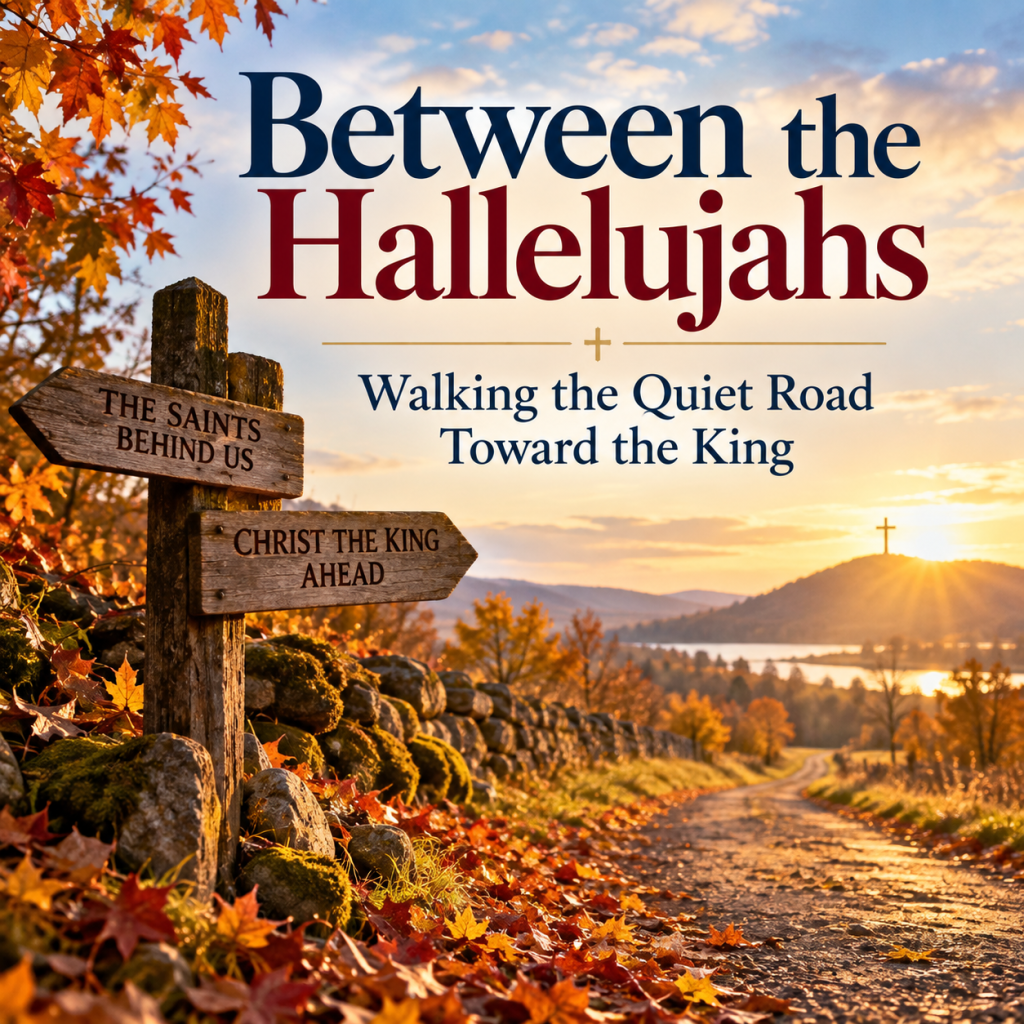
There are stretches of the Christian year when the calendar seems determined to keep us busy.
Saints appear almost daily. There are apostles and martyrs, bishops and reformers, mystics and missionaries, teachers and troublemakers. We have remembered All Saints and All Souls. We have stood among patriarchs and prophets, remembered the faithful departed, and listened again to the voices of those whose lives remind us that holiness has never been particularly tidy.
And then November 5 arrives.
No trumpets.
No procession.
No particularly dramatic saint waiting at the church door.
Just Thursday.
There is something rather wonderfully Anglican about that.
After all the saints have marched past, we straighten the hymn books, extinguish the extra candles, look around the church and discover that we are still here.
And now we walk on.
We have entered one of those little stretches of the Christian calendar that I have always found strangely beautiful. We stand between two great declarations of faith.
Behind us lies the season of saints: the great reminder that the Christian faith has been lived before us by generations of ordinary human beings who somehow managed, by grace, to become windows through which the light of Christ could shine.
Ahead of us waits Christ the King Sunday, when the Church will gather at the end of another liturgical year and make one enormous, stubborn proclamation:
Jesus Christ is Lord.
Between those two declarations lies ordinary time.
And perhaps that is exactly where most of Christianity happens.
The Spirituality of the Hallway
We tend to like destinations.
Human beings are remarkably fond of arriving.
We like Christmas morning, Easter Sunday, weddings, anniversaries, graduations and anything else involving cake. We are considerably less enthusiastic about the long stretches beforehand when somebody asks, “Are we there yet?”
The Church, however, keeps insisting that God is found along the road.
Abraham meets God while travelling.
Moses encounters God while wandering.
Israel learns about God in the wilderness.
The disciples discover Jesus while walking dusty roads between villages.
Paul seems to spend half the New Testament travelling somewhere, frequently by ship, despite mounting evidence that sailing was not his spiritual gift.
Christianity is full of people who have not yet arrived.
Which means Christianity is rather like the rest of life.
Most of us live somewhere between what has been and what will be.
Between the prayer answered and the prayer still waiting.
Between grief and healing.
Between certainty and understanding.
Between planting and harvest.
Between “Amen” and whatever comes next.
We live in the hallway.
And we often assume that the hallway is merely the place we pass through on the way to somewhere important.
God seems to disagree.
After the Saints
The saints we have remembered over these past days might tempt us to imagine holiness as something belonging to extraordinary people.
People in stained-glass windows.
People with feast days.
People who have churches named after them.
People who appear in icons looking remarkably calm despite having endured lives that were anything but.
But the great witness of the saints is not that extraordinary people occasionally become holy.
It is that ordinary people can become extraordinarily available to God.
That is rather different.
Holiness is not spiritual celebrity.
It is availability.
It is waking in the morning and saying, perhaps before coffee and therefore heroically:
“Here I am, Lord.”
It is choosing kindness when irritation would be easier.
It is forgiving when resentment feels justified.
It is telling the truth when silence would be safer.
It is noticing the lonely person.
Feeding the hungry neighbour.
Making room at the table.
Listening before speaking.
Praying when we have run out of impressive words.
Beginning again.
These things rarely make headlines.
They do, however, make saints.
Before the King
And now the Church begins turning our eyes toward the final Sunday of the year.
Christ the King.
It is an audacious feast.
We will proclaim Christ as King in a world crowded with people who would very much like the position.
Kings, presidents, prime ministers, billionaires, influencers, algorithms and occasionally parish committees all seem quite confident that civilization would improve considerably if everyone simply did what they suggested.
Then Jesus appears.
And his throne is a cross.
His crown is made of thorns.
His royal court includes criminals.
His constitution is the Beatitudes.
His economic policy seems suspiciously interested in feeding hungry people.
His immigration policy includes Samaritans.
His cabinet consists largely of fishermen who frequently misunderstand the briefing notes.
And his great commandment is love.
This is the King toward whom the Church is walking.
Which means these days between the saints and Christ the King are not empty days at all.
They are days for asking a dangerous question:
If Christ really is King, what would my life look like if I actually lived as though that were true?
Not merely believed it.
Lived it.
Faithfulness in November
November is rather good territory for such questions.
The leaves have mostly fallen.
Gardens have surrendered.
Daylight has become something of a limited-time offer.
The great blaze of October has faded into bare branches and grey afternoons.
Creation itself seems to become quieter.
And perhaps that is why November can teach us something.
When the leaves disappear, we finally see the branches.
When the celebrations quiet down, we begin to notice what remains.
Faith is not only what happens when the choir sings magnificently, the church is full, the candles are glowing and everyone remembers which Sunday it is.
Faith is also Tuesday morning.
Faith is washing dishes.
Faith is visiting someone who is lonely.
Faith is saying Morning Prayer when nobody else knows you did.
Faith is making soup for a neighbour.
Faith is admitting you were wrong.
Faith is giving thanks when the sky is grey.
Faith is trusting that bare branches are not dead simply because we cannot yet see the buds.
That may be the particular grace of these coming days.
Walking the In-Between
So over the next little while, I want to linger here.
Between the saints and the King.
Between memory and expectation.
Between the falling leaves and Advent candles.
We will think about the spirituality of ordinary days.
About waiting.
About faithfulness.
About endings.
About hope.
About the strange places grace appears when nothing particularly dramatic seems to be happening.
Because I have become increasingly convinced that God does some of God’s finest work in the spaces we are tempted to hurry through.
The saints have reminded us where we have come from.
Christ the King will remind us where history is going.
But today?
Today we walk.
And perhaps that is enough.
One foot in front of the other.
One prayer after another.
One small act of mercy.
One moment of courage.
One neighbour loved.
One forgiveness offered.
One ordinary day handed back to God.
The Kingdom of God, after all, may arrive with trumpets someday.
But most mornings it seems to arrive wearing sensible shoes.
So let us walk these November days together.
The saints are behind us cheering.
The King is ahead of us calling.
And Christ, as always, is beside us on the road.
Which turns out to be the best place of all.
Follow along on Instagram @renewablespiritual for more daily reflections on faith, life, and the surprising places where God still loves to meet us.
Companion Prayer
God of the journey,
you meet us not only at the great destinations,
but along the ordinary roads between them.
Teach us to recognize your grace in quiet days,
to practise faithfulness when no one is watching,
and to trust you when the way ahead is not yet clear.
Give us courage for the next step,
kindness for the neighbour beside us,
and hope enough to keep walking.
As we journey toward the reign of Christ our King,
help us live today as citizens of his Kingdom—
with mercy, generosity, justice, and love.
For you are behind us, before us, and beside us on the road.
Amen.