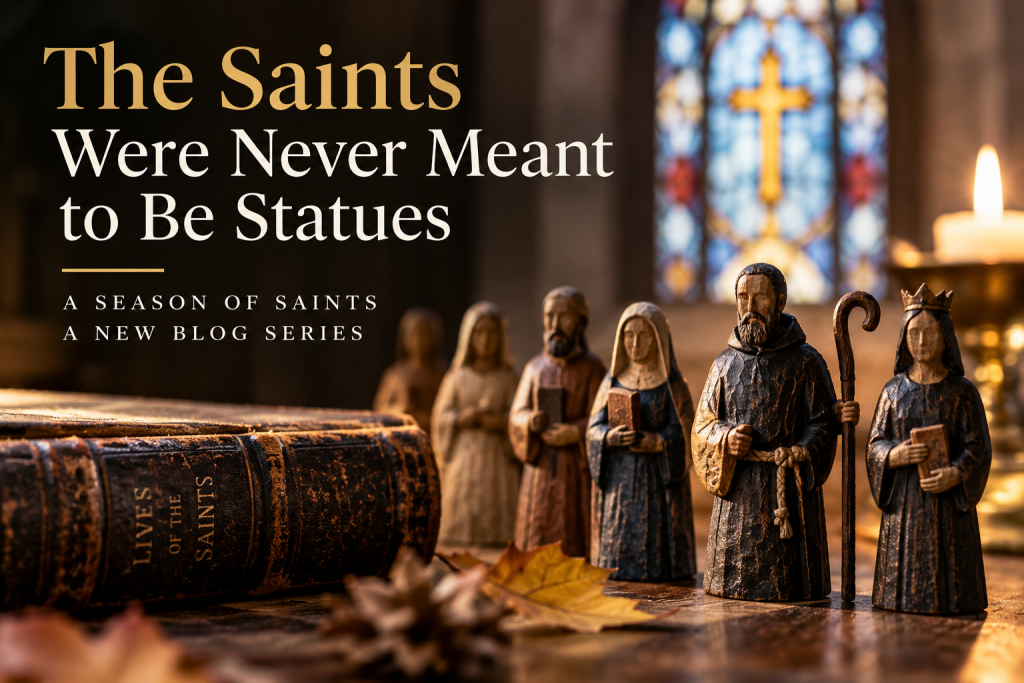
We are entering a season of saints.
Today the Church remembers John Wyclyf and Jan Hus, two reformers who discovered that suggesting the Church might occasionally need reforming is rather like suggesting at a family Christmas dinner that perhaps Grandmother’s gravy could use less salt. You may be perfectly correct. This does not necessarily mean anyone will thank you.
Tomorrow we remember the saints of the Reformation era. Then comes All Saints. Then All Souls. And through the days that follow, the Church’s calendar continues introducing us to this extraordinary collection of apostles, martyrs, teachers, reformers, mystics, bishops, missionaries, kings, queens, monks, nuns, troublemakers and assorted holy eccentrics whom we have come to call the saints.
So for the next little while, I want to spend some time with them.
But before we begin, perhaps we ought to clear up one rather persistent misunderstanding.
The saints were never meant to be statues.
Unfortunately, that is often what we have made of them.
We put them in stained glass. We carve them from stone. We give them halos. We paint them looking serenely toward heaven as though they had never once misplaced their spectacles, become irritated during a church meeting, wondered whether God had forgotten them, or said something at supper they immediately wished they could retrieve.
They look altogether too composed.
Real human beings are seldom that composed.
And the saints certainly weren’t.
Peter denied Jesus.
Thomas doubted.
Augustine spent years running from the God who was pursuing him.
Francis of Assisi scandalized his wealthy family.
Teresa of Ávila occasionally found the Church hierarchy rather trying—which, I suspect, may itself qualify as evidence of sanctity.
The saints argued. They struggled. They misunderstood. They failed. They repented. They started again.
And somewhere in the middle of all that very human confusion, grace got hold of them.
That is what makes them interesting.
Christianity does not teach that saints are a special species of human being. Saints are simply human beings who, in one way or another, allowed the grace of God to become visible through their lives.
Sometimes dramatically.
Usually quietly.
And almost always imperfectly.
That last word matters.
Imperfectly.
We sometimes imagine holiness as a kind of spiritual polishing process. If we pray enough, behave properly, read the right books and refrain from shouting at the driver who has just taken the parking space we were clearly waiting for, eventually God will buff away all our rough edges until we become spiritually respectable.
But the Gospel offers something much more interesting.
God does not wait until people are perfect before using them.
If God did, Scripture would be considerably shorter.
God calls Abraham, who lies.
Moses, who argues.
David, who fails spectacularly.
Peter, who promises too much.
Paul, who begins his career persecuting Christians.
Apparently God’s recruitment standards are wonderfully different from ours.
The story of the saints is therefore not primarily the story of exceptional human achievement.
It is the story of the persistence of God.
God keeps calling.
God keeps forgiving.
God keeps reshaping.
God keeps whispering into ordinary human lives:
Come. Follow me.
And sometimes, remarkably, someone does.
That is why we remember the saints.
Not because they were perfect Christians.
But because their lives became windows through which other people could glimpse Christ.
Some windows were clearer than others.
Some were decidedly cracked.
A few probably needed washing.
But the light came through.
And perhaps that is the invitation these coming days offer us.
We are not merely looking backward at interesting religious people who lived long ago.
The calendar of saints is asking a much more uncomfortable question:
What might the grace of God look like if it became visible through us?
Not through some improved future version of ourselves.
Not after we have solved all our problems.
Not when our faith becomes stronger, our prayers become deeper, our schedules become quieter, and we finally locate whatever mysterious drawer contains the instruction manual for adulthood.
Now.
Here.
In these lives.
Because sainthood is not about escaping ordinary life.
It is about discovering that ordinary life is precisely where holiness begins.
At kitchen tables.
In hospital rooms.
During difficult conversations.
While raising children.
While caring for aging parents.
While forgiving someone.
While admitting we were wrong.
While feeding someone who is hungry.
While standing beside someone who is frightened.
While speaking truth when silence would be easier.
While getting up tomorrow morning and trying, once again, to live like Jesus.
Most of it will never appear in stained glass.
Thank God.
There probably isn’t enough stained glass.
But perhaps the Church has never depended primarily upon famous saints anyway.
Perhaps it has always depended upon millions of unnamed ones.
People who prayed.
People who served.
People who forgave.
People who stayed.
People who loved.
People who quietly carried the light of Christ into one small corner of the world.
And that may be the most important thing to remember as we begin these days together.
The saints are not simply the holy people who came before us.
They are witnesses to what grace can still do with an ordinary human life.
Even yours.
Even mine.
Which is both wonderfully encouraging and, if we are paying attention, slightly alarming.
Because once we stop putting the saints safely on pedestals, we discover they have been pointing somewhere all along.
Toward Christ.
And then, rather inconveniently,
toward us.
Follow along on Instagram @renewablespiritual for more daily reflections on faith, life, and the surprising places where God still loves to meet us.
Companion Prayer
Gracious God,
thank you for the saints who have gone before us:
the courageous and the hesitant,
the famous and the forgotten,
the polished and the wonderfully unfinished.
Keep us from imagining that holiness belongs only to extraordinary people.
Take our ordinary lives,
our gifts and weaknesses,
our faith and questions,
and make them places where your grace can be seen.
Give us courage to follow Christ faithfully,
humility to begin again when we fail,
and love enough to carry your light
into our small corner of the world.
And when we wonder whether you could possibly use people like us,
remind us that you always have.
Amen.