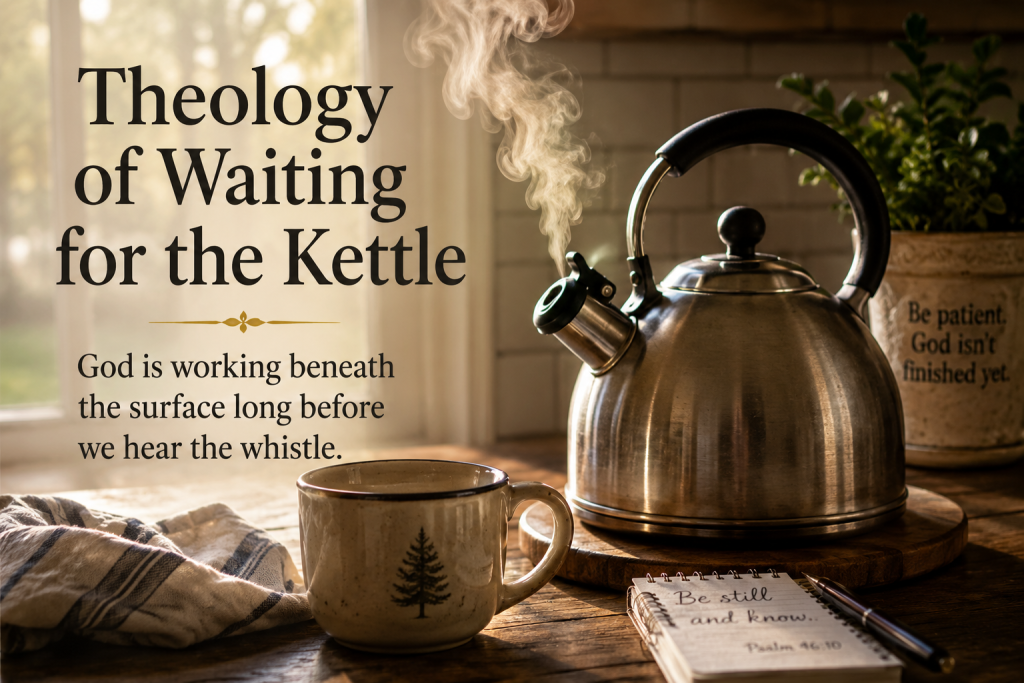
There are few sounds more hopeful than the quiet beginning of a kettle coming to life.
It begins almost imperceptibly. A faint hum. Then a gentle murmur. Eventually a confident rumble. Finally comes the triumphant whistle—or, in these modern and far less dramatic times, the reassuring click that announces tea is imminent.
The trouble, of course, is that we live in an age that has very little patience for kettles.
We have become a civilization of microwaves. Thirty seconds feels long. Computers are judged inadequate if a webpage takes four seconds to load. We stand in supermarket queues wondering why the person ahead of us has apparently decided to purchase every zucchini in Ontario. We tap our fingers at red traffic lights as though our impatience might somehow persuade the laws of physics to change.
Patience has become one of those virtues everyone admires—as long as someone else is practising it.
I confess I have never been particularly gifted in this department.
As a boy on our family farm in southern Ontario, waiting was simply woven into life. You could not hurry the corn. Wheat ignored your schedule. Cows were unimpressed by your watch. Even thunderstorms refused to arrive until they were quite ready.
The older farmers always seemed remarkably calm.
As a child, I assumed they possessed secret knowledge. Now I suspect they had simply spent enough years learning that the universe is entirely indifferent to our preferred timetable.
That lesson appears everywhere in Scripture.
Abraham waited decades for promises to become reality.
Israel waited generations for freedom.
The prophets waited through silence.
The disciples waited through Holy Saturday, believing every hope had died with Jesus.
Even after the Resurrection, Jesus told them to wait again before rushing into ministry.
Waiting, it seems, is not God’s way of wasting time.
It is God’s way of preparing people.
That truth is rather inconvenient because I much prefer efficiency to formation.
If I were writing salvation history, I would have shortened several chapters considerably.
Forty years in the wilderness? Perhaps four weekends.
Seventy years in exile? Maybe until Tuesday afternoon.
The Incarnation itself? Surely God could have accelerated the process.
Fortunately, I was not consulted.
The Kingdom of God appears to move at the speed of love rather than the speed of anxiety.
Love refuses to be rushed.
Friendships deepen slowly.
Trust grows over years.
Healing unfolds in stages.
Forgiveness often requires repeated decisions.
Faith itself matures much like an old oak tree—quietly, invisibly, and without asking our permission.
Perhaps that is why Jesus spent so much of his ministry simply walking.
He could have run.
Instead He walked from village to village, allowing interruptions to become appointments with grace.
Blind beggars delayed Him.
Children climbed onto His lap.
Curious tax collectors invited Him to dinner.
Desperate women touched His cloak.
Jesus never behaved as though compassion were an inconvenience.
Somewhere along the journey, we have confused urgency with importance.
Not everything that feels urgent is eternal.
The kettle teaches otherwise.
No amount of staring at it causes the water to boil faster.
Trust me. I have conducted this experiment extensively.
One eventually discovers that making another trip into the kitchen every twenty-three seconds contributes nothing whatsoever to the process.
The kettle remains gloriously indifferent to supervision.
Grace often behaves the same way.
God is working beneath the surface long before we hear the whistle.
The Holy Spirit is warming hearts while we imagine nothing is happening.
Prayers are being answered in ways we cannot yet recognize.
Character is being shaped while we are busy checking the clock.
That does not mean waiting is pleasant.
It rarely is.
Waiting for medical results.
Waiting for reconciliation.
Waiting for employment.
Waiting for grief to become gentler.
Waiting for clarity.
Waiting for hope to return.
These are holy but difficult seasons.
Yet Christians do not wait alone.
We wait with Emmanuel.
The God who entered time now accompanies us through every slow afternoon, every unanswered question, every ordinary Thursday when nothing appears to be changing.
And perhaps something is changing after all.
Perhaps the deepest miracle is not that God speeds up our lives.
Perhaps it is that God slows down our souls enough to notice His presence.
So this morning, while the kettle quietly prepares another cup of tea, I am reminded that discipleship has never been about arriving first.
It has always been about remaining faithful while the water is still warming.
Eventually the kettle clicks.
Eventually the tea is poured.
Eventually the waiting becomes part of the story we tell with gratitude.
And when that day comes, we may discover that God’s greatest work happened not after the waiting ended, but while we thought nothing at all was happening.
Follow along on Instagram @renewablespiritual for more daily reflections on faith, life, and the surprising places where God still loves to meet us.
Companion Prayer
Patient God,
When I grow restless and want life to move faster than Your wisdom allows, teach me to trust Your timing. Help me to remember that You are always at work, even when I cannot yet see the results. Give me a heart that waits with hope, serves with faithfulness, and finds joy in Your quiet presence.
In Jesus’ name I pray.
Amen.