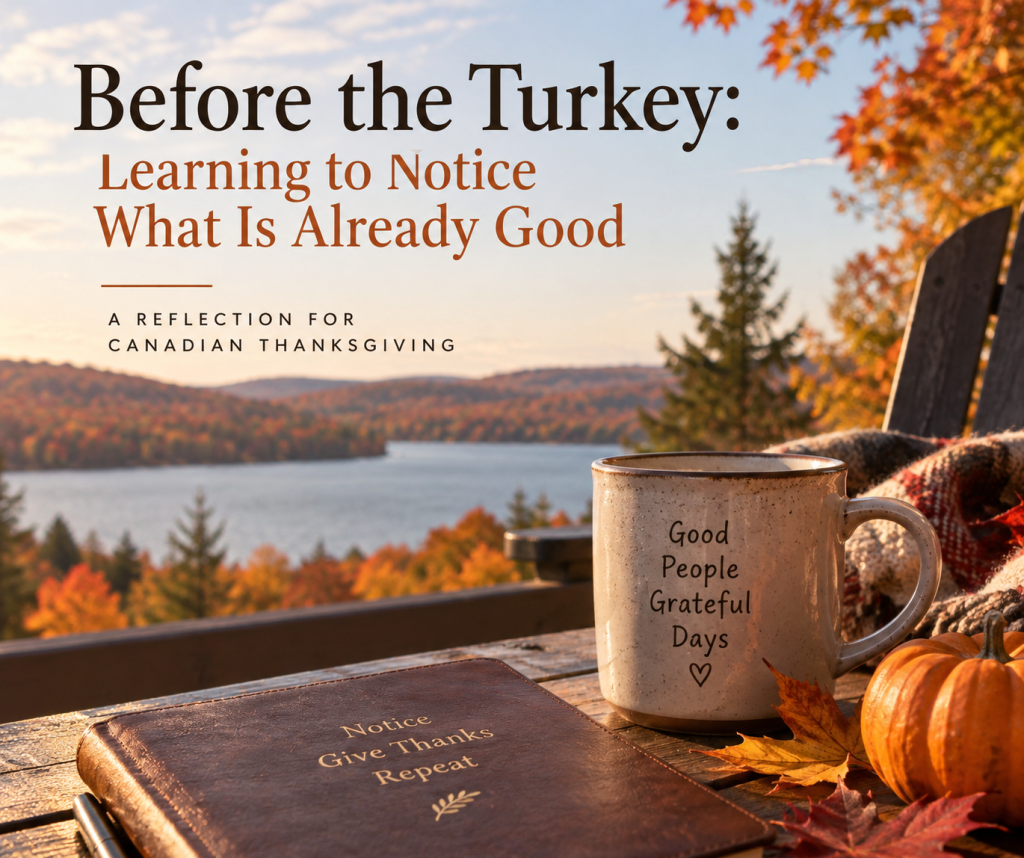
Canadian Thanksgiving is approaching, which means that somewhere across this great country a perfectly sensible family is already engaged in a serious theological dispute about stuffing.
Should it be cooked inside the turkey?
Should it be cooked separately?
Should it contain sausage?
Can gluten-free stuffing actually be called stuffing, or is it merely a collection of optimistic breadcrumbs?
These are questions upon which civilizations have probably fallen.
Thanksgiving has its traditions. There will be turkey and potatoes, pumpkin pie and cranberry sauce. There will be family gatherings where someone will inevitably bring up a subject everyone else had silently agreed not to discuss. There will be children who eat precisely one dinner roll and announce that they are full, only to discover a miraculous second stomach when dessert appears.
And somewhere, probably around two-thirty in the afternoon, someone will say, “We have so much to be thankful for.”
They will be right.
But I wonder whether thanksgiving begins much earlier than the dinner table.
Perhaps thanksgiving begins with noticing.
The Spiritual Discipline of Paying Attention
One of the great dangers of ordinary life is that it becomes ordinary.
We become accustomed to astonishing things.
The sun rises every morning with remarkable reliability, and most of us respond by checking our phones.
Trees spend the autumn turning themselves into spectacular works of art, and we drive past them wondering whether we remembered to buy milk.
Someone loves us.
Someone remembers our name.
Someone asks how we are doing and actually waits for the answer.
There is coffee.
These are not small things.
The trouble is that blessings have an unfortunate habit of becoming invisible when they become familiar.
Scripture repeatedly calls God’s people to remember.
“Give thanks to the Lord, for he is good.”
Remember.
Remember who brought you through the wilderness.
Remember who fed you.
Remember who carried you.
Remember who heard you when you cried.
Remember.
Not because God suffers from insecurity and requires constant compliments, but because we suffer from forgetfulness.
Gratitude restores our vision.
Thanksgiving Is Not Pretending
There is, however, a kind of thanksgiving that I find spiritually unhelpful.
It is the thanksgiving that insists everything is wonderful when everything clearly is not.
Sometimes life hurts.
Some Thanksgiving tables will have an empty chair this year.
Some families are carrying grief.
Some people are frightened about money.
Some relationships are strained.
Some prayers have apparently been sitting in God’s inbox considerably longer than we think reasonable.
Christian thanksgiving does not require us to pretend otherwise.
The Psalms certainly don’t.
The biblical writers were quite capable of saying, “God is good,” and, “This is terrible,” sometimes within remarkably close proximity.
Biblical gratitude is not denial.
It is defiance.
It looks directly at the brokenness of the world and still says:
This pain does not contain the whole truth about my life.
There is sorrow.
And there is grace.
There is uncertainty.
And there is love.
There are things I wish were different.
And there are gifts I would never willingly surrender.
Thanksgiving teaches us to hold both.
The Problem With “More”
We live in a culture extraordinarily skilled at teaching dissatisfaction.
Advertising depends upon it.
You were apparently doing reasonably well until you discovered that your refrigerator lacks Wi-Fi.
Your automobile is now three years old, which means it has somehow become a source of personal embarrassment.
Your telephone, which last year represented the pinnacle of human technological achievement, is presently considered an archaeological artifact.
There is always something newer.
Something faster.
Something larger.
Something you supposedly need.
The Gospel offers a wonderfully subversive alternative.
Before asking, “What else do I need?”
it invites us to ask,
“What have I already received?”
That question can change a life.
Grace Is Usually Wearing Work Clothes
We sometimes imagine blessings as dramatic interventions.
A miracle.
An unexpected cheque.
A spectacular answer to prayer.
And occasionally grace arrives with trumpets.
But most of the time grace appears wearing work clothes.
A friend phones.
A neighbour shovels the sidewalk.
Someone makes soup.
A nurse remembers your name.
A child reaches for your hand.
A congregation prays.
Someone laughs at exactly the moment you had forgotten how.
You wake up.
You breathe.
You begin again.
The Kingdom of God has always had a remarkable fondness for ordinary things: bread, wine, water, seeds, soil, tables, fishermen, conversations.
Perhaps this is because God knows something we frequently forget:
ordinary life is where most of our lives actually happen.
A Week of Thanksgiving
So during this coming week, before Thanksgiving arrives with its turkey, pie, football, dishes, relatives, leftovers, and the annual discovery that nobody owns a roasting pan large enough for the bird they purchased, I want to practise something.
I want to notice.
Not spectacular things.
Ordinary things.
Each day, I want to ask:
What is here today that I would miss if it were gone tomorrow?
That question may lead us somewhere holy.
The person sitting across the table.
The dog waiting at the door.
The old tree outside the window.
The congregation that knows our story.
The friend who keeps calling.
The body that still carries us through another day.
The food on the table.
The roof overhead.
The autumn air.
The ridiculous abundance of grace hiding in places we stopped noticing years ago.
Maybe thanksgiving is not something we manufacture.
Maybe it is something we discover.
Perhaps gratitude begins when we stop demanding that life become extraordinary long enough to recognize that ordinary life was already filled with gifts.
And perhaps that is our spiritual work this week.
Look around.
Pay attention.
Name what is good.
Say thank you.
Because grace has been here all along.
We simply became accustomed to seeing it.
And God, with infinite patience, keeps placing gifts in our path anyway.
Follow along on Instagram @renewablespiritual for more daily reflections on faith, life, and the surprising places where God still loves to meet us.
Gracious God,
slow us down enough to notice the gifts
we have become too accustomed to seeing.
Open our eyes to ordinary grace,
our hearts to unexpected goodness,
and our lives to the quiet abundance of your love.
Teach us to give thanks not because everything is perfect,
but because even here, you are present.
Make us grateful people.
Amen.
I am finding these thoughts so helpful today. Thank you for them.