The Sermon of the Squirrels – Creation’s Persistence and God’s Provision in Unlikely Teachers

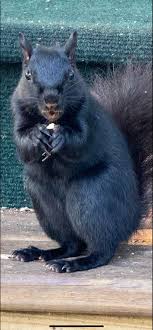
All through the year, I have a visitor that is regularly in attendance on my back deck. It is a black squirrel that I have often described as the fattest squirrel I have ever seen. My nephew doesn’t like it when I say that though, and says, “You shouldn’t fat shame that poor squirrel.” Putting that aside though, this squirrel is absolutely huge. I saw him on the deck again this morning, and in his quiet squirrelly way, he preached me a sermon.

Now, squirrels are not everyone’s favourite creatures. They chatter at us from the trees, dig up the flowerbeds, and seem to have a particular fondness for anything we’d rather keep safe — birdseed, tulip bulbs, and in my case, the occasional tomato. One could say that if there’s an Olympic medal for persistence, the squirrels have already won the gold.

I watched my little squirrel friend the other day. He was clearly determined to break into the bird feeder I had so carefully “squirrel-proofed.” (A phrase that I now realize belongs in the same category as “jumbo shrimp” or “honest politician.”) For a full ten minutes he tried every possible angle   — leaping, hanging upside down, even attempting what looked suspiciously like a three-point landing on the feeder. At last, with an acrobatic twist that would make a gymnast proud, he secured a single seed, scampered away, and then promptly came back for another.

As I watched him, I began to realize: there’s definitely a sermon here.

Jesus tells us in Matthew’s Gospel to “look at the birds of the air” and see how God provides for them. I wonder if He might also have said, “pay attention to the squirrels too.” For here is a creature that embodies persistence. The squirrel doesn’t give up at the first obstacle. He doesn’t stop because the feeder is designed against him. He keeps at it, trusting (or perhaps just instinctively knowing) that there will be something to eat if he just continues the work.

There is something profoundly theological in that. Our faith journey is often filled with obstacles  —  closed doors, difficult seasons, unanswered prayers. It is tempting to give up, to say, “this is too hard,” or “God must not be listening.” But the squirrel, in all his whiskered determination, reminds us that perseverance matters.

And more than that, the squirrel also trusts in abundance. He gathers acorns and buries them  —  so many that he cannot possibly find them all again. And yet, creation does not waste what he forgets. Those lost acorns become oak trees, spreading their branches wide, providing shade, shelter, and more acorns for generations of squirrels to come. God’s provision is not only enough  —  it overflows.

So perhaps the next time we see a squirrel darting across the lawn, or swinging wildly from a feeder, we can hear a little sermon preached to us. A sermon of persistence, of trust in provision, and of abundance that spills into blessing.

It seems even the squirrels have something to teach us about the Kingdom of God.

Amen.

Follow along on Instagram @renewablespiritual.

Companion Prayer

Gracious and abundant God,
you speak to us not only through prophets and preachers,
but through the small, persistent voices of your creation.
Teach us to see your lessons in unlikely teachers  —
in the chatter of squirrels, the patience of birds,
and the quiet rhythms of daily life.

Give us the perseverance to keep faith when the way is hard,
the trust to believe in your provision,
and the joy of knowing your abundance overflows
beyond what we can measure or imagine.

Through Christ our Lord,
Amen.

The Eschatology of Lost Socks – What Laundry Day Can Teach Us About the Kingdom of God

Dear reader, if you’ve known me for very long, you will know that I am very much a creature of habit. I like to structure my life with very set schedules and familiar patterns. In that familiar pattern, Saturday is Laundry Day; the day when the beds are stripped, and the towels are taken from the bathrooms and the kitchen to be laundered and returned fresh for another week. As I started that process, I began to see theology in that laundry.

There are few mysteries in life as profound and perplexing as the disappearance of socks. You put two in the washer, you take one out of the dryer. It’s not higher mathematics, but somehow the numbers never quite add up. Somewhere in the great spinning cosmos of laundry, socks are vanishing — into a parallel universe, a sock-sized black hole, or perhaps a secret society meeting behind the dryer lint trap.

Now, before you accuse me of stretching theology past its breaking point, hear me out. These small, silly mysteries of daily life can point us to the bigger mysteries of God’s Kingdom.

The Already and the Not Yet of Laundry

Theologians often describe the Kingdom of God as “already and not yet.” Christ has come, salvation is here, the Kingdom is breaking in — already. But the fullness of God’s reign, where all things are made whole, is still ahead of us — not yet.

In the same way, laundry day is an exercise in eschatology. We already have the basket full of clean clothes — folded, fresh, almost complete. And yet… the missing sock remains. We live in that tension: the drawer is almost whole, but not entirely.

It’s the same with the Kingdom. We taste it now in acts of mercy, justice, forgiveness, and grace. But we also live in longing for the day when all that is lost — whether socks, loved ones, or fractured hopes — will be gathered up by God’s love.

The Great Sock Reunion

Jesus tells parables of lost sheep, lost coins, lost sons. Each time, the story ends with rejoicing when what was lost is found. If Christ cares for lost sheep and coins, who’s to say the joy of the Kingdom doesn’t include a reunion with that elusive argyle sock?

Of course, the point isn’t laundry — it’s love. The Gospel tells us that God notices, God seeks, God gathers, and nothing is too small or too lost to be redeemed. Even in our own lives, where relationships fray, dreams unravel, or faith feels threadbare, God is weaving all things together.

Folding the Kingdom into Daily Life

So what does the eschatology of lost socks teach us? That our daily, ordinary tasks — yes, even folding laundry — can remind us of holy hope. Each time we sort and match, we can remember that God is sorting and mending the world. Each time we sigh at a single sock, we can remember that what feels incomplete now will one day be made whole.

And perhaps, in the Kingdom of God, there will be no mismatched socks at all — just a holy laundry line, where everything is paired, perfect, and dancing in the breeze of God’s Spirit.

Until then, dear friends, may even your laundry point you to the joy of God’s Kingdom — already here, but not yet complete.

Follow along on Instagram @renewablespiritual.

Prayer

Gracious God,
you gather what is scattered
and mend what is torn.
In the small frustrations of life—
even in the mystery of missing socks—
teach us to glimpse the greater mystery of your Kingdom.

When our lives feel incomplete,
remind us that you are weaving all things together.
When we are weary of searching,
assure us that nothing is ever lost to your love.

Give us patience in the “not yet,”
joy in the “already,”
and hope in the promise that all will be made whole
in Christ Jesus our Lord.

Amen.

The Theology of Dishes – Finding Holiness in the Sink Full of Suds

It happens in every household. The supper is finished, the conversation winds down, and then someone utters the fateful words: “Who’s doing the dishes?” Suddenly, chairs scrape back with remarkable speed, family members discover urgent tasks elsewhere, and the dog must be let out immediately — even if you don’t own a dog.

Yes, the dishes. That never-ending cycle of cups and plates, the great equalizer of domestic life. They pile up as surely as manna in the wilderness, except that unlike manna they do not vanish by morning. No, they are still there, stacked precariously in the sink, silently accusing you of neglect.

And yet — believe it or not — there is theology in the dishes.

Psalm 139 reminds us that God knows us in every place and at every moment. Not just in the pews on Sunday, but in the kitchen on Tuesday night. The God who formed the stars and knit us together in our mother’s womb is also the God who notices when we mutter over a greasy frying pan.

Doing the dishes is an act of service. It is not glamorous service, not the sort that earns you medals or even polite applause. But it is service nonetheless. Jesus knelt to wash the feet of his disciples — a menial, humble task — and told us to do likewise. I sometimes wonder if, in a modern retelling, it might be washing the supper dishes instead of washing the feet.

In my very first parish, I was blessed to serve alongside an amazing honorary assistant priest, Fr. Kent Gardiner — a man of deep humility and an incredible pastor. Each year at Vestry, someone would propose that since the parish held so many church suppers, we ought to install a commercial dishwasher in the kitchen. Kent would rise, clear his throat, and gently say, “I wouldn’t use the thing. Some of the best pastoral work I do is gathered with others in that kitchen, with our hands in soapy dishwater.” And he was as good as his word. After every church supper, there was Kent — apron on, sleeves rolled up — serving Christ and his community one plate and one pan at a time.

And here is the deeper truth: discipleship is not made up only of the grand gestures — those rare moments of heroic faith. It is also made up of countless small obediences, quiet acts of love repeated over and over. Like dishes, it never really ends. The Christian life is not one glorious triumph but a daily rhythm of choosing to serve, again and again.

So the next time you find yourself staring at a mountain of dishes, remember this: holiness may be hiding in the bubbles. The sink can become a sanctuary. And in the clatter of plates and the swish of the sponge, you just might hear the quiet voice of God saying, “Well done, good and faithful servant.”

Follow along on instagram @renewablespiritual.

A Prayer

Gracious God, teach us to see you not only in the great and shining moments of life, but also in the small and ordinary tasks that fill our days. May we find holiness even at the kitchen sink, and in every act of service, may we reflect the love of Christ. Amen.

Sacred Interruptions – When God Meets Us in the Moments We Didn’t Plan For

It gets really full really fast at this time of year…

Yesterday, I came into the office with a very specific list of things that I wanted to accomplish. The list wasn’t one that I would usually consider terribly long, but in my mind, every thing on that list was of crucial importance. But God it would seem, thought otherwise. Yesterday was a day filled with other distractions that derailed my plan almost entirely. Most of those “important tasks” are now on the to-do list for today. And do you know what? The world did not end.

We tend to live by calendars. Some of us are ruled by little squares on a wall calendar, others by a buzzing phone that interrupts us more often than we’d like. And of course, we are terribly proud of how busy those calendars look. I’ve often thought that clergy could take Olympic gold in the event of “calendar clutter.”

But then, along comes God — who, as it turns out, is not bound by iCal or Outlook. God has a habit of stepping into our lives when we least expect it, and certainly when we haven’t pencilled God in. Scripture is full of these “sacred interruptions.” Moses is minding his own business, tending sheep, when suddenly a bush starts burning and talking. Mary is making her plans for a simple village life when Gabriel knocks at the door. Saul is trotting along the Damascus road, intent on mischief, when he finds himself face-down in the dust. None of these were in the day-planner.

And yet, it is precisely in those interruptions that lives are changed and God’s purposes unfold.

Interruptions can be God’s way of slowing us down to notice God’s gift of grace.

We don’t usually welcome interruptions. They break the rhythm, they delay the task, they derail the plan. But sometimes it’s in the missed bus, the unexpected visitor, the phone call at the wrong time, that God does some of God’s best work. One of the saints of our Anglican tradition once said that interruptions are not obstacles to ministry — they are the ministry.

Now, I don’t mean to suggest that every traffic jam is a burning bush or that every telemarketer is Gabriel in disguise. But I do believe that God often meets us in the unscheduled moments: the child who needs our attention when we’re trying to finish an email, the neighbour who drops by just as we’re putting on our shoes, the quiet nudge in prayer when we’d rather be planning our week. These are opportunities to remember that the world does not, in fact, revolve around our calendar — but around God’s grace.

So perhaps the invitation today is this: instead of seeing interruptions as enemies of productivity, we might receive them as holy moments in disguise. Who knows? The person tugging at your sleeve may be the very one God is sending to bless you — or to be blessed by you.

And if that thought doesn’t lighten your schedule, at least it may lighten your heart.

Follow along on Instagram @renewablespiritual.

A Prayer

Gracious God, thank you for meeting us in the interruptions of our lives. Give us eyes to see your hand at work in the unexpected, patience to receive what we did not plan, and joy in the holy surprises of each day. Through Jesus Christ our Lord. Amen.

The Ministry of Laughter – Why Joy is as Holy as Silence

Enjoy a good laugh today…

Dear reader, I have long cherished the quiet moments of prayer, when the silence itself seems to hum with the presence of God. But lately, I’ve also found myself thinking about another kind of prayerful sound: the hearty belly laugh. If silence is the hymn of the contemplative soul, then surely laughter is the psalm of joy — sometimes slightly off-key, but all the more beautiful for it.

I don’t know when we got the idea that holiness always comes with a serious face. Somewhere along the way, Christians began to think that God’s business was best conducted with furrowed brows and pursed lips, as though Jesus came not so much that our joy may be full, but that our frowns may be perfected. And yet, in the gospels, we find a Christ who brings feasts, banquets, and celebrations. The kingdom of heaven, after all, is described more like a wedding reception than a board meeting.

Laughter, I think, is a ministry in its own right. It lifts the weary heart, eases the load of a heavy day, and bridges the distance between strangers. A well-timed laugh has healed more wounds than a thousand sermons — though, I assure you, we clergy keep valiantly trying with both.

I recall once, after a particularly chaotic parish dinner, someone said to me, “Father, I don’t think I’ve laughed that hard in months.” And there it was: holiness. Not in a hushed chapel, but in the clatter of dishes, spilled gravy, and the sound of friends roaring with laughter until tears came. That night, joy was the sacrament we all shared, and the Spirit was unmistakably present — even if the potatoes were overcooked.

The Book of Proverbs reminds us: “A cheerful heart is a good medicine, but a downcast spirit dries up the bones.” Medicine, indeed. The laughter of a child, the chuckle of a grandparent, the snort in the middle of a solemn hymn (though hopefully not from the choir) — these are not distractions from holiness, but reminders of it. They are glimpses of the joy that is at the heart of God’s creation.

So yes, silence will always have its sacred place. But do not underestimate the ministry of laughter. Sometimes the holiest thing we can do is to laugh until our sides ache — and in that moment, we may find ourselves closer to God than we ever imagined.

And, dear reader, if you happen to laugh at yourself along the way, consider it an advanced course in humility. I’ve been enrolled in that course for quite some time now.

Follow along on Instagram @renewablespiritual.

A Prayer for Holy Joy

Gracious God,
You are the giver of joy and the source of every good laugh.
Thank You for the gift of laughter that lightens our burdens,
for the smiles that knit us together in friendship,
and for the joy that points us back to You.

Teach us to cherish holy silence,
but also to celebrate holy laughter —
to know that both are sacraments of Your love.
When life feels heavy, lift our spirits with joy.
When our hearts are weary, remind us that
a cheerful heart is Your good medicine.

May our lives ring with the sound of both prayer and laughter,
until the day when we join in the eternal chorus of joy
around Your heavenly banquet table.

Through Christ our Lord. Amen.

The Ministry of Coffee: On how a morning cup can be as sacramental as it is caffeinated

Dear reader, as I sit this morning with my first steaming cup of coffee, I am reminded once again that God’s grace often comes to us in the most ordinary of ways. Coffee is, for me at least, one of those small but daily sacraments of life. It is not (before anyone calls the Bishop) one of the seven great sacraments of the Church, but it is nonetheless a sign, a token, and a gift of grace. That first sip, when the aroma fills the air and the warmth passes through you — well, let’s just say that more than once I’ve whispered Deo gratias before I’ve managed even my morning prayers.

I sometimes think that the Lord, in creating beans, must have had coffee in mind all along. And when someone first figured out that roasted beans, ground fine and steeped in hot water, could produce this holy elixir — surely angels sang. Some people find God in the sunrise; I, too, find God there, but with a mug in my hand.

Of course, there is humour in all of this. I’ve often remarked that the most theologically charged moment of a parish Sunday is not always the sermon or even the hymns — but the line at the coffee urn after worship. Coffee hour, I have long believed, is the eighth sacrament of Anglicanism. Conversations deepen there, friendships are renewed, the lonely find companions, and someone always discovers that the last cookie has been taken (and offers forgiveness anyway). It is in those simple cups poured and shared that community takes shape.

I am reminded, too, of the Emmaus story. The disciples didn’t recognize Jesus on the road, but when He broke the bread, their eyes were opened. I often think He could just as easily have offered them a cup of coffee and had the same effect. Sharing a cup, breaking bread — they are both reminders of the presence of Christ among us, hidden in the ordinary, revealed in love.

So, dear friends, I encourage you to think of your morning coffee (or tea, or whatever warms your heart) as more than just a necessity for getting the eyelids open. Think of it as a small sacramental act, a reminder that God meets us in the daily and the ordinary, in mugs and moments, as much as in chalices and cathedrals.

Now, if you’ll excuse me, I believe the Kingdom of God is calling from the kitchen — in the form of a second cup.

Follow along on Instagram @renewablespiritual

A Prayer Before Coffee

Gracious God,
You meet us in the simplest gifts of daily life.
Bless this cup before me —
that its warmth may steady my spirit,
its strength may ready me for service,
and its aroma remind me that joy is found in small, holy things.

May this morning’s coffee be a token of Your grace,
sustaining me in patience, kindness, and love.
And if it also helps keep my eyes open during Morning Prayer,
well, Lord, You know my frame, and You understand.

Through Jesus Christ, who breaks bread with us,
and would surely share a cup as well.
Amen.

Grace Before Coffee

Lord of life and early mornings,
we thank You for this holy brew.
May it wake our hearts as much as our minds,
warm our fellowship, and keep us kind.

Bless the hands that prepared it,
the friends who share it,
and grant that no one spill on the church carpet.

Amen.

The Camino Continues: How Pilgrimage Never Really Ends

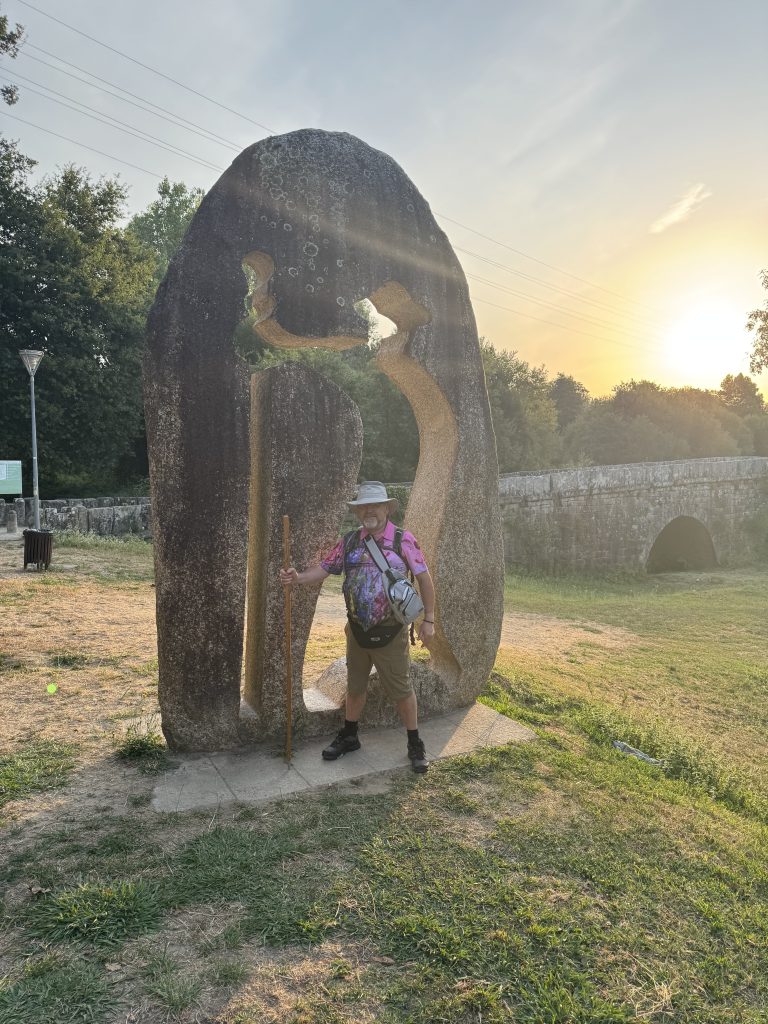
Standing at the Stone Pilgrim just outside Tui, Spain.

Well, dear reader, my boots may be back in the front closet and my pack tucked away on its shelf, but I have come to realize that the Camino is not something you simply finish. Like a particularly catchy hymn that won’t leave your head (I’m looking at you, All Glory, Laud, and Honour), the Camino lingers. It moves into the rhythms of daily life.

Walking through Spain, I learned that pilgrimage is about more than the destination. It is about the road beneath your feet, the people you meet along the way, and the God who walks with you whether you’re crossing a medieval bridge or just the supermarket parking lot. Now that I’m home, I see the same truth: pilgrimage never really ends — it simply changes scenery.

There’s a temptation to think of life as divided neatly into “holy” moments and “ordinary” ones, as though God were only present in a cathedral in Spain, half a world away, and not in my local hardware store. But the Camino teaches us otherwise. The Spirit of God is just as present in the slow line at the grocery checkout as in the hushed silence of a chapel. (Though, in fairness, both can feel equally penitential at times.)

One thing that struck me on the Camino was how each day had its mix of delight and difficulty. Some stages were breathtakingly beautiful; others seemed to be made entirely of blister-inducing cobblestones. Isn’t that life? One day is filled with laughter and grace, another with tears or frustration. Yet in both, Christ is present. The pilgrimage of daily life is no less holy than the walk across Spain — if anything, it is the real work of faith, where love, patience, and trust are put to the test in small, hidden ways.

I remember one evening on the Camino when David and I toasted our fathers with a small dram of Scotch. That moment, as simple as it was, felt sacramental — an earthly act suffused with heavenly grace. At home, I’ve begun to notice how even a quiet walk around the block, can carry that same weight of holiness. Pilgrimage does not stop; it simply finds new routes through the ordinary fabric of our lives.

So today, I give thanks for the road beneath my feet, whatever shape it takes. Whether it’s cobblestones in Spain, the sidewalks of my neighbourhood, or the carpet in my office, all of it is Camino. All of it is life lived in the company of Christ, and in the cloud of saints who walk with us still.

And if, dear reader, you happen to hear me humming “He Who Would Valiant Be” while working, just know — it’s all part of the journey.

Follow along on Instagram @renewablespiritual.

Prayer

Gracious God,
you call us to walk each day in the light of your presence.
Thank you for the pilgrim paths of our lives—
the sacred roads, the ordinary sidewalks,
and even the winding detours that test our patience.
Help us to see that every step is holy
when it is taken with you.
Grant us eyes to notice your grace in small moments,
ears to hear your Spirit in the everyday,
and hearts to trust that the journey never ends—
it only deepens in your love.

Through Jesus Christ, our faithful companion on the way.
Amen.

And if, along the way, I should forget that every step is holy, Lord, kindly remind me — perhaps before I trip over the cat or discover that I’ve been on pilgrimage all along to the kitchen fridge.

The Joy of the Sunday Post-Liturgical Nap

Dear reader, it happened again this week. I had carved out a day with a to-do list as long as my arm — laundry, phone calls, perhaps even the noble attempt to conquer the dust bunnies that seem to breed in dark corners when I’m away. Instead, sometime after lunch, I sat down in my chair for “just a minute” of rest. You already know what happened. When I opened my eyes, an hour had disappeared, and the to-do list was still leering at me.

Enjoy your labour Day day of rest, Dear Reader

Now, in a world obsessed with productivity, I could have berated myself for laziness. But instead, I thought of Walter Brueggemann’s reminder that the Sabbath itself is an act of resistance. When ancient Israel kept Sabbath, they were proclaiming to Pharaoh, “We are not slaves anymore.” They were saying, “Our worth is not in endless bricks or bottomless quotas. Our worth is in the God who rested on the seventh day.” To nap in the middle of a busy day is not only self-care — it is a tiny rebellion against the idol of busyness.

Above all, I am a firm believer in the Sunday post-liturgical nap. Many of you know that I am a strong introvert. There are few things that introverts find more exhausting than being in very public settings — much less being the one leading those public settings. As much as I love parish ministry, and as a liturgist, I dearly love the liturgy, Sundays are exhausting. After the last hymn fades and the final parishioner has left the building, my soul begins to long for that quiet recliner or couch that awaits me at home. The post-liturgical nap is not laziness. It is spiritual survival. It is the space where I can breathe deeply, reset, and remember that God is God — and I am not.

Jesus himself modelled this. He napped in the boat while the disciples panicked at the storm. (I’m not sure my snoring is as holy as his was, but the principle still stands.) And he reminded us that “the Sabbath was made for humankind, not humankind for the Sabbath” — in other words, God’s gift of rest was never meant to be another burden, but a delight.

We often imagine holiness as tireless labour: praying without ceasing, working without faltering, serving without resting. But sometimes, holiness looks suspiciously like a Sunday afternoon nap. It is the reminder that we are creatures, not machines; that God runs the universe just fine without our constant supervision; that our value does not depend on what we accomplish.

Of course, not every nap feels holy. Some of mine look suspiciously like the escape tactics of a procrastinator. (Stephen Leacock once said, “I am a great believer in luck, and I find the harder I work, the more I have of it.” I, on the other hand, find the more I nap, the more the chores pile up — but that’s another sermon.) Still, when our rest is claimed as God’s gift, it becomes more than avoidance — it becomes worship.

So, dear reader, the next time you feel guilty for closing your eyes when the world clamours for productivity, remember this: to nap in faith is to say, “I am not Pharaoh’s slave. I am God’s beloved.” The holiest thing you may do this week might just be to close your eyes, take a deep breath, and trust that God holds the world — even while you nap.

Follow along on Instagram @renewablespiritual.

Prayer for Rest and Renewal

Gracious God,
you created us for work and for rest,
for service and for stillness.
Teach us to receive Sabbath as your gift,
and to trust that the world rests safely in your hands.
Bless our naps, our pauses, and our moments of quiet,
that in them we may be restored to love you more deeply
and to serve others with joy.
Through Jesus Christ, who slept in the boat
and rose to calm the storm.
Amen.

Golf and the Gospel: What My Short Game Teaches Me About Patience, Humility, and the Kingdom of God

Dear reader, yesterday I was invited for a round of golf in the couples’ group that my friends have every Friday afternoon. Now, I know what you’re thinking: “But Padre, you are single!” Quite right. My appearance in a couples’ group may seem a little odd, but I usually get called in as the emergency substitute when someone’s partner is unavailable — sort of the “designated hitter” of the golf course. Each week our friend Ron invents a little side game to make the round interesting for golfers of all levels. This week he unveiled what he called “Poor Man’s Golf.” In this curious version, we were only allowed to use a putter, a nine iron, and a seven iron. The rest of our expensive collection of clubs had to remain at home, mocking us silently from their bags. It meant, of course, that the entire round was basically a study in one thing: the short game.

Ready for that tee shot

Now, my short game is… well, a theological exercise in humility. I can manage a respectable drive, and most days I can keep up in the fairway. But when I’m forced to rely on those little touch shots around the green, I discover that physics has a wicked sense of humour. My chip either dribbles a polite three feet, as if apologizing for disturbing the turf, or else rockets across the green like it has somewhere better to be. My companions, kind souls, always say, “Take your time.” But I was taking my time — that was the problem!

And yet, as I stood there watching the ball do everything but what I intended, I found myself learning again about patience. The Gospel, too, is full of calls to patience — with ourselves, with others, and with God. Growth, like a good chip shot, rarely comes on the first attempt. It comes slowly, with practice, with perseverance, and with a fair bit of laughter at ourselves along the way.

Golf, in its own mischievous way, also teaches humility. Just when you’re feeling a bit smug after a long straight drive, the game offers a reminder: a shank into the rough or a sand trap you didn’t even see coming. Ministry is like that too — we’re given moments of success, but we’re also constantly reminded that we are human, not divine. The Gospel tells us our worth doesn’t come from flawless performance but from being loved by God, who knows our weaknesses and still delights in us.

And then comes grace — golf’s greatest sermon illustration. The “mulligan.” That blessed second chance. Undeserved, unearned, yet generously given. It’s the Gospel in miniature. Life with God is full of mulligans: second chances, fresh starts, and the freedom to try again without fear.

So yes, “Poor Man’s Golf” revealed what I already knew: my short game needs a lot of work. But it also reminded me of the deeper truths of faith: that patience is a virtue to be practised, humility is a gift to be received, and grace is the greatest mulligan of all. And if, on occasion, my seven iron behaves like a broom handle and the ball like a wayward comet — well, perhaps the Kingdom of God is closer than I thought.

Fore!

Follow along on Instagram @renewablespiritual.

Prayer for Patience and Humility on the Course of Life

Loving God,
you teach us patience in every swing,
and humility in every missed shot.
Help us to see the fairways and roughs of life
as places where your grace meets us.
Keep us steady when our aim is poor,
and grateful when the ball rolls true.
May our whole game — short or long —
be played in the light of your Kingdom.
Through Jesus Christ, our guide and companion.
Amen.

Returning to the Patterns I Love

Vacation is over. It’s time to get back to Church!!

Well, dear reader, this last week of vacation seems to have slipped through my fingers like sand at the beach—or perhaps more like the last cookie on a plate, where you’re not entirely sure who ate it, but you strongly suspect it was you. Next week, I return to work, and truth be told, there’s a part of me that looks forward to it.

Monday will mark 32 years since I began my first ministry as Rector of St. Thomas the Apostle and St. David’s in Cambridge. Thirty-two! That’s an awfully large number of candles for a pastoral cake. In fact, if we lit that many at once, I suspect the fire department might feel compelled to attend the party.

But behind the humour lies a deeper truth: these 32 years have not simply been a “job.” They’ve been a way of life. The patterns of prayer, preaching, and pastoral care are so deeply ingrained that they shape not only what I do, but who I am. Some of those patterns, of course, never stopped during vacation. I continued to pray the Daily Office, morning and night, and found myself reflecting theologically on the readings of each day. One does not really “switch off” being a parish priest, any more than one can take a vacation from breathing.

Still, there is something about re-entering the full rhythm of parish life that fills me with joy. To see the familiar faces of the congregation once more, to hear their stories from the weeks I’ve been away, and to join voices together in worship — it feels a little like coming home after a long journey. The truth is, I love the work of ministry. It is what I have been called to do, and, after three decades, I cannot imagine living any other way.

So as vacation draws to a close, I don’t step forward with dread or reluctance, but rather with gratitude and a quiet excitement. God has been faithful in these 32 years of ministry, and I trust that God will continue to be faithful in the days to come. And that, dear reader, is worth far more than any extra week of holiday — though, to be perfectly honest, I wouldn’t say no if someone offered me one.

Follow along on Instagram @renewablespiritual.

A Prayer of Thanksgiving

Gracious and faithful God,
for these 32 years of ministry, I give you thanks.
For the privilege of proclaiming your Word,
for the joy of sharing in your sacraments,
for the gift of walking with your people in times of sorrow and celebration—
I praise you.

As I step forward into the days ahead,
grant me strength where I am weary,
joy where I am burdened,
and above all, a heart ever open to your Spirit.
May all that has been begun, continued, and ended in you
bring glory to your holy Name;
through Jesus Christ our Lord. Amen.