When Love Becomes Extravagant

Holy Week begins not with thunder, but with perfume.

Which is not, if we are being honest, how most of us would organize the week that will change the history of the world.

The Gospel often gives us the scene in Bethany on this Monday. Jesus is at supper. Lazarus — recently returned from the dead and still probably adjusting to the experience — is at the table. Martha is serving, which will surprise absolutely no one familiar with Martha.

And Mary does something startling.

She takes a jar of perfume — expensive perfume — and pours it over Jesus’ feet.

Not a modest amount. Not a polite symbolic dab. The Gospel makes it clear: the whole jar.

The house fills with the fragrance.

Now, if you have ever watched someone open a very expensive bottle of anything and pour it out all at once, you will understand the reaction that follows.

Judas, representing the department of practical concerns, raises a perfectly sensible objection: “Why was this perfume not sold and the money given to the poor?”

It is the sort of comment that sounds extremely responsible.

Which makes it slightly awkward that Jesus immediately defends Mary.

Because what Mary does is not efficient.

It is extravagant.

Holy Week begins with this strange reminder: love does not always operate on a spreadsheet.

Mary sees something others do not yet fully grasp. She senses what is coming. The cross is near. The time for quiet gratitude is almost gone.

So she does something beautiful while there is still time.

There is a particular courage in that.

We often postpone acts of love until circumstances become clearer. Until we feel ready. Until the calendar settles down. Until the moment seems perfectly appropriate.

But Mary understands something we frequently forget: the moment for love is always now.

Her act is not wasteful. It is prophetic.

She anoints Jesus before the burial that will soon come.

The fragrance fills the house.

It is a beautiful image for Holy Week. One act of devotion altering the entire atmosphere.

And perhaps that is where this Monday speaks gently to us.

What fragrance does our life leave behind?

Not the scent of expensive perfume, perhaps — though the altar guild might appreciate the suggestion — but the fragrance of kindness. Generosity. Courage. Gratitude.

Extravagant love may not be efficient, but it is unforgettable.

Mary does not give a speech. She does not organize a campaign. She pours out what she has.

And the house is changed.

Holy Week begins with that invitation: do not wait for the perfect moment to love well.

Pour out the jar.

Companion Prayer

Lord Jesus,
You receive our offerings
not by their size
but by the love within them.

Teach us Mary’s courage —
to give generously,
to love freely,
and to recognize your presence
before the moment passes.

Let the fragrance of grace
fill the spaces where we live.

And help us pour out our lives
in devotion to you.

Amen.

The Most Confusing Parade in History

Palm Sunday may be the only parade in history where almost everyone misunderstands what they are celebrating.

The crowd is enthusiastic. Palms are waving. Cloaks are being thrown on the road with impressive spontaneity. People are shouting Hosanna! with the kind of volume usually reserved for playoff hockey.

And at the center of it all rides Jesus.

On a donkey.

Now, if one were designing a royal entrance into a major city, one might choose something slightly more imposing — perhaps a war horse, a chariot, or at the very least a well-polished camel. But Jesus arrives on what can only be described as the most humble form of transportation available.

This is not accidental.

Palm Sunday is the Gospel’s way of telling us that the kingdom of God rarely arrives the way we expect.

The crowd believes they are welcoming a political hero. A liberator. Someone who will finally straighten out the Romans, reorganize the religious establishment, and generally make everything run more efficiently.

It is the sort of expectation that would make most parish councils nod approvingly.

But Jesus is not entering Jerusalem to seize power.

He is entering Jerusalem to give himself away.

The palms wave for victory. The people cheer for triumph. The disciples may well be imagining cabinet positions.

And all the while, Jesus is riding calmly toward a cross.

It is, when you think about it, the most astonishing misunderstanding in the entire Gospel story.

Palm Sunday asks a question that is still very relevant: what kind of king are we hoping for?

We tend to prefer a Messiah who solves problems quickly, protects our interests, and confirms that we were correct all along. A Messiah who improves our circumstances while leaving our assumptions largely intact.

But the King who rides into Jerusalem does something far stranger.

He chooses humility over spectacle.
Sacrifice over domination.
Love over victory.

And here is the remarkable part: the same crowd that shouts Hosanna on Sunday will soon shout something quite different.

Human enthusiasm can be remarkably flexible.

Which is why Palm Sunday always carries a note of gentle warning for us. It reminds us that it is possible to celebrate Jesus without fully understanding him.

We wave palms. We sing hymns. We shout our praises.

But the real question is whether we are willing to follow him past the parade.

Because Palm Sunday is not the end of the story. It is the doorway to Holy Week — a week that will reveal what this strange kingship truly looks like.

The donkey walks forward.

The crowd cheers.

And somewhere beneath the celebration, the quiet courage of Christ continues its steady path toward love’s most difficult work.

It may not look like the kingdom we expected.

But it is the kingdom we need.

Companion Prayer

Lord Jesus,
You enter our world
not with power
but with humility.

When we seek glory,
teach us your gentleness.
When we expect triumph,
show us the strength of love.

Give us hearts
that follow you
not only in celebration
but through the whole journey of faith.

And lead us faithfully
through the days ahead
toward the victory of your grace.

Amen.

The Calm Before the Donkey

By the Saturday after the Fifth Sunday of Lent, the Church finds itself standing in a curious place.

The tension has been building all week.
Tombs have opened.
Perfume has filled the house.
Councils have gathered in uneasy whispers.
Silence has settled over difficult conversations.

And now, quite suddenly, the story pauses.

Tomorrow — as most parish bulletins will remind us in large enthusiastic fonts — involves palms, crowds, and a donkey with a very important scheduling appointment.

But today is quieter.

This Saturday sits in the Gospel like the deep breath before the choir begins the first hymn on Palm Sunday.

Something is coming.

Everyone senses it.

Jesus certainly does.

The authorities are nervous. The crowds are curious. The disciples, as usual, are somewhere between hopeful and slightly confused about the itinerary.

It is the calm before the donkey.

Now, calm is an interesting spiritual condition. We are not always comfortable with it. When things grow quiet, we assume something must be wrong. We begin checking emotional dashboards and spiritual gauges.

“Surely,” we think, “something dramatic should be happening.”

But the Gospel often moves through these quiet thresholds.

Saturday invites us to notice that God’s work is not always loud. Sometimes the most important movements of grace happen just before the visible action begins.

Jesus knows where he is going.

He knows the road to Jerusalem will involve cheers that turn to accusations, palms that give way to thorns, and a crowd whose enthusiasm will prove… flexible.

Yet he walks toward it calmly.

That calm is not denial. It is resolve.

The Christian life has many Palm Sunday moments — times when everything seems full of momentum and visible excitement. But there are also these Saturdays. Days when we stand at the edge of something important without quite stepping into it yet.

Perhaps you know that feeling.

You sense that change is coming. A decision. A shift. A challenge. A new calling. Something is gathering on the horizon.

And yet today remains still.

This Saturday reminds us that stillness is not wasted time. It is preparation. It is space where courage gathers quietly.

Even donkeys need time to be saddled.

So if your life feels slightly suspended today — not quite where you were, not yet where you are going — take heart.

You are in good company.

The Gospel often pauses before it moves.

And tomorrow, the road into Jerusalem begins.

Companion Prayer

Lord of the quiet threshold,
You lead us through stillness
as well as through action.

When the road ahead feels near
but not yet begun,
give us patience.

In the calm before change,
steady our hearts.
In the silence before the crowd,
anchor us in trust.

Prepare us
for whatever road lies ahead.

And help us walk it
with the same calm courage
we see in Christ.

Amen.

When Silence Says More Than Words

By Friday of the Fifth Week of Lent, the noise in the Gospel has grown intense.

There have been whispers. Meetings. Calculations. Fragrance filling the house. Tombs opening. Decisions hardening.

And then, almost unexpectedly, Jesus grows quiet.

The readings around this point often move us closer to confrontation. Questions sharpen. Accusations surface. Tension mounts. And yet Christ does not match anxiety with anxiety.

He does not panic.

He does not defend himself with frantic speeches.

He does not assemble a crisis management team, though one suspects the disciples would have formed a subcommittee had they been given half a chance.

Instead, there is a steadiness.

And sometimes, there is silence.

Silence, of course, makes us uncomfortable. We prefer resolution. Explanation. Clear messaging. We are suspicious of anything that does not immediately clarify itself.

But silence in Scripture is rarely absence. It is depth.

By Friday of Lent 5, we are standing at the edge of Holy Week. The machinery of betrayal is beginning to turn. The cross is no longer a distant possibility; it is a gathering certainty.

And Jesus does not rush to fill the air with reassurance.

He trusts the Father.

That may be one of the most challenging disciplines of Lent.

We have repented. We have forgiven (to the best of our slightly reluctant abilities). We have examined thirst and practiced patience. We have admired Mary’s yes and Joseph’s steadiness.

Now we are invited into something quieter: trust without constant explanation.

There are moments in the Christian life when words run out. When prayer feels less articulate and more like waiting. When clarity has not yet arrived.

In such moments, we are tempted to manufacture noise — to fill the silence with worry, speculation, or enthusiastic theological commentary.

But Jesus walks toward the cross with composure.

He does not deny the coming pain. He does not romanticize it. He simply continues.

The Friday before Holy Week reminds us that faith is not sustained by constant emotional intensity. It is sustained by trust.

Silence does not mean God is absent.

Sometimes it means God is at work beyond our comprehension.

If this Lent has brought you to a place where answers are fewer and questions sharper, take heart.

The Lord who speaks life into tombs also knows how to stand quietly before opposition.

And in that quiet, redemption unfolds.

Perhaps this Friday invites you not to strive for eloquence, but to rest in steady confidence.

You do not need to solve the story.

You need only remain faithful in it.

Companion Prayer

Faithful Christ,
When words fail
and answers seem distant,
hold us steady.

Teach us trust
that does not depend on noise.
Give us courage
to walk quietly
when clarity has not yet come.

In silence,
keep us near you.
In uncertainty,
anchor us in your love.

And lead us
toward the cross
with calm hearts.

Amen.

When the Crowd Begins to Whisper

By Thursday of the Fifth Week of Lent, the air in the Gospel story has shifted.

The perfume has been poured.
Lazarus has walked out of the tomb.
The authorities have begun to panic.

And somewhere in the background, a meeting is called.

There is something almost comical about it — in the driest possible biblical way. Lazarus is raised from the dead, and instead of applause, there is strategy. Instead of celebration, there is calculation.

“What are we to do?” they ask.

It is a fair question.

Because resurrection is inconvenient.

It disrupts tidy systems. It unsettles established arrangements. It makes people reconsider assumptions. It draws crowds. It threatens control.

The chief priests and Pharisees are not caricatures of villainy. They are anxious leaders trying to manage a situation spiralling beyond their influence.

Which, if we are honest, is a fairly universal human experience.

By Thursday of Lent 5, the cross is no longer theoretical. The tension is building. Jesus is no longer merely teaching; he is unsettling.

And here is the uncomfortable truth: we prefer a manageable Messiah.

We like our faith inspiring but not destabilizing. Encouraging but not disruptive. Devotional but not world-altering.

But when death loses its grip — when tombs open — systems tremble.

The religious leaders worry about Rome. They worry about public reaction. They worry about losing their place and their nation.

Anxiety, it seems, can dress itself in very pious clothing.

And so they decide something must be done.

There is a peculiar irony here. In attempting to preserve stability, they set in motion the very events that will reveal God’s deepest purpose.

Human fear meets divine intention.

Lent often exposes our quieter anxieties. What feels threatened? What feels unstable? What are we trying to preserve at all costs?

The Gospel suggests that sometimes what we are trying to preserve is precisely what needs to be surrendered.

Caiaphas, with a certain grim efficiency, remarks that it is better for one man to die than for the nation to perish.

He speaks more truth than he realises.

God’s purposes often unfold through the very calculations meant to prevent them.

By Thursday of this week, the path to Jerusalem is unmistakable. The whispers have grown louder. Decisions are being made.

And yet Jesus continues walking.

There is something deeply reassuring about that.

The crowd may whisper. The leaders may scheme. The tension may rise.

But Christ is not hurried.

He is not surprised by opposition. He is not deterred by anxiety.

He walks steadily toward love’s completion.

If this Lent has stirred unease in you — if resurrection has unsettled something you thought stable — do not panic.

The Gospel does not promise comfort without cost.

It promises that even when fear gathers in council, grace remains sovereign.

And sometimes, when the crowd begins to whisper, God is already writing redemption into the margins.

Companion Prayer

Sovereign God,
When fear gathers
and anxiety whispers,
steady us.

Where we cling to control,
teach us trust.
Where we resist change,
open us to your purpose.

Give us courage
to follow Christ
even when the path is costly.

And remind us
that no scheme,
no fear,
no council of worry
can thwart your redeeming love.

Amen.

When God Interrupts Your Plans (Politely, But Firmly)

There is something delightfully inconvenient about March 25 landing in the middle of Lent.

Just when we are deep in tombs and perfume and rising tension toward Jerusalem, the Church quietly clears its throat and says, “Oh, and by the way — today we remember an angel interrupting a young woman’s life with news that will rearrange the universe.”

The Annunciation arrives in purple.

Which feels a bit like someone announcing a wedding during a particularly serious vestry meeting.

And yet, it belongs exactly here.

Because March 25 is about beginnings. About divine initiative. About grace entering ordinary life without first requesting a scheduling consultation.

Mary is minding her own business when Gabriel appears. There is no evidence she had been anticipating this. She is not filling out an application for “Mother of the Messiah.” She is not attending a workshop entitled How to Respond to Unexpected Archangelic Visitations.

She is simply living.

And then heaven interrupts.

If the Fifth Sunday of Lent placed us outside a tomb, March 25 places us inside a quiet room in Nazareth. A conversation unfolds. A promise is spoken. A future is announced that Mary did not draft.

Her response is both courageous and astonishingly calm.

“Let it be to me according to your word.”

Now, I do not know about you, but if an angel were to inform me that my entire life plan required immediate revision, I would likely request clarification, documentation, and possibly a short period of reflection.

Mary asks a question — sensibly — and then consents.

There is a steadiness in her that feels almost unsettling.

March 25 in Lent reminds us that salvation does not begin with our effort. It begins with God’s initiative. Before there is cross, before there is tomb, before there is resurrection, there is consent.

There is a young woman saying yes.

And her yes does not remove uncertainty. It does not eliminate risk. It does not come with a fully illustrated roadmap.

It is trust.

The Christian life, particularly deep in Lent, can start to feel like something we are managing. We are repenting. Forgiving. Being patient. Attempting devotion. Watching stones move.

And then March 25 gently reminds us: this story began with grace long before you organized it.

God enters quietly. Unexpectedly. Not through spectacle, but through availability.

Mary’s greatness lies not in dramatic heroics but in openness. She does not understand everything. She does not control the outcome. She simply yields.

Which, if we are honest, may be the most demanding form of faith.

It is one thing to strive. It is another to surrender.

Lent is drawing us toward the cross. March 25 reminds us that the cross itself began with incarnation — with God choosing to dwell in vulnerability.

And it began with a yes.

Perhaps today asks not whether we understand God’s plan, but whether we are willing to be interrupted by it.

Where is grace asking to take root in your ordinary life?

Where is God gently revising your expectations?

Where is a quiet yes waiting?

If an angel does appear, you may of course seek counsel.

But if God’s invitation comes in subtler form — through conscience, compassion, conviction — do not overlook it.

The kingdom of God has always begun in small rooms.

And sometimes, in the middle of Lent, heaven whispers:

Begin again.

Companion Prayer

God of holy interruptions,

You enter our ordinary days

with extraordinary grace.

When your call unsettles us,

steady us.

When your invitation surprises us,

give us courage.

Teach us Mary’s trust —

to ask honestly,

to listen carefully,

and to say yes

when love requires it.

May Christ be formed in us

as we walk this Lenten road.

Amen.

When the Fragrance Fills the House

By Tuesday of the Fifth Week of Lent, we are well past polite spirituality.

The tomb has been opened. Lazarus has shuffled out. Grave clothes are being removed at a respectable pace. The air is charged with the nearness of Jerusalem.

And then, in one of the most tender scenes in all of Scripture, Mary of Bethany does something entirely impractical.

She breaks open a jar of costly perfume and pours it over Jesus’ feet.

The house, we are told, is filled with the fragrance.

Now, if you have ever been responsible for parish finances, you may sympathize slightly with Judas at this point. “This could have been sold,” he mutters. “Funds allocated. Efficiency maintained.”

Which is to say, the treasurer has entered the chat.

But Mary is not operating on efficiency.

She is responding to love.

There is something extravagant about this moment. The perfume is costly. The gesture is public. The timing is inconvenient. The cross is looming. The air itself is changed.

By Wednesday of Lent 5, the season grows more intimate. We are no longer simply considering repentance or patience. We are being drawn toward devotion.

Mary does not calculate return on investment. She does not wait for a more sensible moment. She pours out what she has because she knows who stands before her.

Love, when it recognizes love, does not negotiate.

And yet, we are such reasonable people.

We prefer devotion in measured portions. A dignified hymn. A well-structured prayer. A charitable act that fits comfortably into our calendar. We are less comfortable with anything that looks… excessive.

But the Gospel seems unconcerned with moderation at this point.

The fragrance fills the house.

It is a beautiful image — the idea that one act of love can alter the atmosphere of an entire room.

And here is where Lent gently presses us.

What fills the house of our lives?

Efficiency?
Worry?
Careful spiritual accounting?

Or something fragrant?

Mary’s act is not sentimental. It is prophetic. She anoints Jesus for burial before anyone else dares to name what is coming. Her devotion is not naïve; it is courageous.

She gives now because she knows time is short.

Perhaps this Wednesday asks us not for grand gestures, but for honesty about love.

Have we grown cautious in our devotion?
Measured in our generosity?
Afraid of appearing foolish for Christ?

The Gospel suggests that love which risks embarrassment may be closer to holiness than love that stays tidy.

And if the fragrance lingers long after the jar is empty, perhaps that is the point.

A life poured out in love may seem extravagant in the moment.

But it changes the air for everyone.

Companion Prayer

Lord of costly love,
You receive what we pour out
without calculation.

Where we have grown cautious,
soften us.
Where we have measured devotion,
free us.

Teach us the courage
to love extravagantly,
to give generously,
and to fill the spaces around us
with the fragrance of grace.

May our lives be poured out
for you,
without fear
and without reserve.

Amen.

When the Grave Clothes Come Off (Slowly)

Yesterday we stood outside a tomb.

Lazarus was called out. The stone was rolled away. The air was thick with astonishment and possibly a lingering reminder that four days is not an insignificant amount of time.

Resurrection, we declared, has the final word.

And then Monday arrived.

Which is to say, Lazarus still had to take off the grave clothes.

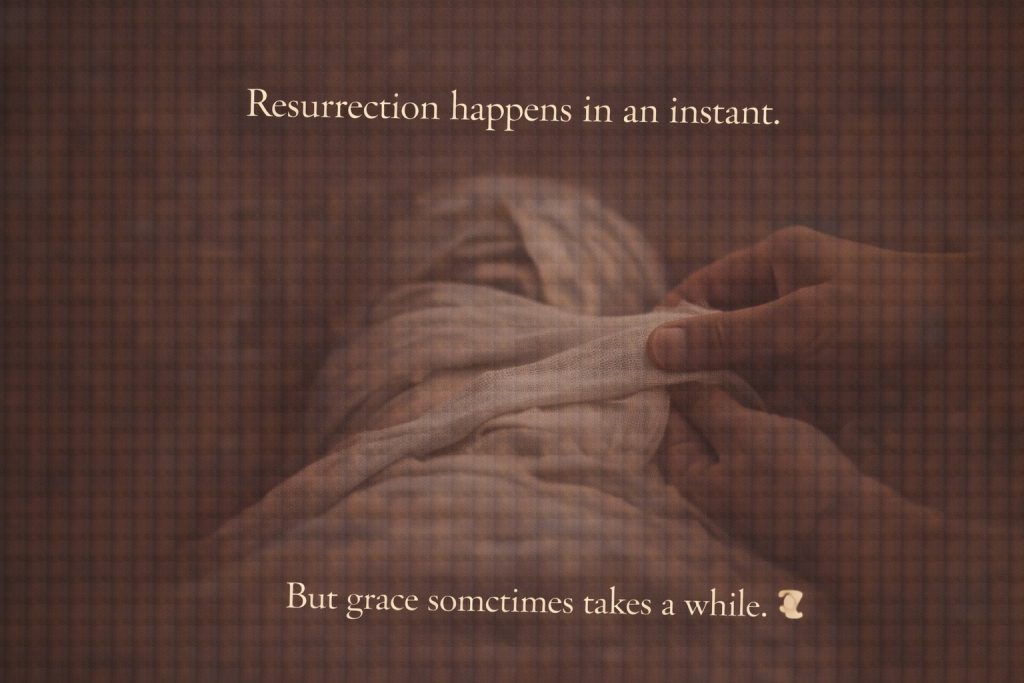
There is a small but significant detail in the Gospel story. When Lazarus emerges, he is alive — gloriously, unmistakably alive — but still wrapped in burial cloths. Jesus does not personally unwrap him. He turns to the community and says, “Unbind him, and let him go.”

Resurrection begins in an instant.

Freedom unfolds more gradually.

The Monday after the Fifth Sunday of Lent feels like that.

We have heard the promise. We believe in life. We affirm that stones can be moved. And yet we discover that even when new life has begun, old wrappings remain.

Habits. Fears. Patterns. Ways of thinking that belonged to the tomb.

It would be rather convenient if spiritual renewal came pre-packaged and wrinkle-free. One dramatic prayer, and suddenly we are entirely transformed, our anxieties neatly folded away, our patience flawless, our temper saintly.

But resurrection, like most divine gifts, invites participation.

Lazarus must walk out. The community must help unwrap. Life is given; growth continues.

This is, in many ways, deeply reassuring.

Because by Monday, we may have already noticed that despite yesterday’s triumphant Gospel, we are still slightly impatient in traffic. Still prone to worry. Still attached to certain predictable irritations.

We are alive in Christ — and occasionally tangled.

The Christian life is not about denying the grave clothes. It is about letting them be removed.

Some of them fall away easily. Others cling stubbornly, like spiritual duct tape.

The grace of God does not shame us for this. It invites community. It invites honesty. It invites patience with the process.

“Unbind him,” Jesus says.

Not, “Explain why he is still wrapped.”

The Monday after resurrection reminds us that salvation is both event and journey. New life has begun. Now comes the steady work of walking into it.

And if you find yourself halfway unwrapped this week — grateful for life but slightly constrained by old patterns — take heart.

The tomb is behind you.

The unbinding takes time.

And Christ is not alarmed by the pace.

Companion Prayer

Lord of Life,
You call us out of sealed places
into new beginnings.

When old habits cling
and fear lingers,
help us trust your patience.

Give us courage to step forward,
humility to accept help,
and grace to grow into freedom.

Unbind what still holds us.
Strengthen what is newly alive.

And keep us walking
in the light of resurrection.

Amen.

When the Stone Is Still in the Way

By the Fifth Sunday of Lent, we are no longer dabbling in spiritual housekeeping.

We are standing outside a tomb.

The Gospel often gives us Lazarus at this point in the season. Which is to say, things have become unmistakably serious. There is grief. There is delay. There is a stone firmly lodged in place. And there is Jesus, arriving four days later than anyone would have preferred.

It is a scene that tests faith.

Mary and Martha are not subtle about it. “Lord, if you had been here…” Which is the polite biblical way of saying, “We had a timeline.”

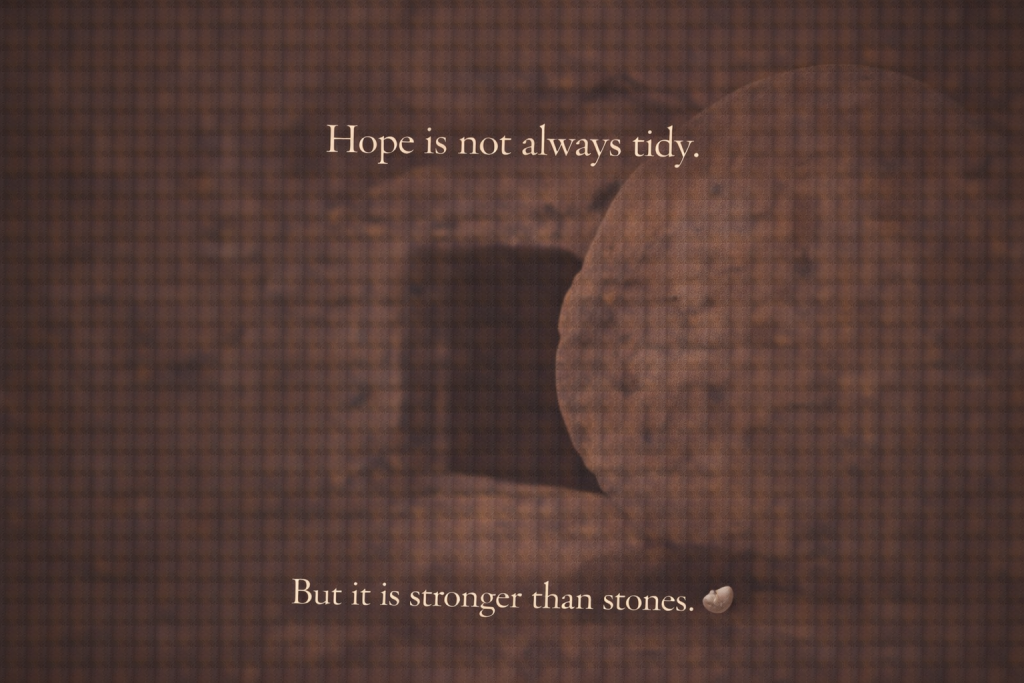
The Fifth Sunday of Lent is about resurrection, yes. But before it is about resurrection, it is about waiting. It is about standing before what feels immovable and discovering that hope is not tidy.

There is something profoundly human in this story.

We are quite comfortable with minor inconveniences. Lent has already asked us to examine our thirst, practice patience, forgive generously, and remain steady. All admirable spiritual exercises.

But now we are confronted with something that feels final.

A sealed tomb.

The Christian life does not avoid such moments. It names them.

We all have stones in our lives — griefs we did not choose, disappointments we did not anticipate, situations that seem immovable despite our prayers.

And here is where the humour must tread gently.

Because if you have ever attempted to move a large stone — or even rearrange a modest piece of furniture without assistance — you will know that optimism alone is insufficient.

Jesus stands before the tomb and says, “Take away the stone.”

Martha, ever practical, objects. “Lord, there is a stench.”

The Gospel is refreshingly honest about the odour.

Resurrection does not bypass decay. It confronts it.

The Fifth Sunday of Lent reminds us that hope is not denial. It is trust in the presence of God even when the stone is still very much in place.

Jesus does not scold Martha for her realism. He invites her to trust beyond it.

“Did I not tell you that if you believed, you would see the glory of God?”

Notice the order. Belief precedes sight.

Which is inconvenient for those of us who prefer proof before commitment.

Lazarus is called out of the tomb not because the sisters have mastered optimism, but because Jesus is life.

And perhaps this Sunday asks us not whether we can move the stone ourselves, but whether we are willing to let Christ speak into the place that feels sealed.

Resurrection may not yet be visible. The stone may still appear heavy. The circumstances may not have shifted.

But Jesus stands there nonetheless.

And that changes everything.

By the Fifth Sunday of Lent, the Church is already leaning toward Holy Week. The shadow of the cross is longer. The air is heavier.

And yet this Gospel insists: death does not have the final word.

Not then.
Not now.
Not ever.

If you are standing before something that feels immovable this Lent, take heart.

The One who weeps at the tomb also calls life out of it.

And stones, however stubborn, are not eternal.

Companion Prayer

Lord of Life,
You stand beside our sealed places
and do not turn away.

When grief feels heavy
and hope feels distant,
remain with us.

Give us courage
to trust beyond what we see,
and faith to believe
that your voice is stronger than death.

Roll away what binds us.
Call us into new life.
And hold us steady
as we wait for resurrection.

Amen.

When You Discover Grace Has a Long Memory

By the Saturday after the Fourth Sunday of Lent, the week has settled into something reflective.

Sunday rejoiced.
Monday trusted that mercy still held.
Thursday admired quiet faithfulness.
Friday wrestled with costly forgiveness.

And now Saturday sits calmly in the corner like a wise parishioner who has seen this all before.

There is something about this particular Saturday that invites a kind of spiritual exhale. We are far enough into Lent to know we are not sprinting. We are close enough to Holy Week to sense that deeper waters are ahead.

It is a day for remembering.

And remembering, as Scripture repeatedly shows us, is no small spiritual discipline.

Israel is told again and again: Remember what the Lord has done. Remember the wilderness. Remember the deliverance. Remember the covenant.

We, on the other hand, have a rather selective memory.

We remember our failures vividly.
We remember awkward conversations in impressive detail.
We remember what someone said in 2007 with archival clarity.

What we struggle to remember is grace.

We forget how many times we have been forgiven. We forget how often God has steadied us. We forget that the very air we breathe is sustained mercy.

Saturday after the Fourth Sunday of Lent is a quiet invitation to recall not our shortcomings, but God’s faithfulness.

Grace has a long memory.

It remembers the promise when we forget it.
It remembers the covenant when we doubt it.
It remembers who we are becoming when we grow impatient.

There is something profoundly hopeful in this.

We often imagine that our spiritual progress depends on our ability to remember God. In truth, it depends far more on God remembering us.

And God does.

This Saturday might be less about striving and more about gratitude. Less about evaluating the week and more about noticing where grace has already been at work.

Perhaps you were more patient than expected.
Perhaps you forgave — however awkwardly.
Perhaps you simply kept walking.

These are not small things.

The Christian life is not a race toward perfection. It is a steady remembering of mercy.

And if you find yourself tempted to rehearse your deficiencies this weekend, consider instead rehearsing God’s faithfulness.

You may find it considerably more encouraging.

Lent is not only about repentance. It is about learning to see clearly — and one of the clearest truths is this:

You are remembered.
You are held.
You are being carried farther than you realise.

Even on an unremarkable Saturday in March.

Companion Prayer

Faithful God,
When our memory fails,
let yours hold us.

Help us remember
your mercy more clearly
than our mistakes.

Teach us gratitude
for quiet growth,
for steady patience,
for forgiveness begun.

As we continue this Lenten road,
anchor us in the certainty
that you do not forget your children.

Amen.