There is something both valuable and dangerous about setting aside particular days and seasons for important things.
They help us remember.
They focus our attention.
They call us back to truths that we might otherwise neglect.
And then the calendar turns.
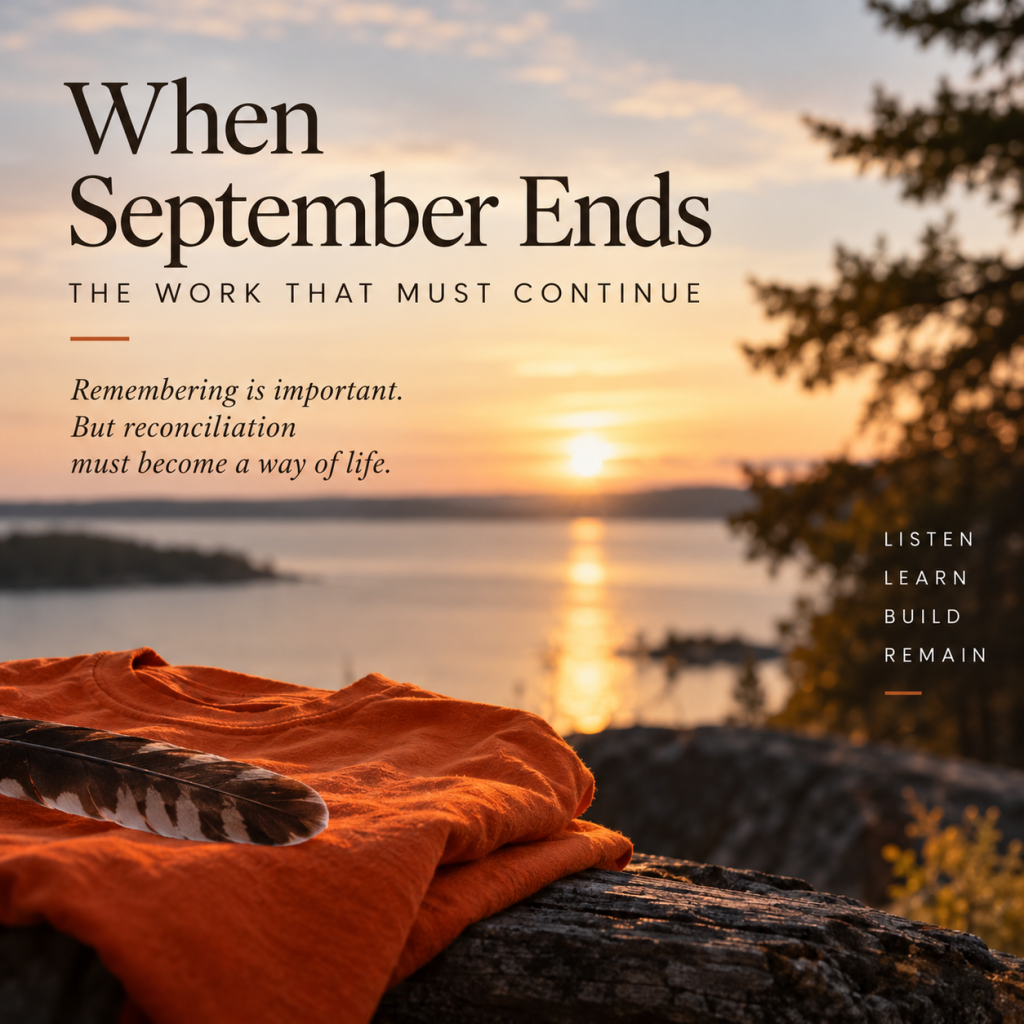
The orange shirts are folded and placed back in the drawer. The special prayers disappear from the liturgy. The educational resources are put away. The social media posts move on to something else. October arrives, Thanksgiving approaches, and the machinery of parish life continues its relentless journey toward Advent and Christmas.
And this is precisely where the Church must be careful.
Because reconciliation cannot become something we remember every September.
It must become part of who we are.
Over these past days, we have reflected upon truth, repentance, listening, relationship, justice, healing, and the long road of reconciliation between Indigenous and non-Indigenous peoples in Canada. We have acknowledged the Church’s participation in systems that caused enormous harm. We have considered the difference between apology and repentance, between good intentions and changed behaviour, between speaking about reconciliation and actually becoming reconciled people.
But perhaps the most important question comes now:
What will be different because we remembered?
That is the question the Church cannot avoid.
Jesus once told his disciples that if they brought their gift to the altar and remembered that their brother or sister had something against them, they should leave their gift there and first go and be reconciled.
That teaching should make Christians profoundly uncomfortable.
Jesus does not treat reconciliation as an optional addition to worship.
He places it at the very heart of worship.
The integrity of what happens at the altar is connected to the integrity of our relationships beyond it.
That means reconciliation with Indigenous peoples cannot remain safely contained within committees, commemorations, statements, or special services. It must eventually find its way into budgets, calendars, partnerships, property decisions, educational priorities, preaching, advocacy, and the everyday habits of congregational life.
Otherwise, we risk creating the appearance of reconciliation without accepting its cost.
And genuine reconciliation always costs something.
It costs us the comfort of believing that good intentions are enough.
It costs us the privilege of always setting the agenda.
It costs us the assumption that the Church must be the leader in every relationship.
It costs us the temptation to decide what healing should look like for someone else.
Perhaps most difficult of all, it requires the Church to learn a posture that historically we have not always practised very well:
We must learn how to receive.
For generations, churches approached Indigenous communities believing that we possessed something they needed. We came as teachers, missionaries, administrators, reformers, and authorities. Too often we failed to recognize that the people before us already possessed languages, traditions, wisdom, spirituality, community, and profound relationships with the land.
Reconciliation requires something different.
It asks whether the Church can enter relationships without needing to control them.
Can we listen without preparing our response?
Can we learn without immediately trying to teach?
Can we build friendships that do not exist primarily to accomplish a church programme?
Can we allow Indigenous voices to challenge our theology, our assumptions, our institutions, and even our understanding of ourselves?
Those are not small questions.
But they are necessary ones.
Healthy relationships are rarely built through grand gestures. They are built through consistency.
They are built when someone shows up again.
And again.
And again.
They are built when we remember names.
When we honour invitations.
When we keep promises.
When we listen to stories we have heard before because the person telling them still needs them to be heard.
When we remain at the table after the difficult conversation.
When we discover that friendship is not a strategy.
Perhaps this is where the Church’s renewed commitment to reconciliation must begin.
Not with another statement.
Not with another declaration.
But with the quiet discipline of becoming trustworthy.
Trust cannot be demanded.
It cannot be legislated.
It cannot be produced by a carefully worded apology.
Trust grows slowly when words and actions begin to resemble one another.
For churches, that means asking some practical questions.
Whose voices shape our decisions?
What Indigenous history do our congregations actually know about the land upon which we worship?
Which Indigenous communities are our neighbours?
Do we know them?
Have we listened to them?
Have we supported Indigenous-led ministries and organizations financially?
Do our children learn the history of the residential school system and the Church’s involvement in it?
Do we understand the Calls to Action of the Truth and Reconciliation Commission well enough to recognize which ones directly challenge the Church?
And perhaps most importantly:
If every orange shirt disappeared tomorrow, would anyone looking at the life of our congregation still know that reconciliation matters to us?
That question reaches deeper than symbolism.
Symbols matter. Orange shirts matter. Land acknowledgements matter. Memorials matter. Days of remembrance matter.
But symbols are meant to point toward something.
The danger comes when we begin mistaking the signpost for the destination.
Christian faith has always insisted that love eventually becomes visible.
Jesus does not merely tell us to believe in love.
He commands us to practise it.
Feed the hungry.
Welcome the stranger.
Visit the prisoner.
Forgive.
Seek justice.
Make peace.
Love your neighbour.
Follow me.
The verbs of the Gospel are remarkably active.
So must be our reconciliation.
The Church does not need to become perfect before entering this work. If perfection were required before Christians attempted anything worthwhile, very little would ever happen.
But we do need to become faithful.
Faithful enough to listen.
Faithful enough to learn.
Faithful enough to repent when we discover that our understanding was incomplete.
Faithful enough to repair what can still be repaired.
Faithful enough to advocate when Indigenous communities face injustice.
Faithful enough to invest our resources where our words say our priorities lie.
Faithful enough to remain in relationship when the conversation becomes uncomfortable.
And faithful enough to understand that reconciliation is not something one generation will complete.
We are planting trees beneath whose shade we may never sit.
That is not failure.
That is faithfulness.
Scripture is filled with people who worked toward promises they would never fully see. They built altars, planted vineyards, raised children, crossed wildernesses, rebuilt cities, and trusted that God’s purposes extended beyond the boundaries of their own lifetimes.
Perhaps reconciliation requires that same spiritual maturity.
We may not live to see everything healed.
But we can refuse to pass the wounds forward unchanged.
We can leave the next generation relationships stronger than we received them.
We can leave them institutions more honest than we inherited.
We can leave them churches less defensive about the past and more courageous about the future.
We can teach them that reconciliation is not an act of charity offered by one group to another.
It is part of the Christian vocation to become a people among whom broken relationships are taken seriously because we worship a God who reconciles.
September will end.
The orange shirts will eventually return to their drawers.
The calendar will turn.
But the work must continue.
Perhaps that should be our commitment as this series concludes:
Not simply that we will remember.
But that we will remain.
Remain in conversation.
Remain willing to learn.
Remain committed to justice.
Remain present in relationship.
Remain accountable to the truth.
Remain open to Indigenous voices and leadership.
Remain willing to discover what repentance may yet require of us.
Because reconciliation will not finally be measured by what the Church says during the last days of September.
It will be measured by the relationships we are still tending in November.
The commitments we are still honouring in February.
The partnerships we are still strengthening next June.
The justice we are still seeking years from now.
Truth must lead somewhere.
Repentance must change something.
And reconciliation must become a way of life.
May God give the Church the humility to listen, the courage to change, the patience to build trust, and the faithfulness to remain on this road long after the calendar tells us that September is over.
The work of reconciliation does not end when the season of remembering ends. That is when we discover whether we truly meant what we said.
Follow along on Instagram @renewablespiritual for more daily reflections on faith, life, and the surprising places where God still loves to meet us.
Companion Prayer
God of truth and reconciliation,
keep us from believing that remembering is enough.
Give us humility to listen,
courage to face the truth,
and faithfulness to remain in relationship
when the work becomes difficult.
Where trust has been broken,
teach us to become trustworthy.
Where harm has been done,
lead us beyond apology into repentance, repair, and justice.
Bless Indigenous peoples, communities, leaders, and Elders,
and teach your Church to walk alongside rather than ahead,
to receive as well as to give,
and to honour relationships with patience and integrity.
When September ends,
do not let our commitment end with it.
Make reconciliation not simply something we speak about,
but something we live.
Through Jesus Christ,
who calls us into the ministry of reconciliation.
Amen.