There is a danger in setting aside a week for Truth and Reconciliation.
The danger is not that we will talk about it too much. The danger is that we will begin to imagine that a week is enough.
We can wear orange. We can acknowledge the land. We can listen to stories, offer prayers, attend events, and speak carefully about the painful history of residential schools and the Church’s participation in them. All of these things matter.
But reconciliation was never intended to become an annual observance on the Church calendar.
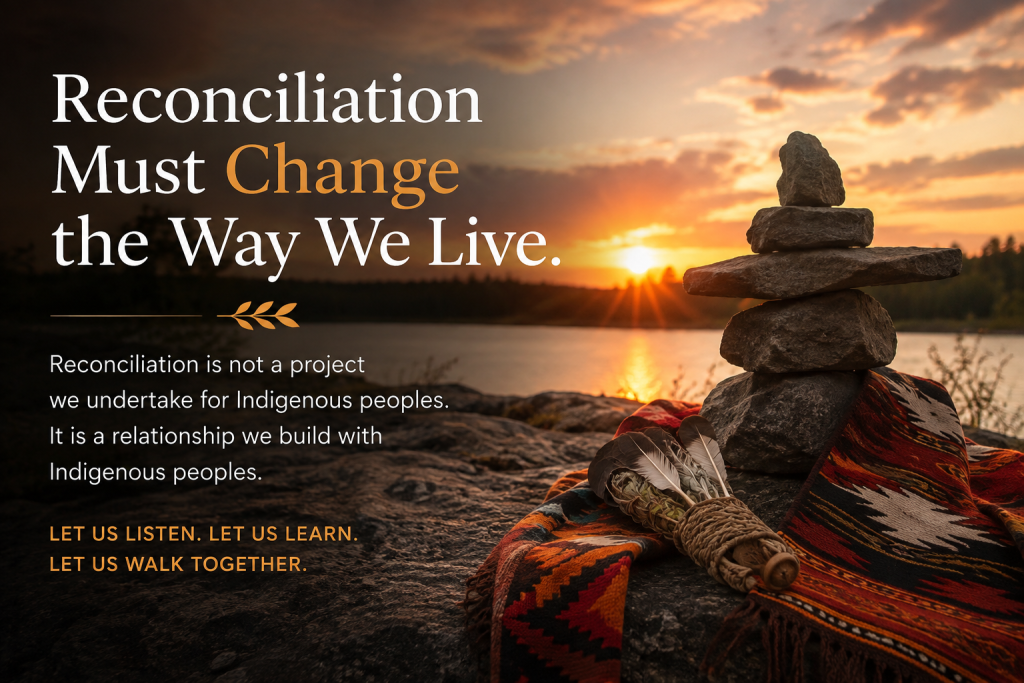
Reconciliation must eventually change the way we live.
The Gospel repeatedly reminds us that restored relationships require more than good intentions. Jesus does not simply teach people to think kindly about their neighbours. He calls them to cross boundaries, surrender privilege, repair what has been damaged, tell the truth, seek forgiveness, and begin living differently.
That is considerably more demanding.
For the Church in Canada, reconciliation with Indigenous peoples cannot remain primarily a matter of remembering what happened long ago. History matters enormously, particularly when generations were taught versions of that history that minimized or ignored Indigenous voices. Truth must come before reconciliation because relationships built upon incomplete truth will always remain fragile.
But once we have heard the truth, another question follows.
What are we going to do with what we now know?
That may be one of the most important questions facing the Church.
Perhaps every parish should ask it.
What has changed in our congregation because we have listened to Indigenous voices?
What have we learned about the Indigenous peoples upon whose traditional territories we worship?
Whose voices have shaped our understanding of reconciliation?
Where have we invested our time, relationships, influence, and resources?
Which Calls to Action have we actually acted upon?
And perhaps most challenging of all: what are we prepared to change?
Healthy relationships cannot be built when one party assumes that reconciliation means the other person eventually becoming comfortable with the way things already are.
Real reconciliation changes everyone involved.
This is especially important for the Church because our history includes times when we believed that we knew what was best for Indigenous peoples. We arrived with institutions, theology, education, culture, and authority, too often assuming that Christian faith required Indigenous people to become more like us.
A reconciled future cannot be built using the same posture.
The Church must learn again how to listen without immediately trying to lead.
There is something deeply Christian about that.
Jesus frequently begins encounters not with instructions but with questions. What do you want me to do for you? What are you looking for? Do you want to be made well?
Perhaps reconciliation requires the Church to recover the humility of asking before answering.
What would healing look like?
What would partnership look like?
What would justice require?
What do Indigenous communities need from the Church now?
And then comes the harder spiritual discipline: listening carefully enough that the answers are allowed to change us.
Because reconciliation is not a project we undertake for Indigenous peoples. It is a relationship we build with Indigenous peoples.
That small word with carries enormous theological weight.
The Kingdom of God is filled with that word.
God with us.
Christ eating with those others rejected.
Jesus walking with disciples who were confused and frightened.
The risen Christ travelling with two grieving people on the road to Emmaus.
Again and again, God chooses relationship rather than distance.
Perhaps this is where the Church’s renewed commitment must begin.
Not simply with another statement.
Not simply with another service.
Not simply with another week of good intentions.
But with relationships patiently built over years.
Relationships in which we learn names and stories. Relationships in which Indigenous voices are not invited merely to bless decisions we have already made. Relationships in which we show up when there is no photograph to take, no anniversary to observe, and no institutional recognition to receive.
Relationships in which we become dependable.
That may be one of the most important gifts the Church can offer the work of reconciliation: faithfulness.
We know something about faithfulness.
We gather Sunday after Sunday. We pray year after year. We baptize children and bury grandparents. We keep returning to the table. We keep telling the story. We keep trusting that God can make something holy through ordinary acts repeated with love.
Reconciliation may require precisely that kind of persistence.
September 30 will come.
Orange shirts will eventually return to drawers.
The public conversation will move toward something else.
But the Church must remain.
Listening.
Learning.
Repenting.
Building relationships.
Supporting Indigenous leadership.
Seeking justice.
Keeping promises.
Showing up again.
Because reconciliation will not finally be measured by how thoughtfully we observed a particular week.
It will be measured by the relationships we are still tending when the week is over.
And perhaps that is the commitment the Church needs to make again today:
We will still be here tomorrow.
Still listening.
Still learning.
Still walking together.
Still trusting that the God who reconciled the world to himself in Christ can teach us, patiently and persistently, how to become people of reconciliation too.
Follow along on Instagram @renewablespiritual for more daily reflections on faith, life, and the surprising places where God still loves to meet us.
Companion Prayer
God of truth and reconciliation,
teach us to listen with humility,
to act with courage,
and to remain faithful when attention moves elsewhere.
Help us build relationships rooted in justice, respect, and love,
and make us steadfast companions on the long road toward healing.
Amen.