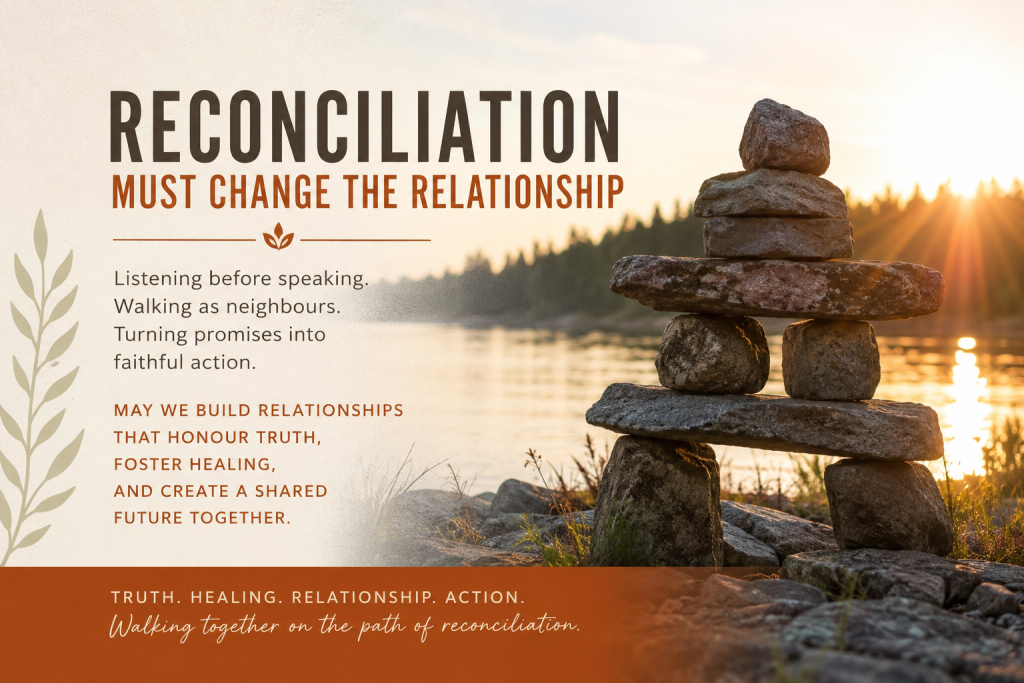
There is a danger in speaking often about reconciliation.
The danger is not that we will say too much. The danger is that we will become so accustomed to the language that we stop allowing it to change us.
Words like truth, healing, reconciliation, and relationship can begin to sound familiar in the Church. We place them in prayers. We include them in liturgies. We speak them at meetings and acknowledge the land upon which we gather. All of these things can matter deeply.
But reconciliation was never meant to become comfortable vocabulary.
It is meant to become a different way of living together.
For generations, the relationship between the Church and Indigenous peoples was shaped by an assumption that the Church knew what was best. We arrived carrying not only the Gospel, but our culture, our institutions, our expectations, and our conviction that others needed to become more like us.
That history should make the Church especially careful about how we approach reconciliation today.
Because even our desire to repair the relationship can become another form of control if we insist upon determining what the repair should look like.
Perhaps one of the most important questions the Church can ask during this week is not, What should we do for Indigenous peoples?
Perhaps the better question is:
What are Indigenous people asking of us?
That is a very different question.
It requires listening before planning.
It requires relationship before programming.
It requires humility before leadership.
And, perhaps most difficult of all for the Church, it requires us to surrender our instinct to manage the outcome.
Jesus consistently approached people in ways that restored dignity and agency. He asked questions. He listened. He allowed people to speak their own needs. Even when the answer seemed obvious, Jesus sometimes asked, “What do you want me to do for you?”
There is something profoundly important in that question.
It refuses to reduce another person to a problem we have already decided how to solve.
Reconciliation must carry that same humility.
Healthy relationships are not built when one party continually speaks and the other is expected to receive. They are built when people begin to know one another — when stories are shared, trust is slowly earned, wounds are acknowledged, promises are honoured, and friendship is allowed to grow without constantly being turned into a project.
That may mean our congregations need fewer conversations about Indigenous peoples and more opportunities for conversations with Indigenous neighbours.
It may mean learning whose traditional territory our churches occupy and then taking the much more demanding step of discovering who those neighbours actually are today.
It may mean attending Indigenous events when we are not the hosts.
It may mean supporting Indigenous ministries without expecting recognition.
It may mean purchasing from Indigenous artists and businesses, reading Indigenous authors, learning local histories, supporting language revitalization, advocating for clean water and equitable services, and listening carefully when Indigenous leaders tell us where our energy would actually be helpful.
And sometimes it may mean simply showing up.
Not with a microphone.
Not with a programme.
Not with an agenda.
Just with the willingness to become neighbours.
The Church has spent generations becoming skilled at inviting people into our spaces. Reconciliation may require us to become equally skilled at entering someone else’s space respectfully — not as the institution in charge, but as guests.
That is a significant spiritual shift.
The Gospel calls it humility.
Humility does not mean pretending that we have nothing to offer. It means understanding that we are not always the ones who should decide what needs to be offered.
There is another difficult truth we must face.
Relationships cannot be repaired by occasional attention.
If Indigenous reconciliation matters only around Orange Shirt Day or the National Day for Truth and Reconciliation, then we have turned a relationship into an annual observance.
Real relationships do not work that way.
Friendship requires presence.
Trust requires consistency.
Healing requires time.
And reconciliation requires the Church to remember in February what it promised in September.
Perhaps that is where our renewed commitment must begin.
Not with another statement.
Not with another beautifully worded resolution.
But with the quiet determination to build relationships that continue after the orange shirts have been folded and returned to the drawer.
Every congregation could ask a simple question:
Who are the Indigenous people and communities with whom God is calling us to become better neighbours?
Then we could listen.
We could learn.
We could show up.
We could remain.
Because reconciliation will never finally be accomplished by institutions issuing statements to one another.
It will grow when people begin to know one another.
When strangers become neighbours.
When neighbours become friends.
When truth is spoken without defensiveness.
When promises become habits.
When solidarity continues even when nobody is watching.
The Church cannot undo its history.
But by the grace of God, we can decide what kind of relationship we will build from this moment forward.
And perhaps one day the strongest evidence of our commitment to reconciliation will not be found in the words we have written about Indigenous peoples.
It will be found in the relationships we have built with them.
That is work worthy of repentance.
That is work worthy of perseverance.
And that is work worthy of the Gospel we proclaim.
Follow along on Instagram @renewablespiritual for more daily reflections on faith, life, and the surprising places where God still loves to meet us.
Companion Prayer
God of truth and healing,
teach us to listen before we speak,
to walk as neighbours rather than leaders,
and to turn our promises into faithful action.
Give us humility to build relationships,
courage to remain when the work is difficult,
and grace to travel together toward reconciliation.
Amen.