Sunday morning has a rhythm familiar to many of us.
We gather. We listen to Scripture. We confess our sins. We exchange the peace. We come to the table. We receive bread and wine. We are blessed. And then we are sent into the world.
That final movement matters.
Because Christian worship was never intended to end at the church door.
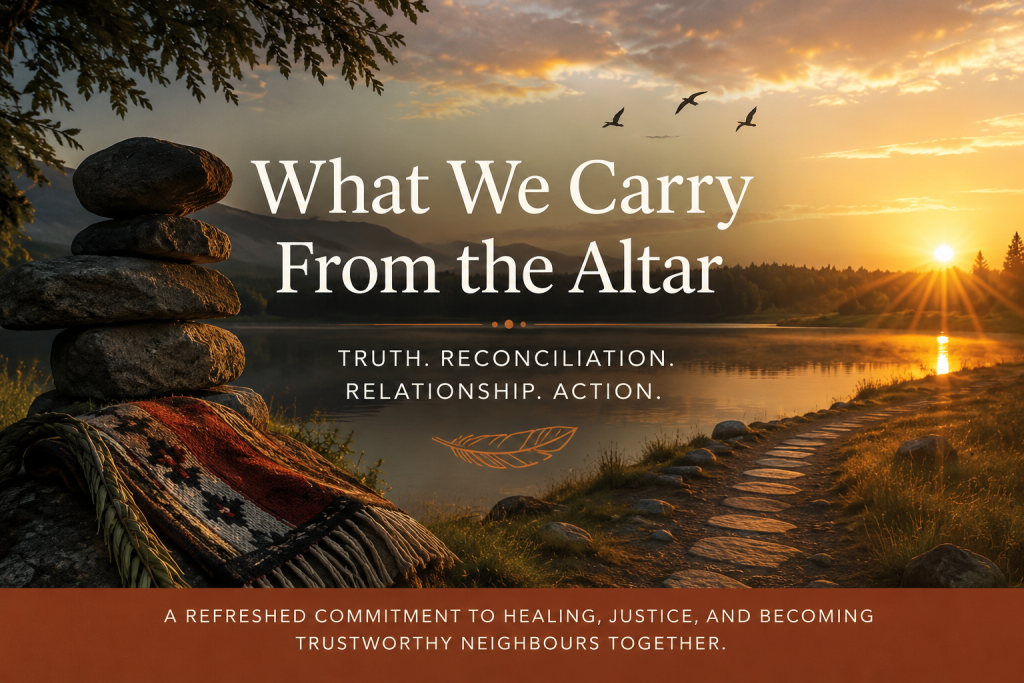
This Sunday falls within a week when Canadians are being called again to confront the truth of our history with Indigenous peoples and to renew our commitment to reconciliation. Churches will pray. Some will acknowledge the traditional territory upon which they gather. Some will hear the stories of residential schools and Survivors. Some will wear orange.
All of these things can matter.
But the deeper question for the Church is what happens when the service is over.
What do we carry from the altar into the work of reconciliation?
The Eucharist makes a remarkable claim about us. We come to Christ’s table as people who have received mercy, and then we are sent into the world to become people through whom mercy, justice, peace, and healing may become visible.
We cannot receive reconciliation from God as a gift and then treat reconciliation with our neighbours as an optional ministry.
That is particularly challenging for the Church in Canada.
Our relationship with Indigenous peoples is not simply part of Canadian history. It is part of our Christian history. Churches participated in systems that harmed Indigenous children, families, languages, cultures, and communities. Christian language was sometimes used to justify assumptions of superiority. The name of Jesus became entangled with institutions and policies that caused wounds whose consequences continue today.
We cannot change that history.
But we are responsible for what kind of history we write next.
And that history will not be written primarily in statements issued by national church offices.
It will be written in relationships.
It will be written when congregations take the initiative to learn about the Indigenous peoples whose traditional territories they inhabit.
It will be written when churches listen to Indigenous voices without immediately trying to explain, defend, correct, or solve.
It will be written when Indigenous leadership is respected rather than merely consulted.
It will be written when church budgets reveal that reconciliation is important enough to receive more than our good intentions.
It will be written when we stand beside Indigenous communities seeking justice even when doing so is inconvenient, politically uncomfortable, or costly.
And it will be written when we remain committed long after September has disappeared from the calendar.
There is something deeply Eucharistic about this work.
At the altar, we bring what we have. Bread. Wine. Ourselves.
God receives those gifts and gives them back transformed.
Perhaps reconciliation asks the Church to place something else upon the altar as well.
Our defensiveness.
Our need to control the conversation.
Our desire to be quickly forgiven.
Our assumption that reconciliation should proceed according to a timetable comfortable for us.
Our temptation to declare the work finished because we have apologized.
These things may also need to be surrendered.
Because reconciliation cannot be built upon the Church’s desire to feel better about its past. It must be built upon our willingness to participate faithfully in a different future.
That requires humility.
Humility does not mean pretending that we have nothing to contribute. It means recognizing that we are not always the ones who should determine what our contribution ought to be.
For much of Canadian history, churches approached Indigenous peoples with answers already prepared.
Perhaps reconciliation begins differently.
Perhaps we arrive with a question:
What would it mean for us to become good neighbours?
And then we listen carefully enough to hear the answer.
That question should eventually reach every parish council, every diocesan synod, every church budget, every theological college, and every ministry planning meeting.
What would becoming good neighbours require of us here?
Not somewhere else.
Not at the national level.
Here.
Perhaps it means developing an ongoing relationship with a local Indigenous organization or community.
Perhaps it means financially supporting Indigenous-led ministries.
Perhaps it means studying the Truth and Reconciliation Commission’s Calls to Action and asking which ones require a response from our congregation.
Perhaps it means examining the history of the land and property our churches occupy.
Perhaps it means inviting Indigenous teachers to help us learn — and ensuring they are properly compensated rather than expecting them to educate us for free.
Perhaps it means using our institutional voice when Indigenous neighbours are confronting injustice.
The particular answer will differ from place to place.
The obligation to ask the question does not.
This is where reconciliation becomes discipleship.
Jesus never called the Church merely to regret injustice. He called us to participate in the coming of a Kingdom in which relationships are restored, the dignity of every person is honoured, truth is spoken, and those pushed to the margins are brought into the centre of our concern.
That Kingdom cannot remain something we proclaim at the altar.
It must become something we practise beyond it.
So today, as we gather around the table, perhaps we should listen carefully to the words with which we are sent back into the world.
We are not dismissed because worship is finished.
We are sent because worship must continue.
The Eucharist becomes visible in the lives we live after receiving it.
And perhaps one measure of the Church’s commitment to truth and reconciliation will be whether Indigenous neighbours can encounter in us something of the reconciliation we celebrate every Sunday.
Not simply a Church that has apologized.
Not simply a Church that remembers.
But a Church learning to listen, willing to change, prepared to act, and committed to becoming a trustworthy neighbour.
If reconciliation is truly part of our worship, then eventually it must become part of our way of life.
Follow along on Instagram @renewablespiritual for more daily reflections on faith, life, and the surprising places where God still loves to meet us.
A Prayer for Reconciliation
God of truth and healing,
teach us to listen with humility,
to repent through action,
and to become trustworthy neighbours.
Give us courage to surrender what must change
and grace to walk faithfully with Indigenous peoples
along the long road of reconciliation.
Amen.