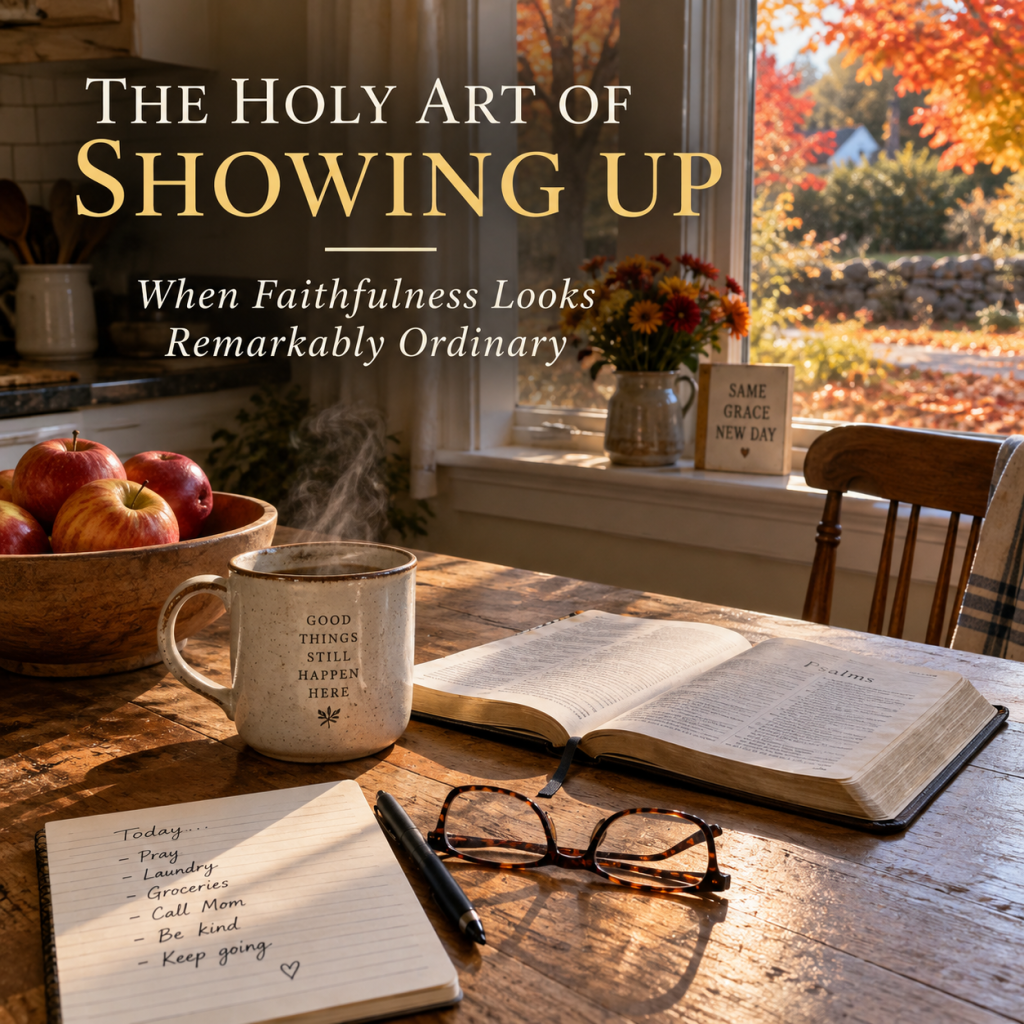
There are days when the Christian life feels wonderfully significant.
There are baptisms and weddings, Christmas Eve services glowing with candlelight, Easter mornings bursting with alleluias, and those rare moments when the sermon actually comes together precisely as the preacher hoped it might.
These occasions are sufficiently unusual that clergy generally remember them.
Then there is Tuesday.
Tuesday seldom arrives carrying trumpets.
Tuesday arrives with laundry.
There are dishes in the sink, emails requiring answers, groceries requiring purchase, appointments requiring attendance, and something mysterious growing in a container at the back of the refrigerator which everyone in the household has silently agreed not to investigate.
And somewhere in the middle of all this ordinary life, God says:
Here.
Here is where I would like you to be faithful.
One of the great misunderstandings of the spiritual life is the assumption that holiness must be dramatic.
We imagine saints standing courageously before emperors, missionaries crossing oceans, prophets confronting kings, and apostles setting off toward unknown lands carrying nothing but the Gospel and a remarkably inadequate travel wardrobe.
And certainly the history of our faith contains such people.
But most Christian discipleship has never looked like that.
Most Christian discipleship has looked like someone getting out of bed in the morning and trying once again to love God and neighbour.
It looks like making breakfast.
Keeping promises.
Calling someone who is lonely.
Forgiving the person who has irritated us for reasons that, upon careful theological examination, turn out to be approximately 83 percent ridiculous.
It looks like praying when prayer feels meaningful and praying when it does not.
It looks like returning to worship.
Returning to kindness.
Returning to generosity.
Returning to hope.
Again and again.
There is a wonderfully unglamorous word for this.
Faithfulness.
We live in a culture fascinated by beginnings.
New programs.
New diets.
New plans.
New ministries.
New exercise equipment purchased in January which, by March, has become an exceptionally expensive device upon which to hang clothing.
Beginnings are exciting because they contain possibility.
Faithfulness is different.
Faithfulness asks what happens after the excitement has disappeared.
The Scriptures understand this.
God’s people spend a great deal of biblical history discovering that covenant is not merely something declared in dramatic moments. Covenant must be lived on ordinary mornings.
Israel receives the commandments at Sinai amid thunder and lightning.
Very impressive.
But eventually someone still has to go home and love their neighbour.
Jesus calls the disciples beside the Sea of Galilee.
Wonderful moment.
But then they must spend the next several years walking dusty roads, listening, learning, misunderstanding, trying again, and occasionally arguing about which of them is the greatest.
The disciples, it should be noted, were remarkably gifted at demonstrating that Jesus did not recruit his followers from a catalogue entitled Promising Candidates for Immediate Sainthood.
And perhaps that is encouraging.
Because neither were we.
Jesus simply says, “Follow me.”
And following is rarely accomplished in one magnificent leap.
It happens one step at a time.
This is why Ordinary Time is such an important part of the Church year.
It teaches us something we desperately need to remember:
God does not require extraordinary circumstances in order to do holy work.
The colour may be green.
The hymns may be familiar.
The calendar may contain no major feast.
Nothing particularly dramatic may be happening.
And yet the Kingdom of God continues quietly growing.
Jesus understood this better than anyone.
When he wanted to describe God’s Kingdom, he frequently reached for very ordinary things.
Seeds.
Bread.
Yeast.
Fields.
Fishing nets.
Coins.
Sheep.
Jesus apparently believed the universe could reveal profound theological truth without requiring a PowerPoint presentation.
A mustard seed disappears into the soil.
Nothing seems to happen.
Then something happens.
A little more.
Then more.
Eventually there is a plant where previously there was only dirt.
This is how grace often works.
Quietly.
Patiently.
Almost invisibly.
We sometimes look at our lives and wonder whether anything spiritual is happening at all.
Perhaps prayer feels routine.
Perhaps worship feels familiar.
Perhaps we are not experiencing great revelations or dramatic transformations.
But perhaps something deeper is happening.
Perhaps God is forming us through repetition.
Every time we choose compassion rather than contempt.
Every time we choose patience rather than irritation.
Every time we choose generosity rather than fear.
Every time we return to prayer.
Every time we show up.
Something is being planted.
Something is growing.
The growth may be too small to notice today.
But grace has never been terribly concerned with our preferred timetable.
Ask any gardener.
You can plant a seed on Monday and stare at the ground intensely on Tuesday, but this rarely intimidates the seed into faster growth.
The spiritual life requires the same patience.
God is working beneath the surface.
And perhaps this is especially important during these autumn days between Thanksgiving and All Saints.
Thanksgiving invited us to notice the gifts already surrounding us.
All Saints will soon invite us to remember lives shaped by grace.
But between those two celebrations lies this stretch of Ordinary Time.
And perhaps the Church quietly asks us:
What happens between gratitude and sainthood?
Mostly this.
We show up.
We pray.
We forgive.
We serve.
We begin again.
We try to love the person standing in front of us.
And tomorrow we do it again.
The saints we celebrate on November 1 did not become saints because every day of their lives was extraordinary.
They became saints because grace was allowed to inhabit their ordinary days.
They kept turning toward God.
Sometimes courageously.
Sometimes reluctantly.
Sometimes joyfully.
Sometimes with the spiritual enthusiasm of someone being asked to leave a warm bed on a cold October morning.
But they kept turning.
That may be one of the most hopeful things we can say about holiness.
Holiness is not reserved for spiritual superheroes.
It is what happens when ordinary people keep making room for God.
So perhaps today does not need to be remarkable.
Perhaps you do not need a revelation.
Perhaps heaven does not require you to accomplish something magnificent before supper.
Perhaps the invitation is simpler.
Show up.
Say your prayers.
Do the work that belongs to you.
Be kind.
Forgive someone.
Feed someone.
Listen carefully.
Notice beauty.
Give thanks.
And trust that God can take these small acts of faithfulness and weave them into something larger than we can presently see.
Because the Kingdom of God has always had a curious preference for small beginnings.
Seeds.
Bread.
A manger.
A cross.
An empty tomb.
Ordinary things through which God accomplishes extraordinary grace.
And perhaps that is the quiet miracle of Ordinary Time.
Nothing appears to be happening.
And God is everywhere at work.
Most holiness is not found in doing something extraordinary. It is found in doing ordinary things faithfully enough that grace has time to grow.
Follow along on Instagram @renewablespiritual for more daily reflections on faith, life, and the surprising places where God still loves to meet us.
Companion Prayer
Faithful God,
meet me in the ordinary places of this day.
When nothing seems remarkable,
teach me to recognize your grace.
When faithfulness feels repetitive,
give me patience to keep showing up.
When I am tempted to believe that small things do not matter,
remind me that your Kingdom grows from seeds,
your grace is revealed in bread,
and your love became flesh in a manger.
Give me grace to pray,
to forgive,
to serve,
to listen,
to notice,
and to love the person you place before me.
Take these small acts of faithfulness
and make of them something holy.
And when I cannot see what you are doing,
help me trust that beneath the ordinary soil of my life,
grace is still growing.
Amen.