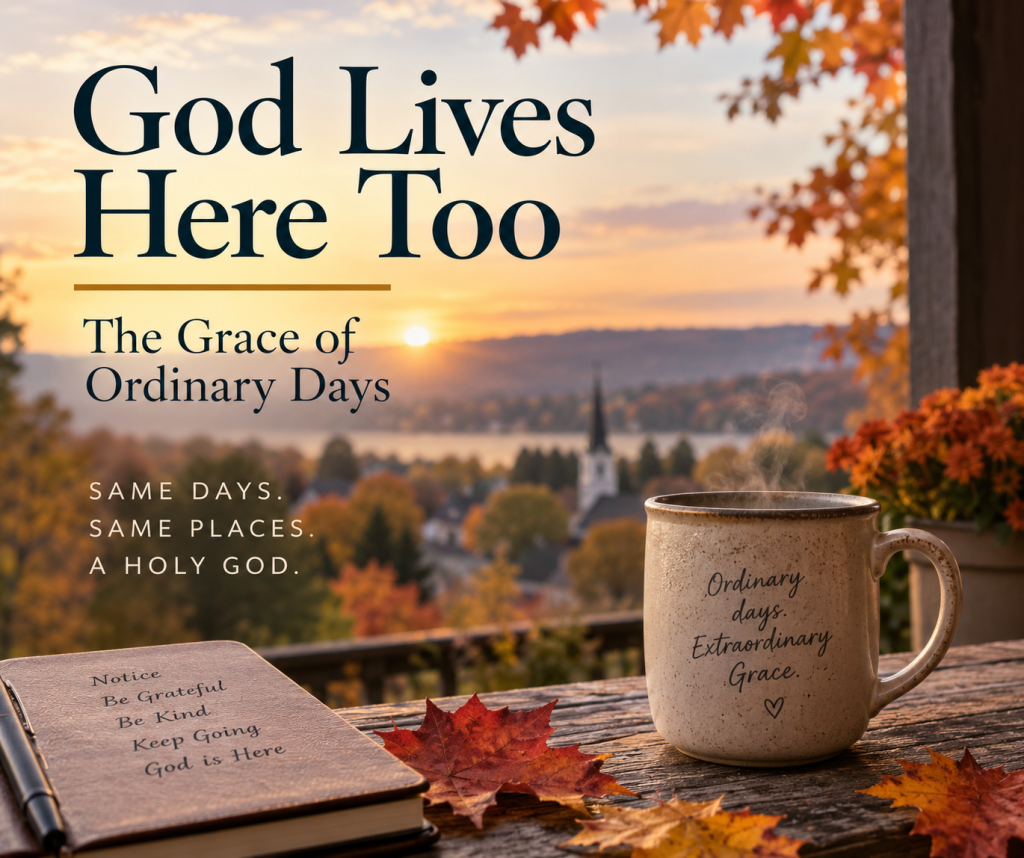
There is a peculiar little stretch of the Christian year that arrives after Thanksgiving and before All Saints.
Thanksgiving has been celebrated. The turkey has been carved. The leftovers have been placed in increasingly optimistic plastic containers. Somewhere at the back of the refrigerator there is probably a spoonful of cranberry sauce that nobody quite knows what to do with, but which nobody is yet prepared to throw away.
And All Saints is still waiting for us on November 1.
Between the two lies a collection of perfectly ordinary October days.
No great festival.
No dramatic liturgical season.
No angels appearing to shepherds. No Magi following stars. No palms waving. No empty tomb. No tongues of fire.
Just Tuesday.
And Wednesday.
And Thursday.
Which may be precisely why these days have something important to teach us.
The Spiritual Problem with Tuesday
Most of us are reasonably good at noticing God when something extraordinary happens.
A child is born.
Someone we love is healed.
A prayer is answered in a way we cannot explain.
We stand beside a lake at sunset and, for perhaps thirty seconds, become convinced that we are deeply spiritual people.
Then a mosquito lands on our neck and the mystical experience comes abruptly to an end.
The extraordinary gets our attention.
But most of life is not extraordinary.
Most of life consists of getting dressed, making breakfast, answering messages, finding our keys, doing our work, paying bills, washing dishes, buying groceries, keeping appointments, taking out the garbage, and wondering how something we distinctly remember putting in a safe place has apparently entered another dimension.
And if God is present only in extraordinary moments, then God is absent from most of our lives.
Christian faith insists upon something much more wonderful.
God is the God of ordinary days.
The Holiness Hidden in Plain Sight
One of the great themes running through Scripture is God’s remarkable habit of appearing in places nobody thought particularly important.
Moses encounters God while tending sheep.
David is discovered while doing farm chores.
Elijah hears God not in earthquake, wind, or fire, but in the sound of sheer silence.
Jesus spends thirty years in Nazareth before beginning the three years of ministry recorded in the Gospels.
And when that ministry begins, Jesus continually points toward ordinary things.
Seeds.
Bread.
Fish.
Coins.
Birds.
Flowers.
Vineyards.
Children.
Farmers.
Housekeepers.
Dinner tables.
Apparently Jesus did not suffer from our modern conviction that something has to be spectacular before it can be significant.
He seemed convinced that the Kingdom of God could be hiding almost anywhere.
That should make us suspicious of Tuesday.
There may be more happening there than we imagine.
Perhaps We Have Been Looking in the Wrong Places
We sometimes speak about wanting to “find God,” as though God were a misplaced set of car keys.
Where is God?
Perhaps God has not gone anywhere.
Perhaps the difficulty is that we have trained ourselves to notice only what is dramatic.
We look for miracles and overlook mercy.
We wait for revelation and miss kindness.
We hope for some unmistakable spiritual experience while somebody beside us quietly needs a cup of tea and twenty minutes of our attention.
The Christian life is not primarily about escaping ordinary life in order to encounter God.
It is about learning to recognize that ordinary life has been inhabited by God all along.
That is, after all, what Christians mean when we speak about the Incarnation.
“The Word became flesh and lived among us.”
God did not save the world by remaining safely spiritual.
God entered the neighbourhood.
God became flesh.
God ate meals.
God walked dusty roads.
God went to weddings.
God touched sick people.
God noticed children.
God wept at a friend’s grave.
The Incarnation is God’s declaration that ordinary human life is worth inhabiting.
And if God was willing to inhabit it, perhaps we should pay more attention to it.
The Grace of Small Things
So, for these remaining days of October, I want to think about the grace of ordinary days.
I want us to look for holiness in places where holiness seldom receives a plaque.
The person who telephones someone who is lonely.
The neighbour who brings in another person’s garbage bins.
The parent making lunches before sunrise.
The caregiver who answers the same question for the seventeenth time with tenderness.
The volunteer who arrives early and stays late.
The person who quietly forgives.
The friend who listens without immediately trying to fix everything.
The stranger who holds the door.
The parishioner who notices somebody sitting alone and moves over.
None of these things will make the evening news.
Thank God.
The evening news already has enough to do.
But perhaps heaven notices differently.
Jesus once suggested that even a cup of cold water offered in love matters to God.
We have built entire civilizations around the assumption that greatness must be large.
Jesus seems considerably less impressed by size.
The Kingdom begins like mustard seed.
Bread begins with yeast.
Generosity begins with a cup of water.
Discipleship begins with “Follow me.”
Holiness often begins with the next faithful thing.
Saints Are Made on Ordinary Days
And that brings us toward All Saints.
We sometimes imagine saints as spiritual superheroes: people who woke each morning radiating holiness, prayed for six hours before breakfast, never became irritated in traffic, and presumably never said anything regrettable while assembling flat-pack furniture.
But saints were human beings.
They had ordinary days too.
They became saints not because every moment of their lives was extraordinary, but because ordinary moments were repeatedly offered to God.
Faithfulness accumulated.
Prayer accumulated.
Mercy accumulated.
Courage accumulated.
Small acts of love accumulated.
Eventually a life emerged.
That may be one of the most encouraging truths of the Christian faith.
You do not have to accomplish something spectacular today.
You only have to ask what love requires here.
You do not have to solve every problem.
You can do the next faithful thing.
You do not have to become a saint by supper.
Frankly, that would make for a very stressful afternoon.
You can simply allow God to make this ordinary day holy.
October’s Invitation
The trees are changing now.
The daylight is shortening.
Gardens are surrendering their last gifts.
Leaves gather along sidewalks with the remarkable ability to migrate immediately onto a lawn that was raked fifteen minutes earlier.
Creation itself is slowing down.
Perhaps we can too.
For the rest of this month, I want to practise noticing.
Noticing the person in front of me.
Noticing the food on my table.
Noticing the changing trees.
Noticing the work entrusted to me.
Noticing the people whose quiet faithfulness makes my life possible.
Noticing opportunities for kindness.
Noticing where someone is hurting.
Noticing where gratitude might become generosity.
And above all, noticing God.
Because perhaps the great spiritual discovery of these ordinary days will be that there really are no ordinary days.
There are only days we have noticed and days we have not.
Every morning arrives carrying twenty-four hours that have never existed before.
Every person we encounter bears the image of God.
Every meal can become thanksgiving.
Every conversation can become an opportunity for grace.
Every act of mercy can become prayer.
Every ordinary day can become holy ground.
Thanksgiving has passed.
All Saints is coming.
And here we are in between.
Exactly where most of life happens.
Perhaps God is here too.
In fact, I suspect God has been here all along.
We were simply waiting for something spectacular enough to notice.
Follow along on Instagram @renewablespiritual for more daily reflections on faith, life, and the surprising places where God still loves to meet us.
Companion Prayer
God of ordinary days,
slow us down enough to notice you.
Meet us in our work and our rest,
our meals and conversations,
our interruptions and routines.
Give us eyes to recognize holiness
in small kindnesses, quiet faithfulness,
and the people you place before us.
When we are waiting for something spectacular,
remind us that Christ still comes among us
in bread shared, burdens carried,
mercy offered, and love freely given.
Make this ordinary day holy,
and make us attentive enough to know it.
Amen.