Walking the Camino – Episode 3B: Of Scotch, Cold Pools, and Cake with Instructions

Dear reader, when last I left you, we had just finished a light lunch at the edge of O Porriño—a modest but satisfying meal which we believed would be followed by a short 2-kilometre stroll to our hotel pickup point. Imagine our surprise, then, when the stroll turned out to be 4 kilometres, which is less “light constitutional” and more “unscheduled bonus pilgrimage.”

Still, after having walked 20 km already, what’s another four? We laughed in the face of our weariness (though it might have been more of a grimace), and took off with the enthusiasm of two middle-aged men who forgot how far a kilometre feels once your legs have filed a formal protest.

We were eventually retrieved by our driver — a cheerful man of many talents, as it turns out. Not only was he our chauffeur, but also our bartender, concierge, and informal therapist.

Upon delivering us to the Hostal Expo, he offered us the chance to revive our aching limbs with a restorative. David, in a moment of divine inspiration (or perhaps just survival instinct), suggested a Glen Rothes Scotch, noting that this might bring peace to our troubled joints, not to mention our souls.

Now, I, being of simple yet refined taste, take my whisky neat. This announcement caused great alarm in our multi-talented driver/bartender, who immediately launched into a multi-stage process that would’ve impressed any liturgist. He insisted on ice, which he froze further in the freezeralong with my glass so that it could be adequately chilled, as though preparing it for surgery. Only after the ritual chilling of the glass did he finally pour the scotch — with what can only be described as ecumenical generosity. David had requested a single. I received three, possibly four, depending on the metric system employed.

And, being a responsible pilgrim unwilling to waste sacred Scottish spirit, I drank it all. For the healing of the nations. And my hips.

Looking at the Hostal Expo from the pool in the garden

Thus fortified, we retired to the garden pool, a sparkling body of water that looked inviting and, according to the young man at reception, was “very cold.” He issued this warning with the same tone one might use when mentioning an unmedicated wild animal.

But David and I, being Canadian and of indeterminate common sense, paid him no mind. No pool is too cold, we declared. And then we dove in.

What followed was not so much a swim as an experience of baptism by glacial immersion. I can say with some authority that my pool back in Kingston never reached this temperature, not even in August with the solar heating operating. But I must also say — it was glorious. We floated, we groaned, we thawed out our legs in alternating stages. We stayed in for hours. It was, quite possibly, the finest therapy I’ve ever received outside of formal confession.

Now, one does eventually need dinner. But Spain, as we are learning, dances to the rhythm of a later clock. When I asked about eating at 5:00, the receptionist looked briefly horrified and said, “In Spain, we eat at 9 or 10. The earliest… maybe… is 7:30.” Which, to a Canadian stomach that’s been begging for mercy since 5, is the moral equivalent of Lent.

At 7:30 on the dot, we arrived for dinner like children at the school bell.

I started with a French omelette, fluffy and divine, filled with cheese and ham and perhaps a little grace. Then came a veal steak with French fries — simple, hearty, and served without apology.

And then, dear reader… the Santiago Cake.

Santiago cake prior to the addition of Port wine

Now, I have baked Santiago Cake. I have eaten Santiago Cake. I have even shared recipes for Santiago Cake. But never — never — have I been warned not to touch the cake.

Our server appeared, solemn and ceremonial, and said, “Do not touch.” He then disappeared, and re-emerged with a bottle.

He instructed us to stab the cake repeatedly with our forks, like culinary penitents. And then, with great drama, he poured Port wine over the cake until it was a glorious sponge, transformed into the spiritual cousin of an English trifle. It was… transcendent.

A cafe con leche. What a civilized way to end a meal

So now, as I sit here with a large café con leche and a satisfied sigh, David is already in bed snoring with the resolve of a man who knows tomorrow involves only 12 kilometres and minimal hills.

I shall soon follow him into sleep, hopeful that tomorrow brings more grace, more shade, and—if the Lord is willing — another pool.

May your own evening be filled with rest, refreshment, and cake worth waiting for.

Follow along on Instagram @renewablespiritual.

A Prayer at the End of a Long Day’s Walk

O God of the long road and the quiet rest,
Today we have walked further than we thought we could—
one step at a time, past the aches in our bodies,
and through the doubts that whispered we’d had enough.
Thank you for the strength we didn’t know we had,
for every kind face, cool breeze, and stamp along the way.

You met us in the forest trail,
in the smile of a stranger,
in the piping of an unexpected tune.
You waited for us at café tables,
in chilled pools, and in meals served with care.

For moments of laughter,
for sips of wine and slices of cake,
for every small grace that stitched this day together —
we give you thanks.

Now, as night falls and our legs grow still,
let your peace settle over us like a blanket.
Restore what is weary.
Renew what is sore.
And prepare us for the road that lies ahead.

For we walk not alone.
You are always near —
around the bend,
at the table,
within our hearts.

Amen.

Walking the Camino – Episode 3: Onward, Limping Lightly

Welcome back, dear reader. You now rejoin the ongoing saga of a much relieved pilgrim — a man who has survived the day he feared most with hips still attached and spirits remarkably intact.

Yes, today was the one — the 22-kilometre gauntlet, the Everest of this pilgrimage (minus the altitude and the snow, but plus the sun and suspicious industrial smells). With my arthritic hips and David’s melodramatic knees, we were both poised for what we imagined would be a cross between Chariots of Fire and an orthopaedic infomercial.

We woke early — by which I mean before the coffee had brewed itself properly, which, in Spain, is practically a violation of the Geneva Convention — and we brought our backpacks downstairs for transfer. We received our first stamp in the all-important pilgrim credential, which confirms not only our movement through time and space, but also (eventually) that we haven’t just been bar-hopping through Galicia pretending to be spiritual.

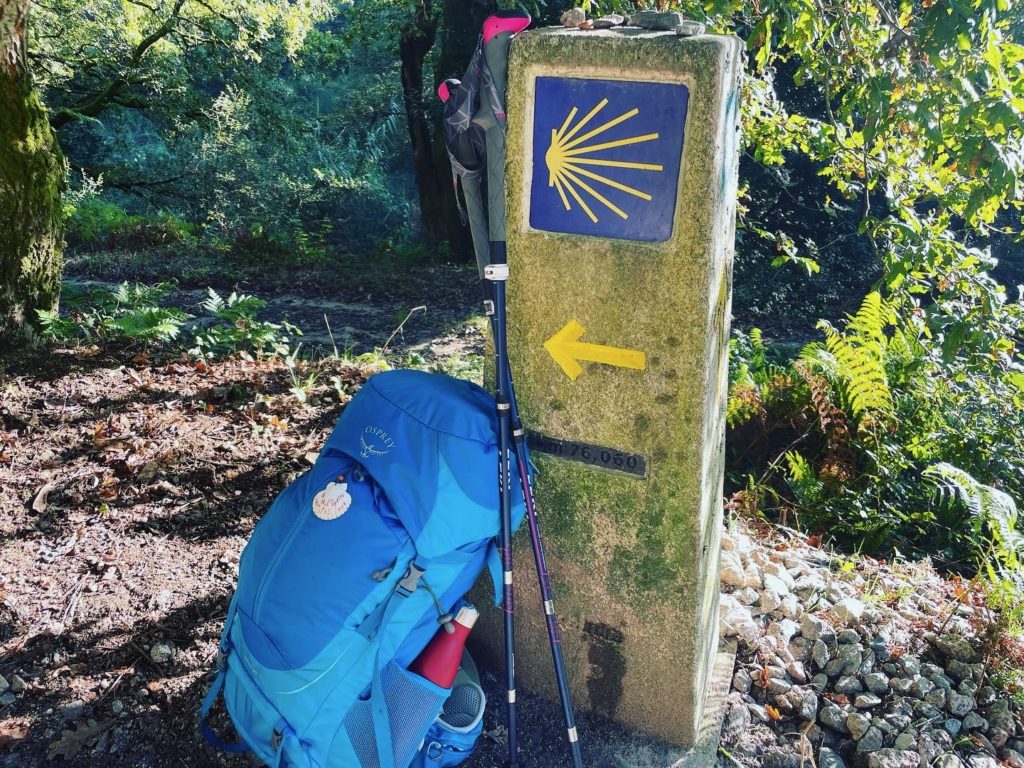
Standing in front of the stone pilgrim outside Tui.

Then upstairs for breakfast, and dear friends, let me say: if heaven has a buffet, it likely resembles this one. Fresh fruits, wheels of cheese, aged meats that smelled like the Holy Spirit might have blessed them individually, thick yoghurt, orange juice squeezed by angels, and coffee that I suspect came directly from the Eternal Roast.

Suitably fortified, we set off.

A few kilometres in, a local man waved us over to what can only be described as a tiny café birthed from a garage, run by his family. There were chairs, coffee, and—you guessed it — a second stamp. We, of course, stopped. Because one does not simply pass by good coffee in Spain. Nor does one pass up a stamp when one’s knees might revolt before the next one.

A few more kilometres on, deep in a forest, we encountered a Guardia Civil car parked under the trees — its two officers standing with expressions of profound seriousness and… a stamp. One imagines their law enforcement briefing that morning:

“Men, your mission today: stand quietly among the pines and validate passports for the weary.”

Naturally, we obliged. It’s not every day you get officially endorsed by the Spanish police and the Catholic Church within the same morning.

But it was the sound just beyond that checkpoint that moved me most. From deep within the trees, like the haunting call of my ancestors, I heard… bagpipes. Yes, bagpipes, here in southern Spain. David glanced at me and quipped, “Even here, you Scots need to be piped in!” And sure enough, there was a piper in full regalia playing Scotland the Brave, looking only slightly sunburnt and entirely proud. And yes—he had a stamp too. (And a tip jar. Which is just sensible theology.)

At this point, we had stopped counting kilometres, partly because we didn’t want to know, and partly because I’d left my Apple Watch at home, which has proven to be both spiritually enlightening and wildly inconvenient.

Standing at a very old marker along the way.

Eventually, we came to a fork in the trail — and like all good biblical metaphors, we had a choice. To the left: the routa alternativa — 6.55 km of forested path, shady and scenic. To the right: the “Area Industrial” — 1.1 km shorter, and paved. I consulted a group of young Spanish women walking near us. “Nature,” they said wisely, “is beautiful.”

But our aging joints had already voted. Expedience won. And thus, dear reader, we entered the industrial park — a sacred labyrinth of cement, heat, and exactly zero trees.

As the sun baked us like communion wafers left on a dashboard, I said to David, “The moment we see a café, we stop.” Which would have been a fine plan — had there been any cafés. But alas, industrial parks, like vestry meetings, are designed for work, not refreshment.

Roman Road XIX. You din’t find roads much older than this

Eventually, just as we were about to surrender ourselves to the pavement, we emerged, hobbling, into O Porriño, having clocked in at over 20 kilometres. And there, like a vision of the promised land, stood a restaurant offering cerveza, vino y tapas.

We sat. We sipped. We sighed.

David looked over his beer and said with deep sincerity,

“This now holds the record for the longest I’ve ever walked to get a beer.”

We still had 2 km to go to reach our hotel, but after 20, what’s another two? A cool-down lap. A postlude to the liturgy.

Perhaps walking through the beauty of nature in the Routa Alternative would have been a better choice, but we saw a lot of beautiful nature today anyway.

So I’ll leave you here, dear reader, glass in hand, sipping what may well be the tastiest glass of Albariño I’ve ever had — and preparing for the last bit of today’s journey.

There may yet be more to this story. But first: lunch. Then a nap. And maybe… a hymn of thanksgiving.

Follow along on Instagram @renewablespiritual.

Walking the Camino – Episode 2C: Of Coffee, Contours, and the Curious Case of the Tuna Salad

And so, dear reader, in the great tradition of pilgrims everywhere — and by that I mean those motivated primarily by caffeine — we once again set out into the afternoon sun of Tui in search of that most sacred of Spanish sacraments: a really good cup of coffee.

Fueled by an optimistic disregard for topography, we wandered down the winding streets from our venerable hotel to the edge of the Miño River, blissfully unaware that every delightful step downhill would soon become a penitential uphill return.

Along the Miña River looking across to Portugal

The riverfront, I must say, was glorious. The view of Portugal, reclining lazily on the far bank like a smug neighbour who finished their chores before lunch, was absolutely lovely. The breeze danced across the water like a hymn, and somewhere in the distance, a bell tower rang the Angelus, prompting my Canadian stomach to declare, quite unilaterally, that it was suppertime—even though in Tui, not even the flies had stirred from their siesta yet.

The streets, in fact, were so empty I began to wonder if some ancient Iberian custom forbade movement before sunset. Perhaps everyone was inside praying. Or eating. Or waiting for the weather to turn its wrath elsewhere.

In our continued wandering (or as I call it, liturgical strolling), we found a charming heladería. Naturally, I ordered a café con leche and a scoop — or three — of gelato. The young woman behind the counter nodded and began assembling this holy offering.

Gelato — Pinapple, Mandarin Orange, and strawberry

But then, just as I was about to indulge, she froze (pun unintended), gasped, and dashed over as if I’d just asked for pineapple on a tortilla.

“You said… celiac?” she asked.

I nodded, half a spoonful from joy.

With the solemnity of a Eucharistic minister intercepting a dubious wafer, she confiscated my gelato. Then she disappeared into the back for several minutes. When she returned, she was triumphantly bearing a new bowl of gelato — this time assembled from unopened, untainted, immaculate containers. Truly, dear friends, it is easier to keep kosher in Galicia than it is to navigate a potluck back home.

By the time we made our slow, heroic ascent back to the hotel, the bells were striking seven, and the town had begun to come alive. Locals emerged from doorways like actors entering stage left—all freshly dressed, well-rested, and suspiciously cheerful—as though the day’s heat hadn’t happened at all.

A Russian Salad

Inspired by their liveliness (and by the sudden pang of hunger triggered by the smell of garlic in the air), David and I decided to reverse the natural order of things. We had already had our postre — gelato — and now we would enjoy our supper. A backward meal for a backward hill.

The local café we selected featured a “Russian salad” as the special. Now, when one hears “salad,” one thinks perhaps of lettuce, tomatoes, a cucumber if you’re lucky. But no—this “salad” was, in fact, a majestic mound of fresh tuna, lightly supported by some modest vegetables, which seemed to have stumbled into the dish by accident. It was delicious, mysterious, and deeply unRussian.

By some continued miracle—possibly the Camino itself at work — my blood sugar remained remarkably steady, even after wine, seafood, and enthusiastic gelato consumption. No insulin needed again. I am now convinced the Camino Diet may become a spiritual discipline at home. Wine, walking, and whipped tuna—it’s practically sacramental.

Finding joy in the journey

Now back at the hotel, knowing that tomorrow holds the longest walk of our pilgrimage, it is time to retire. The sandals are off, the feet are up, and my soul—which has been trailing slightly behind me since Toronto—is finally catching up.

Follow along on Instagram @renewablespiritual.

So I leave you, dear reader, with this simple prayer:

A Prayer for Letting the Soul Catch Up

Lord of the long road and the quiet evening,
Thank you for this day of simple gifts —
a breeze on the river, a quiet bell, a scoop of ice cream.
Let my heart be still long enough to notice
where You’ve been walking beside me all along.
Help my soul catch up with my feet.
And tomorrow, walk with me once more.
Amen.

Walking the Camino Episode 2B: Pilgrimage, Piety, and the Pleasures

You might be forgiven, dear reader, if you’ve come away from these early blog entries believing that my primary focus on this pilgrimage is not penitence, nor prayer, nor even blister prevention — but rather, the noble art of eating. I assure you this is only partly true. The rest of the time I am either thinking about food, talking about food, or walking in search of food, which is, spiritually speaking, a kind of prayer.

David and I set off this morning to explore the medieval city of Tui — a charming town which, while not particularly large, is positively overrun with ancient stones, crumbling grandeur, and the very specific type of cobblestone that exists solely to remind you that orthotics are a blessing.

We are staying at Hotel A Torre De Xudeo, a structure so old and venerable it probably remembers when pilgrims still travelled with donkeys and spiritual baggage rather than hiking poles and gluten intolerance. The grand stone staircase in the reception area could well have been climbed by Saint James himself — though judging by its incline, he probably only did it once.

The little breakfast room in Hotel a Torre de Xudeo

This hotel, I might add, is ideally situated. By “ideally,” I mean it is so close to the Cathedral that one need only stumble down the steps (trying not to fall), take a sharp left past the Poor Clares, and you’re practically there. Speaking of the Convent of the Poor Clares, it sits just up the street — humble, closed, and silent. I assume the sisters are inside praying, baking, or quietly judging the footwear of passing tourists.

A few hundred metres further on stands the Cathedral of Santa María, a structure of such majesty that one approaches it not with footsteps but with awe. The bells — vast, noble, and likely audible from Portugal — hang overhead like iron archangels awaiting a signal. Inside, the space is cavernous and dark. The stone walls are measured in feet of thickness, presumably to keep out the cold and modernity. The windows, bless them, are charmingly small — as if the builders feared light might distract the faithful.

A beautiful Reredos in aone of many side chapels in La Catedral de Santa Maria in Tui.

Despite its gloom, the cathedral’s presence commands reverence. I stood in silence for several minutes before being distracted by the entirely secular but deeply theological thought: “Is it lunch yet?”

We meandered down through the twisting medieval streets, which were charmingly uneven and very nearly ankle-threatening, until we reached the Miño River, gazing across to Portugal with the wistful air of pilgrims who are entirely aware that there’s probably a good café just over there, if only they had time to cross.

And then, naturally, it was time to eat.

Now, in this part of Tui, every other establishment is either a restaurant, a bar, or some glorious hybrid of both. We selected one with the air of quiet confidence and a promising wine list. The waiter, who clearly sized us up as men in urgent need of refreshment, brought David a beer so cold it seemed to glisten with virtue.

Scaoolps for lunch
And Octopus…

As for myself, I inquired about Vinho Verde, my Portuguese go-to. The waiter, not missing a beat, explained that here in Spain, the equivalent is called Vino Albariño, made with the same grape, but presumably blessed by different bishops. One sip took me back ten years to Mira, Portugal, and an unforgettable lunch with my friend Rev. Silvário, who—like this wine—was bold, sharp, and went very well with shellfish.

Vino Alvariño … One taste reminds you that God is good.

And shellfish, dear reader, is precisely what we ordered.

We enjoyed scallops and octopus, both cooked to perfection. I would go so far as to say that the Galician diet, heavy on seafood and wine and light on stress, may be the most effective wellness regimen I’ve yet encountered. My blood sugar levels, normally prone to dramatics, have been perfectly behaved. My insulin remains untouched in my bag, sulking quietly while I enjoy another meal it did not earn.

And as always, beautiful very cold Gluten-free beer.

It may yet be that St. James was onto something. A long walk, a reverent heart, and a good lunch — with wine that tells stories and seafood that sings hymns — might just be the recipe for holiness.

Tomorrow, we walk. But today, we eat, pray, and marvel.

There is likely to be a part C today, as we are about to make a foray out to find a café on the Miño river to go and enjoy a nice espresso. I’m sure we will find many other interesting things along the way to the river. Stay tuned…

Follow along on Instagram @renewablespiritual.

Walking the Camino Episode 2: At Last, a Trouble-Free Moment (And a Seafood Platter Fit for the Apostles)

After a travel day so long and so chaotic that Dante might have made it an extra circle of hell, we finally arrived at our hotel in Tui—and miracle of miracles — it was the first thing that went off without a single hitch. No lost reservations, no language barriers, no need for interpretive dance to explain dietary restrictions. Just a kind young woman at reception who spoke such flawless English I briefly suspected she’d been imported from Stratford-upon-Avon.

Now, our room did suffer the tragic loss of its air conditioning system, which had, we were told, died peacefully sometime the night before. But no matter! The heroic receptionist presented us with fans, which we politely accepted and promptly ignored, as Galicia had decided to throw us a breeze and a blessing.

Santiago to Vigo. From Vigo we had a short bus ride in to Tui.

After unpacking our slightly battered luggage and declaring ourselves only mildly dishevelled, the first order of business was clear: real food. Having survived on the gastronomic equivalent of sandpaper—airport chicken—we ventured out into the ancient streets of Tui in search of something edible and, ideally, deliciously Spanish.

By divine grace and sheer hunger, we stumbled into a lovely little bar-restaurant that served traditional Galician fare and, even more miraculously, a gluten-free menu. It felt like the Holy Spirit had not only guided us to this place but also whispered in the ear of the chef.

We ordered the seafood platter. Because, well, when in Galicia… And let me tell you, dear reader, it was not a mere meal—it was a liturgy of shellfish. Our waiter, with the solemnity of a Eucharistic minister, brought us a bottle of house-made white wine. I took one sip and briefly considered canonizing the vineyard.

Razor Clams aplenty.

And then, it began.

Plate after glorious plate of shellfish appeared, as if the kitchen were reenacting the feeding of the five thousand, only with more mussels and fewer loaves. Each dish seemed determined to outdo the last—razor clams, cockles, mussels, prawns—all seemingly in competition to become the patron saint of my tastebuds. David and I ate with the enthusiasm of condemned men enjoying their final meal… which, given the amount of food, was not entirely out of the question.

Beautiful Mussels

Dessert, or postres as the locals say, came next. David was presented with a cheesecake that looked positively angelic. My gluten-sensitive self was limited to Helado de Cítricos. But before you shed a tear on my behalf, let me assure you: this citrus ice cream was less a dessert and more a revelation. I half-expected the tablecloth to part and a heavenly choir to descend.

An assortment of other delicious shellfish

We waddled back to the hotel in that special kind of fullness that turns your legs into sandbags and your mind to pudding. Showers were the next sacramental act. David went first, emerging minutes later as a new man. I followed, and by the time I stepped out, wrapped in the dignity of a hotel towel, the only sound in the room was David’s snoring—rhythmic, unashamed, and utterly unbothered. I joined him in unconsciousness moments later.

Tuesday morning arrived, and I awoke feeling more rested than I have in months. The hotel breakfast—or desayuno, which sounds far fancier—was abundant. David had more options than a cruise ship buffet. My choices were fewer, but glorious: fresh yoghurt, paper-thin slices of chorizo and prosciutto, and not one, but two café con leches… and a cortado for good measure. Friends, if breakfast were a sacrament, this one would be valid, licit, and deeply satisfying.

Today, we’re at leisure to explore Tui—a medieval town that deserves more than a passing glance. Tomorrow, the boots come on. The Camino begins in earnest. And if it’s even half as nourishing—spiritually or culinarily—as today, then sore feet will be a small price to pay.

I will post a part II for this day as it goes on. For now, it is time to go and explore this beautiful place.

Follow along on Instagram @renewablespiritual.

Walking the Camino Episode 1B: LORD, GIVE ME PATIENCE… AND I NEED IT NOW!

One defence mechanism I’ve developed over the years—besides pretending to know how to fold a fitted sheet—is the ability to laugh in the midst of discomfort. A spiritual discipline, if you will. And today, dear reader, I offer you this tale of travel, turbulence, and tailbone trauma, with the hope that you, too, might find a chuckle tucked in between the groans.

Now, those of a certain vintage may recall a cinematic pilgrimage of sorts from 1987—a delightful piece of work called Planes, Trains, and Automobiles. It starred Steve Martin and John Candy, and it chronicled the misadventures of two mismatched men simply trying to get home for Thanksgiving. As I sit here in Tui (finally), I can confidently report that David and I have now lived out a very Anglican, very real-world version of that film—except with less turkey and significantly more sitting.

Act I: The Great Canadian Launch

Our journey began in Bolton, where we departed the Rectory in the back of an Uber at the unsaintly hour of just after 7:00 a.m. (Toronto time). The car ride to Pearson was the only automotive portion of our pilgrimage, and likely the most comfortable, though even that proved a bit too plush for my condition—more on that momentarily.

Now, the airline had emailed strict instructions: arrive three hours before departure. In days gone by, such caution would have been necessary. One had to navigate crowds, queues, surly customs officers, and the occasional minor existential crisis in Duty-Free. But not this Sunday. The airport was so deserted I half-expected tumbleweeds to blow through security. There were no lines. None. Zip. Zilch. We had nearly three hours to do… absolutely nothing.

A Confession: My Cross to Bear

Before we go any further, I must share with you a private affliction. A condition passed down from my father (along with his knack for storytelling and his taste for Marmite). I call it D.A.S.—Diminutive Ass Syndrome. The Lord, in His infinite wisdom and humour, left me with a posterior tragically lacking in padding. While not usually fatal, D.A.S. becomes a serious trial when one is required to sit for long periods on hard plastic chairs.

And sit I did. For three hours. Then another hour, cramped into the coach-class micro-seat of American Eagle’s discount airline. (If those seats were any closer together, I’d have had to introduce myself to my kneecaps.) Compared to those seats, the Pearson waiting area began to look like the Ritz.

Act II: Welcome to JFK, Please Be Seated

Upon landing in New York, we discovered our next flight had been cancelled. Rebooked for a 4:45 departure. It was now 1:00. So, we waited. Again.

We ate airport food, a term I use loosely, and sat at our gate. Then, around 3:00, the screen simply blinked and erased our flight like it had never existed. A few moments later, a new one appeared. Different gate. Later flight. Another cancellation. Another three hours.

By now, I had achieved a form of spiritual levitation, whereby my backside existed on an entirely different plane of reality—namely, the one in which everything hurt.

Act III: The Patience Olympics

At 5:00, they called my name like I’d won a prize. I hadn’t. I was simply being summoned to a new gate, a new flight, a new seat-shaped form of purgatory, this time for a 7:45 p.m. departure.

Dear reader, if you’ve stayed with me this long, you’re already more patient than I was.

At 7:45 p.m., we finally boarded a plane bound for Madrid. The captain assured us the flight would take just over six hours. Six hours! A number which filled me with equal parts hope and dread. That would bring us into Madrid at around 2:00 a.m. Toronto time, whereupon we would—surprise!—wait again for a flight to Santiago.

Act IV: Lost Luggage and Gluten-Free Grace

Our bags did not make it. Of course they didn’t. They had been checked through to Santiago, and we were left circling a barren baggage carousel in Madrid. By some miracle (and the kindness of a staff member at Iberia Airlines), we were rebooked on a 7:10 p.m. flight. It was now noon. We had seven hours to… yes, sit.

Best tasting gluten-free beer ever… And I don’t even like beer.

David sought liquid courage in the form of a cold beer. When I requested one sin gluten, the woman behind the counter lit up and scurried off to retrieve a bottle of gluten-free goodness, as if she’d just found the Holy Grail. I could’ve wept.

Act V: But Wait—There’s More!

The final stage involved boarding a train—because of course it did—to take us 110 km backwards from Santiago to Tui, our actual starting point. We were now officially acting out the entire plot of Planes, Trains, and Automobiles, with a little bit of Waiting for Godot thrown in for theological flavour.

I must confess, I hadn’t walked a single kilometre yet on this pilgrimage, but I had sat enough to qualify for sainthood.

The Moral of the Story (or Lack Thereof)

If you’re wondering what I’ve learned from all this, the answer is simple: God does not give us patience. God gives us opportunities to learn patience. And friends, in the last 30 hours, I have been offered so many of those opportunities I am practically fluent in frustration.

But now, I lie on a proper bed, in a peaceful little room in Tui. I am stiff, sore, jet-lagged, and—dare I say it—grateful. The Camino begins in earnest tomorrow. I’ll walk with purpose, pray with intention, and yes… probably complain just a little.

But this I know: God was in all of it. In the cancelled flights. In the hard seats. In the cold gluten-free beer. Even in the silent baggage carousel. Because sometimes grace is not about ease—but about endurance.

Follow along on Instagram @renewablespiritual.

And so, with fear and trembling (and a heating pad), I dare once again to pray:

Lord of the long road and the slow unfolding,
You know how quick my spirit is to rush,
how eager I am for resolution,
and how hard it is to wait.

Teach me to breathe deeply when the way is delayed.
Give me grace in the in-between.
When plans shift, when doors close,
when I am asked to sit still—again—
remind me that You are not in a hurry.

Shape my heart to trust You,
not only in movement, but in the stillness too.

And if You are offering me one more chance
to learn the holy art of waiting,
then help me not to waste it.

Amen.

Walking the Camino – Episode One: The Journey Begins

The day has finally come.

After months of anticipation, prayer, training walks, gear lists, and heart-deep conversations, I find myself taking the very first steps of a journey I’ve dreamed of for years: walking the Portuguese Camino from Tui to Santiago de Compostela.

Day One doesn’t begin on the trail, though. It starts in the familiar cityscape of home — with an early-morning Uber pickup at 7:15 a.m., backpacks neatly zipped, passports secure, and spirits wide open. David, my trusted travel companion for this pilgrimage, is by my side. There’s a quiet kind of joy between us — the kind that comes from knowing something sacred is beginning.

We head to Pearson International Airport, checking in for our 10:44 a.m. flight to JFK in New York. There, we’ll face a 4-hour, 15-minute layover before boarding our overnight transatlantic flight to Madrid. From Madrid, the real journey toward Tui—and the trail—will begin.

It’s ironic, really. We’ve prepared to walk long distances each day for ten days through Spain, yet our pilgrimage begins with long hours of sitting. Airport lounges. Cramped coach seating. Crowds. Waiting. More waiting.

And yet, I’m reminded: this is part of the Camino too.

Pilgrimage begins in the stillness of travel. Every pause is a prayer.

Coach class isn’t exactly a luxurious way to travel — tight knees, stiff backs, and not enough leg room — but in a way, it’s fitting. The Camino invites simplicity. Discomfort is part of the formation. Even now, before the walking starts, the experience is shaping us — inviting patience, humility, presence.

We wait not just for a plane, but for something deeper to unfold.

The Portuguese Camino from Tui is often called “the spiritual variant,” and it feels right to begin with this reflective stillness. There’s a grace to this first day, even in the liminal spaces of terminals and air travel.

Tomorrow, we’ll wake up in Spain. Tomorrow, we’ll make our way to Tui. But today, we begin — not with walking, but with letting go, with trusting the journey, with embracing the unknown.

Follow along on Instagram @renewablespiritual.

Next stop: Madrid. The trail awaits.

A Prayer for the Journey

O God of all our journeys,
As we begin this pilgrimage,
Give us grace in the waiting and peace in the pauses.
Bless our comings and goings,
our check-ins and boardings,
our cramped seats and long layovers.

May this time of travel
be more than movement—
may it be preparation of the heart.

Hold us in your mercy,
guide us by your Spirit,
and go before us to the road in Tui,
where our feet will walk with purpose,
our spirits open to your mystery,
and our hearts aligned with your call.

In the name of Christ, the true Way,
Amen.

Walking the Camino The Prologue: On the Eve of the Journey

Tomorrow, I go.

After months of preparing, praying, packing, and walking in spirit—
now it’s time to walk with my feet.

The journey to Spain begins tomorrow,
and with it, the unfolding of something that’s been quietly growing in my heart for a long time.

But before I take that first official step on the Camino, I need to pause for one more thing:

Gratitude.

Walking The Camino: Decisions To Make, Packing, What To Take And Leave  Behind - Books And Travel
Before the first step comes the final breath of gratitude.

I give thanks for all of you who have prepared with me.

For those who’ve walked with me — digitally, prayerfully, and personally — through these reflections.
For your comments, encouragement, and quiet companionship.

I give thanks for those who’ve prayed for me as I prepared.
Your intercessions have been a steady wind at my back.

And I give thanks for those who will pray for me — and with me — as I make this pilgrimage to Santiago de Compostela.

Why Do Catholics Light Candles? Practices and Symbolism | LoveToKnow
When we can’t walk with someone, we can still walk beside them in prayer.

I go not alone.
I go carrying your blessings, your hopes, your stories.
I go with Christ before me, behind me, beside me.
I go as a pilgrim — not just in geography, but in heart.

This is no longer preparation.
This is pilgrimage.

And now, it begins.

Follow along on Instagram @renewablespiritual.

The Portuguese Camino from Tui, walking the 100 km - STINGY NOMADS
The journey begins not when we leave — but when we are ready to be changed.

Pilgrim’s Prayer: On the Eve of Departure

Gracious and loving God,

Thank you for the gift of this journey—
for the time of preparation,
for the strength to begin,
and for those who have held me in prayer.

As I go, go with me.
Walk beside me in every step,
meet me in every stranger,
and speak through every silence.

May the road rise to meet me—
and may the prayers of your people carry me
all the way to Santiago.

Bless those who walk with me in spirit.
Bless those I will meet on the Way.
And bless what is still unfolding within me.

For it is all grace.
And it is all Yours.

Amen.

Buen Camino, friends.
And thank you — for walking this preparation journey with me.
Now, let’s begin.

Let Your Blisters Bless You

Sooner or later, it happens.

You’ve prepped for months.
You’ve packed smart.
You’ve broken in your boots and worn the good socks.
But still — you get a blister.

Blister Prevention Tips for Camino de Santiago Pilgrimage
Even pain can become part of the pilgrimage.

It’s one of those realities of the Camino that every pilgrim shares at some point.
And when it happens, something shifts.
You stop pushing so hard.
You walk more tenderly.
You listen to your body.

And — maybe for the first time — you begin to realize:
Pilgrimage isn’t about perfection.
It’s about presence.

2016-June-14-Camino-488-edited
The Camino often teaches us how to receive, not just give.

We all want the journey to feel strong, smooth, and seamless.
But sometimes the places that ache the most are the ones that open us up—to grace, to help, to healing.

When you’re hurting, you’re more likely to:

  • Accept help you’d usually decline.
  • Rest when you’d rather push on.
  • Ask for care instead of offering it.

And that, too, is holy.

Like the psalmist says:
“You have been my refuge, a strong tower against the enemy.” —Psalm 61:3
And sometimes, that enemy isn’t outside of us.
It’s our own pride.
Our impatience.
Our drive to do it all on our own.

Follow along on Instagram @renewablespiritual.

pilgrim Archives - Nadine Walks
Walking gently isn’t weakness. It’s wisdom.

So here’s today’s invitation:

Let your blisters bless you.
Let the discomfort deepen your attention.
Let your vulnerability open you to grace.

Because pain, when it’s held with care,
can become sacred ground.

Pilgrim’s Prayer: For the Places That Hurt

God of the road and the resting place,

When pain slows me down,
teach me not to resist —
but to listen.

In the ache,
show me how to receive.

When I feel weak,
remind me I am still on the way — still loved,
still part of this holy journey.

Let my wounds teach wisdom.
Let my blisters become blessings.

And let every tender step
bring me closer to Your gentle heart.

Amen.

Learning to Walk Slower

In the early days of walking the Camino, it’s easy to think the goal is distance.

Get to the next town.
Reach the next landmark.
Make good time.

But then something shifts.

Your legs grow tired. Your feet start to ache.
And suddenly, the focus changes — from arriving to being.

Person walking along a foggy path in the early morning light 66365261 Stock  Photo at Vecteezy
The slower the pace, the more clearly you see.

One of the most surprising lessons of pilgrimage is this:
You need to slow down — not just for your body, but for your soul.

There’s a kind of rush we carry even into sacred spaces. A pressure to keep moving, to prove we’re “doing it right.” But the Camino teaches another way.

It says: Breathe.
Listen.
Be present.

The crunch of gravel underfoot.
The glance of a fellow pilgrim.
The quiet sound of your own thoughts, finally heard.

Hiking Boots Flowers Stock Illustrations – 214 Hiking Boots Flowers Stock  Illustrations, Vectors & Clipart - Dreamstime
Stillness isn’t stopping—it’s sacred attention.

Psalm 71 says, “You have taught me from my youth… and to this day I declare your wondrous works.”
But those works don’t only appear in the finish line or the mountain-top moment.
They’re found in the small, quiet places — when we slow down enough to see them.

We don’t need to rush to meet God.
We need to recognize that God is already here — along the path, in the pause, in the pace of grace.

Free Sunlit Forest Path Image | Download at StockCake
God often waits in the moments we try to rush past.

So here’s today’s invitation, as the journey unfolds:
Learn to walk slower.
Let your rhythm be set by grace, not pressure.
Let your walk be a practice of presence.

Because the point of pilgrimage isn’t just to get somewhere.
It’s to be here — heart open, eyes lifted, soul awake.

Follow along on Instagram @renewablespiritual.

Pilgrim’s Prayer: For a Slower Walk

Holy One,

Teach me to walk with intention,
not with hurry.

When I rush ahead,
slow my steps.
When I strive to prove something,
remind me that I’m already loved.

Let the road be more than a route—
let it be a teacher.

May I find You
not just in the destination,
but in every step that leads me there.

Amen.