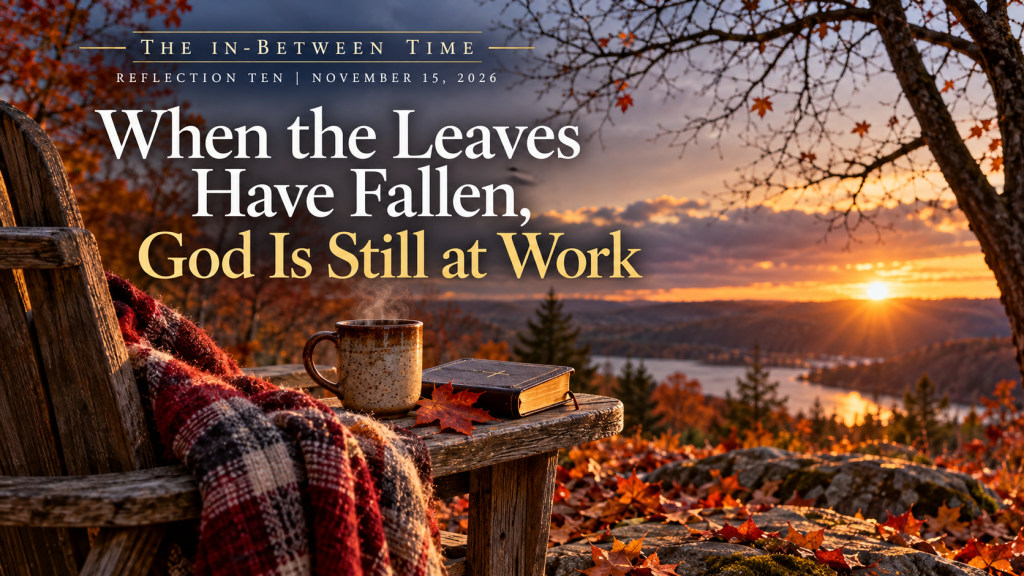
The In-Between Time — Reflection Ten | November 15, 2026
There is something wonderfully honest about the middle of November.
By now, most of the leaves have fallen. The trees stand rather awkwardly against the grey sky, looking as though they have been caught without their Sunday best. The gardens have surrendered. The flowers have retired. And the squirrels, having spent the autumn frantically burying enough food to survive three winters, are now wandering about looking vaguely puzzled, having forgotten where they put most of it.
I have always suspected that squirrels are God’s way of reminding us that activity and accomplishment are not necessarily the same thing.
November has a way of stripping things back.
The brilliant colours of October have faded. The great celebrations of All Saints and All Souls have passed. The Church year is approaching its conclusion, and Christ the King Sunday waits just ahead of us, ready to remind us that the final word belongs not to the powers of this world, but to the One who reigns from a cross.
And here we are, in this curious little stretch of time between remembrance and renewal, between the glory of the saints and the proclamation of Christ’s eternal reign.
It is a season that does not particularly concern itself with appearances.
And perhaps that is precisely why we need it.
The Spiritual Gift of Being Unimpressive
We live in a world that places a remarkable amount of importance on looking successful.
We measure achievement, celebrate productivity, admire influence, and generally behave as though a human life ought to resemble a well-managed corporation, preferably one with an impressive annual report and a modest surplus.
Even the Church is not entirely immune.
We count attendance. We measure giving. We evaluate programmes. We prepare reports. We discuss strategic priorities, mission statements, and occasionally the colour of the carpet with a degree of theological intensity normally reserved for the doctrine of the Trinity.
There is nothing inherently wrong with planning or measuring. Good stewardship requires both.
But somewhere along the way, we can begin to confuse visible success with faithfulness.
We start to believe that if something is growing, flourishing, and attracting attention, God must be at work.
And if something appears quiet, diminished, or uncertain, perhaps God has gone elsewhere.
November offers a gentle correction.
Look at the trees.
They are not producing anything particularly impressive at the moment. There are no blossoms, no fruit, and very little to recommend them to anyone seeking an uplifting photograph.
Yet beneath the surface, life continues.
Roots remain anchored. Energy is conserved. The tree prepares itself for a future it cannot yet see.
What appears to be inactivity is actually a different kind of faithfulness.
And the same may be true of us.
Not every season of faith is meant to produce something visible. Some seasons are simply meant to deepen our roots.
The God Who Works Beneath the Surface
Jesus understood this better than most.
In the fourth chapter of Mark’s Gospel, he tells a wonderfully understated parable about the Kingdom of God.
A farmer scatters seed upon the ground. Then, Jesus tells us, the farmer sleeps and rises, night and day, while the seed sprouts and grows.
And here comes the rather delightful part.
The farmer does not know how.
I find that enormously comforting.
Here is a man who has done what he was supposed to do. He has planted the seed. He has tended the ground. And then he goes to bed.
The Kingdom of God continues its work without requiring him to remain awake and supervise it.
This is deeply troubling news for those of us who believe that nothing worthwhile can possibly happen unless we are personally involved in organizing it.
I confess that clergy can be particularly susceptible to this misunderstanding.
We occasionally behave as though the Almighty has entrusted the entire future of Christianity to our ability to answer emails promptly, attend committee meetings, and remember where we placed the parish keys.
One might reasonably wonder how the Church survived the first three centuries without a diocesan strategic planning retreat.
And yet it did.
Not because planning is unnecessary, but because the Church has never ultimately depended upon our efficiency.
It depends upon the faithfulness of God.
The seed grows while the farmer sleeps.
Grace continues its quiet work when our strength runs out.
And the Kingdom advances in ways that cannot always be photographed, counted, or neatly entered into the minutes of the last meeting.
When Faith Feels Like November
Of course, there is another reason why this season speaks so powerfully.
Sometimes our own lives feel like November.
There are times when the bright colours seem to have disappeared.
Perhaps a relationship has changed. Perhaps illness has interrupted our plans. Perhaps grief has settled into the ordinary rhythm of our days, no longer announcing itself dramatically, but quietly taking its place at the breakfast table.
Perhaps we have reached a point in life when the things that once seemed so important no longer carry the same meaning.
Or perhaps we are simply tired.
Not the kind of tired that can be remedied by an early bedtime and a decent cup of tea, although I remain a strong advocate of both.
I mean the deeper weariness that comes from carrying responsibilities, disappointments, unanswered prayers, and the steady demands of being human.
In such seasons, faith can feel rather unimpressive.
Prayer becomes difficult.
Hope seems less certain.
The familiar language of belief can sound strangely distant.
And we may wonder whether God is still doing anything at all.
But here is something worth remembering.
The tree does not cease to be alive because its branches are bare.
The earth does not cease to be fruitful because its fields are resting.
And a soul does not cease to belong to God because it is passing through a season of silence.
Indeed, some of the deepest work of grace happens precisely when we have very little to show for ourselves.
The psalmist writes:
“Be still, and know that I am God.” (Psalm 46:10)
Notice that the instruction is not to be impressive.
It is not to be productive.
It is not even to be particularly cheerful.
It is simply to be still.
And to remember who God is.
That may be one of the most difficult spiritual disciplines of all.
The Saints Knew Something About This
Having just emerged from our celebrations of All Saints and All Souls, we would do well to remember that the saints were not uniformly spectacular people.
Some certainly accomplished extraordinary things.
Others lived lives that would have attracted remarkably little attention.
They prayed. They worked. They cared for children. They tended gardens. They visited the sick. They fed neighbours. They forgave people who were exceedingly difficult to forgive.
And occasionally, I suspect, they became irritated with one another over matters of absolutely no eternal significance.
The saints were human, after all.
Holiness does not require the complete elimination of ordinary human foolishness, although it would undoubtedly make parish meetings considerably shorter.
What distinguished the saints was not that every moment of their lives was extraordinary.
It was that they learned, however imperfectly, to trust the extraordinary faithfulness of God in the midst of ordinary life.
They understood that the Kingdom often grows quietly.
That grace can be hidden.
That love expressed faithfully over many years may accomplish more than a thousand grand gestures.
And that the most important things in life are not always the things that attract the greatest attention.
There is a holiness in perseverance.
There is a holiness in remaining faithful when enthusiasm has faded.
There is a holiness in showing up, loving generously, and trusting that God is doing something with our small offerings.
Even when we cannot see what that something might be.
The King Who Refused to Look Like a King
And all of this brings us toward the approaching conclusion of the Church year.
Next Sunday, we will celebrate Christ the King.
It is a glorious title.
It suggests majesty, authority, sovereignty, and triumph.
One might reasonably expect trumpets, banners, golden crowns, and perhaps a procession of sufficient length to require a traffic management plan.
But the Gospel has a rather startling way of redefining royalty.
When we encounter Christ’s kingship most clearly, we find ourselves looking not at a throne of gold, but at a cross.
Not at a ruler surrounded by powerful admirers, but at a suffering man surrounded by mockery.
Not at someone demonstrating authority through force, but at someone revealing the power of love through self-giving.
The King of Kings appears, by every ordinary measure of worldly success, to have lost everything.
And yet, precisely there, God is accomplishing the salvation of the world.
The cross is the ultimate reminder that appearances can be profoundly misleading.
What looks like defeat may become redemption.
What looks like an ending may become a beginning.
What looks like weakness may reveal the deepest strength imaginable.
And what looks like an empty, barren November landscape may be preparing for the astonishing possibility of spring.
God’s greatest work is not always announced by splendour. Sometimes it begins in silence, grows in obscurity, and changes the world through love.
Learning to Trust the Quiet Work
So perhaps the invitation of this November day is not to do more.
Perhaps it is to trust more.
To trust that God is at work in the places where we cannot see progress.
To trust that our prayers matter even when the answers are slow in coming.
To trust that kindness is never wasted, that forgiveness bears fruit beyond our understanding, and that love offered faithfully has consequences we may never live long enough to witness.
To trust that the Church belongs to Christ, not to our committees, our buildings, our budgets, or our occasionally heroic attempts to keep the photocopier functioning.
And to trust that our own lives are held within a grace far greater than anything we could manufacture for ourselves.
There is something liberating about that.
We do not have to make every season bloom.
We do not have to turn every difficulty into an inspiring success story.
We do not have to pretend that the bare branches are covered in flowers.
Sometimes faith simply means standing where we are, rooted in the promises of God, and allowing the season to be what it is.
That is not resignation.
It is hope.
The kind of hope that knows winter is real, but refuses to believe that winter is final.
A Little Grace for the Road Ahead
As I look out upon the November landscape, I find myself increasingly grateful for the honesty of this season.
There is no pretending.
The trees are bare. The days are shorter. The earth is quiet.
And yet, life continues.
Beneath the surface, the promise of renewal remains.
Perhaps that is what this in-between time is teaching us.
We have remembered the saints who have gone before us.
We are approaching the celebration of the King whose reign will never end.
And between those two great affirmations, we are invited to live faithfully in the ordinary, sometimes weary, often beautiful circumstances of our own lives.
We may not see all that God is doing.
We may not understand the timing.
We may occasionally feel rather like those squirrels, wandering through the landscape with great determination and only the vaguest recollection of what we were supposed to be accomplishing.
But the good news is that the future of the Kingdom does not depend upon our perfect understanding.
It depends upon the steadfast love of God.
And that love is already at work.
In the quiet prayer.
In the unexpected kindness.
In the reconciliation that begins with one difficult conversation.
In the courage to begin again.
In the faithfulness of ordinary people who keep loving, serving, and hoping, even when the branches are bare.
So today, let the November landscape preach its sermon.
Let the trees remind you that there is life beneath what appears lifeless.
Let the quiet remind you that God does not need to shout to be present.
And let the approaching feast of Christ the King remind you that the One who holds the whole creation in love is the same One who holds your life.
After all, the God who brought resurrection out of a sealed tomb is unlikely to be particularly troubled by a few fallen leaves.
And that, I think, is more than enough reason to hope.
Because when the leaves have fallen, when the colours have faded, and when everything seems to have grown quiet, God has not finished the story.
God is still at work.
And spring, in all its astonishing forms, is still part of the promise.
Follow along on Instagram @renewablespiritual for more daily reflections on faith, life, and the surprising places where God still loves to meet us.
Companion Prayer
Gracious God, when life feels as bare as the November trees, remind us that your grace is still at work beneath the surface. Give us patience in the waiting, courage in uncertainty, and faith to trust what we cannot yet see. Deepen our roots in your love, and teach us that even in the quietest seasons, you are preparing new life. Through Jesus Christ our Lord. Amen.