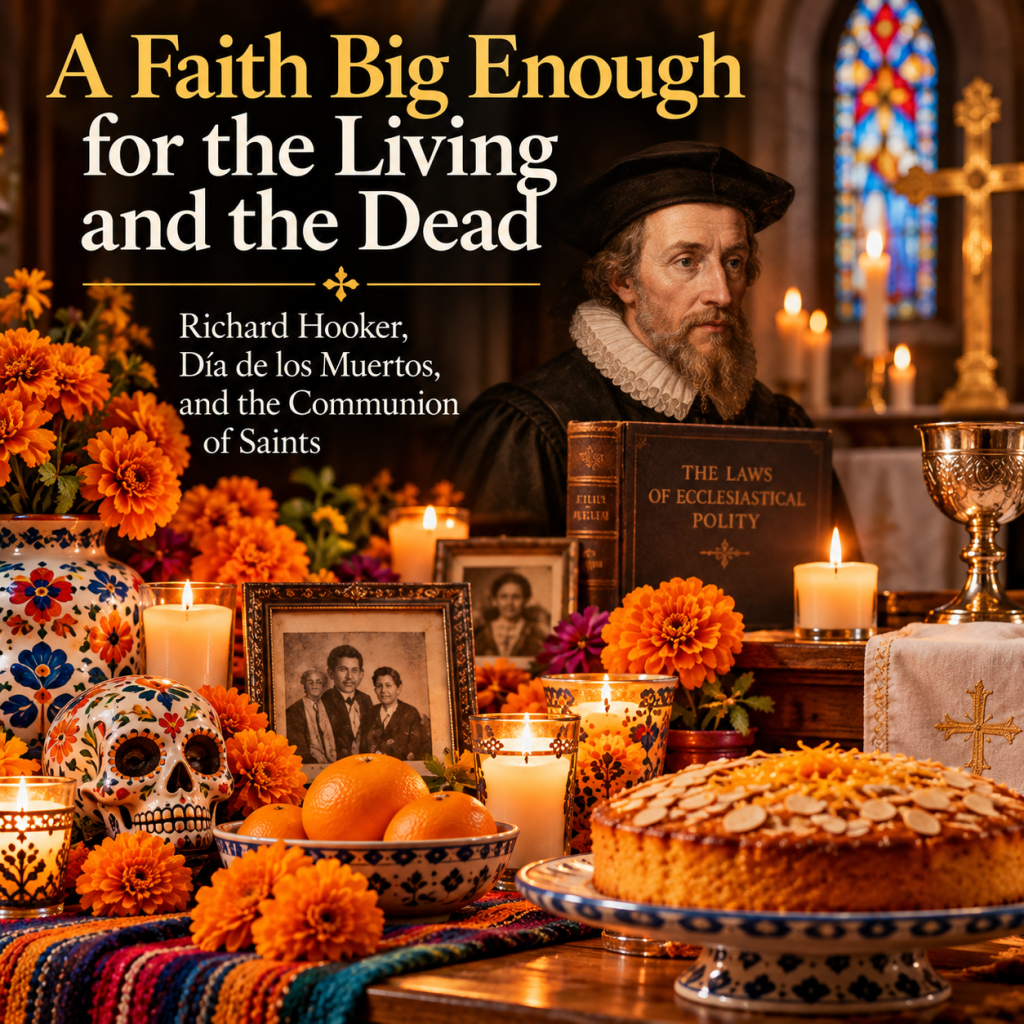
There is something rather wonderful about the Church calendar at this time of year.
Having spent October 31 remembering saints of the Reformation, November 1 celebrating All Saints, and November 2 remembering the faithful departed on All Souls, today—November 3—we turn our attention to Richard Hooker, Priest and Teacher of the Faith.
Apparently the Church, having spent several days contemplating heaven, eternity, death, resurrection, saints, martyrs, reformers, and the entire communion of saints, decided that what we really needed next was an Anglican theologian.
This seems entirely appropriate.
If there is one thing Anglicans know how to do, it is to take a perfectly straightforward theological question, pour a cup of tea, establish a committee, consult three contradictory historical sources, and produce an answer beginning with the words, “Well, it rather depends…”
Richard Hooker would probably have understood.
He died in 1600, having lived through one of the most turbulent periods in English Christianity. The Reformation had shaken the Church to its foundations. Catholics and Protestants were arguing about Scripture, sacraments, authority, worship, bishops, vestments, and almost everything else Christians could possibly disagree about.
Which is to say, Christianity was proceeding much as usual.
Into all of this stepped Hooker.
He was not interested in pretending that theological differences did not matter. They mattered enormously. But neither was he convinced that every disagreement needed to result in somebody being declared a heretic before luncheon.
Hooker believed in a Church capable of holding things together.
Scripture mattered.
Tradition mattered.
Reason mattered.
The accumulated wisdom of the Church mattered.
Human experience mattered.
And perhaps most importantly, God was considerably larger than our arguments about God.
That strikes me as particularly important during these days surrounding All Saints and All Souls.
Because these days are really about memory.
We remember the saints.
We remember the faithful departed.
We remember those whose lives shaped ours.
And memory is one of the ways love refuses to surrender to death.
When Memory Sets the Table
There is another beautiful tradition unfolding around these same days.
Across Mexico and in Hispanic and Latino communities throughout the world, families observe Día de los Muertos—the Day of the Dead.
Its history is rich and complex, bringing together Indigenous traditions and Christian observances surrounding All Saints and All Souls.
And at the centre of many celebrations stands the ofrenda.
An ofrenda is a place of remembrance.
Photographs of those who have died may be placed there. Candles are lit. Marigolds bring brilliant colour. Favourite foods may be offered. Objects associated with loved ones may be carefully arranged.
The result can be astonishingly beautiful.
But what moves me most is not simply the beauty.
It is the conviction underneath it:
We will remember you.
Your photograph still has a place.
Your story still has a place.
Your name still has a place.
Love has not packed away the good china simply because death came through the door.
There is something profoundly Christian in that refusal to forget.
Christians do not believe that death makes a human life irrelevant.
Quite the opposite.
We proclaim that every human life is held eternally in the love of God.
That is why Christians have remembered names from the beginning.
Peter.
Mary Magdalene.
Stephen.
Paul.
Francis.
Clare.
Teresa.
Richard Hooker.
And then there are the names that will never appear in a Church calendar.
Your grandmother.
My grandfather.
The neighbour who taught Sunday School for forty years.
The priest who baptized you.
The friend whose telephone number is still somewhere in your contacts because deleting it somehow feels terribly final.
The person whose chair you can still picture at the kitchen table.
These too belong to the communion of saints.
The Communion of Saints Is Bigger Than the Calendar
One of the dangers of talking about saints is that we can make holiness sound like a religious honours programme.
The really impressive Christians receive feast days.
The rest of us apparently receive coffee hour.
But All Saints and All Souls remind us that the communion of saints is infinitely larger than the calendar.
It includes the famous and forgotten.
Martyrs and mothers.
Bishops and bakers.
Theologians and farmers.
People who wrote enormous books about ecclesiastical polity and people who would have fallen asleep somewhere around page seven.
God knows them all.
And perhaps Richard Hooker can help us here.
Hooker resisted a Christianity that made everything unnecessarily narrow. He understood that the life of faith required humility—the recognition that God has given us Scripture, reason, tradition, community, worship, and one another to help us discern faithfully.
That requires listening.
It also requires admitting the astonishing possibility that God may occasionally be at work somewhere beyond the boundaries of our own experience.
This is where I find the image of the ofrenda particularly compelling.
I do not need to pretend that every cultural tradition is identical to Anglican theology in order to recognize something holy within it.
A candle burning beside a photograph.
A flower placed in memory.
A favourite food prepared because someone once loved it.
A family telling the old stories again.
These things say something the Church has always proclaimed:
Love remembers.
And Christian hope dares to say something even more astonishing:
God remembers too.
Remembered by God
There is an old biblical meaning of remembrance that goes deeper than simply recalling information.
When God “remembers,” something happens.
God remembers Noah.
God remembers the covenant.
God remembers God’s people.
This is not because the Almighty has suddenly found the celestial sticky note that fell behind the divine filing cabinet.
God’s remembrance is active.
God remembers in order to save.
And this is the hope beneath every Christian act of remembrance.
When we name the departed before God, we are not informing God of something God has forgotten.
We are placing our memory inside God’s greater memory.
We are saying:
I remember them.
I love them.
I miss them.
And I trust that they are already known more completely and loved more perfectly by you.
Perhaps that is why these November days matter so much.
All Saints tells us that holiness is real.
All Souls tells us that love survives death.
Día de los Muertos reminds us that remembrance need not always be grey and solemn; sometimes memory comes dressed in marigolds and music and food and laughter.
And Richard Hooker reminds us that faithful Christianity can be generous enough to recognize truth, beauty, wisdom, and grace wherever they appear.
There Is Still Room at the Table
Perhaps that is the image I want to carry forward from these first days of November:
a table surrounded by the living and the dead.
Some chairs are occupied.
Some chairs are empty.
Some people are present in flesh and blood.
Others are present only through photographs and stories and the strange ache that comes when somebody says their name.
But above the whole table stands Christ.
The One who ate with sinners.
The One who wept at the grave of his friend.
The One who entered death itself.
And the One whom death could not hold.
This is why Christians remember.
Not because we are unwilling to accept death.
But because we refuse to grant death the final word.
We light candles.
We tell stories.
We celebrate Eucharist.
We keep feast days.
We place photographs where we can see them.
We cook recipes handed down through generations.
We speak names aloud.
And occasionally we read Richard Hooker.
Admittedly, the last of these requires somewhat more stamina.
But all of them, in their different ways, proclaim the same astonishing truth:
The family of God is larger than the room we can see.
That is the communion of saints.
Not merely a list of unusually holy people.
Not simply stained-glass windows and ancient names.
It is the great company of those held together in Christ—the living and the departed, the celebrated and the forgotten, those whose names appear in calendars and those whose names are written only upon our hearts.
And perhaps holiness begins when we discover that God has made room for all of them.
And, wonderfully, has made room for us as well.
The table is larger than we imagined.
The family is larger than we imagined.
Grace is larger than we imagined.
And somewhere beyond the boundaries of what we can presently see, the feast has already begun.
“Memory is one of the ways love refuses to surrender to death—and in God, no beloved name is ever forgotten.”
Follow along on Instagram @renewablespiritual for more daily reflections on faith, life, and the surprising places where God still loves to meet us.
Companion Prayer
God of the living and the departed,
you hold every name in your eternal memory
and gather every generation within your love.
We thank you for Richard Hooker,
for teachers who have helped us think faithfully,
and for all the saints—famous and forgotten—
whose lives have shown us something of Christ.
Teach us to remember with gratitude,
to grieve with hope,
and to recognize your grace
in traditions and people beyond the boundaries of our own experience.
Bless the photographs we treasure,
the stories we continue to tell,
the tables where an empty chair is still noticed,
and every candle lit in love and remembrance.
When grief makes absence seem overwhelming,
remind us that in Christ no beloved life is lost,
no faithful love is wasted,
and no name is forgotten.
Until we gather at that greater table
where death is no more
and the whole communion of saints rejoices together,
keep us faithful, generous, curious, and hopeful.
Through Jesus Christ,
who is resurrection and life.
Amen.