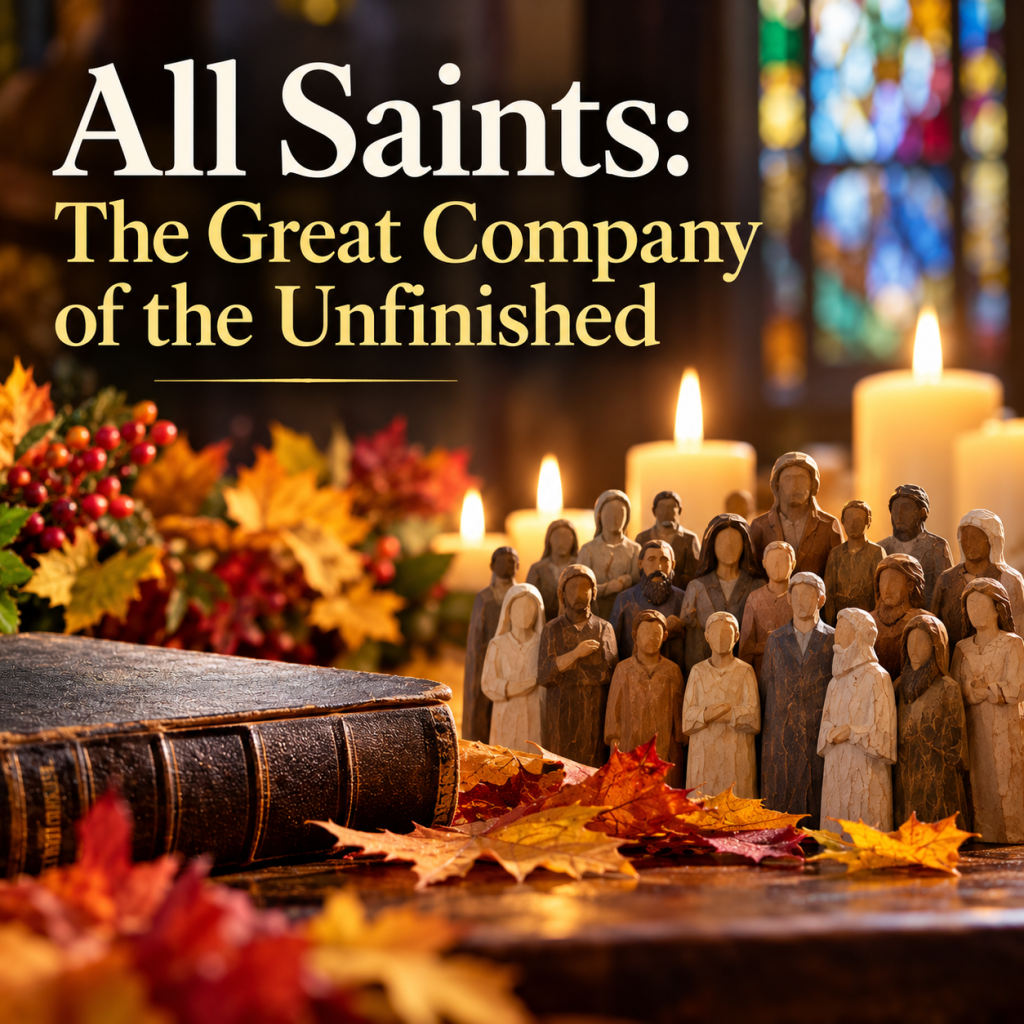
Today is All Saints’ Day.
It is one of those magnificent days in the Church calendar when we attempt something almost absurdly ambitious: we remember everybody.
Not simply the famous saints whose names ended up attached to churches, hospitals, schools, towns, and occasionally rather complicated traffic intersections. Not merely Augustine and Francis and Teresa and Patrick and Mary Magdalene.
Today we remember all the saints.
The celebrated ones.
The forgotten ones.
The saints whose stories fill books and the saints whose names disappeared from human memory generations ago.
And perhaps most importantly, we remember that the Church has never actually known the names of most of its saints.
That seems worth remembering.
Because Christianity has occasionally developed a rather peculiar idea of sainthood. We imagine saints as spiritual superheroes — people who floated several inches above the ground, prayed continuously, never became irritated in committee meetings, and apparently possessed none of the character defects familiar to the rest of us.
This is unfortunate.
Partly because it isn’t true.
And partly because it leaves the rest of us with very little hope.
If sainthood requires flawless behaviour, unwavering faith, perfect patience, and a serene disposition before breakfast, then I fear the Communion of Saints may be considerably smaller than advertised.
Fortunately, the Gospel suggests something much more interesting.
Saints are not people who managed to become perfect.
Saints are people who discovered that God’s grace is larger than their imperfection.
And that changes everything.
Saints With Mud on Their Shoes
One of the dangers of remembering saints is that time tends to polish them.
Give the Church a few centuries and we can make almost anyone look respectable.
We paint halos around their heads.
We place them in stained glass.
We carve them in stone.
And before long we forget that they once had muddy shoes, difficult relatives, unpaid bills, disappointing days, unanswered prayers, and probably several opinions that would have made parish council meetings considerably longer than necessary.
They were human beings.
Peter denied Jesus.
Thomas doubted.
Paul could apparently start an argument in almost any city around the Mediterranean.
Augustine spent years running away from God.
Francis of Assisi began life with considerably more enthusiasm for parties than poverty.
The saints were not people without contradictions.
They were people in whom grace somehow became visible through the contradictions.
That is important because it means holiness is not God’s reward for finally getting ourselves sorted out.
Holiness is what happens when ordinary human lives become increasingly available to God.
Sometimes beautifully.
Sometimes awkwardly.
Sometimes after several false starts.
And occasionally after God has had to knock rather loudly.
The Saints Nobody Remembers
But All Saints’ Day invites us to look beyond even these familiar figures.
Behind every famous saint stand millions of unnamed ones.
Someone taught Augustine to pray.
Someone fed Francis when he had given everything away.
Someone washed the linens in the early churches.
Someone cared for the sick during epidemics.
Someone taught children the stories of Jesus.
Someone visited prisoners.
Someone quietly forgave an enemy.
Someone kept showing up at worship when life was falling apart.
Someone slipped money into the hand of a struggling neighbour.
Someone planted a garden whose harvest fed people they would never meet.
Someone sat beside a hospital bed and whispered the Lord’s Prayer.
No statues.
No feast days.
No stained glass.
Just faithfulness.
And perhaps that is where most sainthood has always happened.
Quietly.
Without applause.
In kitchens and workshops and gardens and hospital rooms and classrooms and farm fields.
At dinner tables.
Beside graves.
Behind church altars.
In the pew three rows from the back where someone faithfully sat for forty-seven years and where, strangely enough, nobody else ever dared to sit.
Every congregation has one.
Possibly several.
The Great Communion
When Christians speak of the Communion of Saints, we are saying something astonishing.
We are saying that the Church is larger than the people currently sitting in it.
The Body of Christ stretches across geography, culture, language — and even death.
We belong to a story that began long before us and will continue long after us.
The saints remind us that we did not invent Christianity.
We inherited it.
Someone handed the faith to us.
Someone told us the stories.
Someone prayed before we knew how to pray.
Someone built the churches in which we worship.
Someone translated the Scriptures we read.
Someone sang the hymns before we learned the melody.
Someone carried the faith through war and famine and persecution and migration and family upheaval and ecclesiastical arguments about things that seemed terribly important at the time and are now entirely incomprehensible.
And somehow the Gospel arrived at our door.
That is the Communion of Saints.
A great river of faith flowing through generations.
And now, for a little while, the river flows through us.
The Question All Saints Asks
Which means All Saints’ Day is not merely about remembering the past.
It asks a question about the present.
What will we pass on?
Not whether people will remember our names.
Most won’t.
That is perfectly all right.
Most of the saints have already demonstrated that anonymity is no obstacle to holiness.
The question is whether the world will be slightly more merciful because we were here.
Whether someone will know they are loved because we told them.
Whether someone will eat because we shared.
Whether someone will find courage because we stood beside them.
Whether someone will discover Jesus because they encountered something of his compassion in us.
That is sainthood.
Not spiritual celebrity.
Not perfection.
Not having a church named after you.
Simply allowing the love of Christ to travel through your life into someone else’s.
And Perhaps One Day…
There is something wonderfully humbling about realizing that the saints we remember today once woke up on ordinary mornings.
They had no idea anyone would call them saints.
They simply had another day ahead of them.
Another neighbour to love.
Another prayer to say.
Another mistake to make.
Another opportunity to forgive.
Another chance to begin again.
Which means holiness may be happening around us right now.
The woman delivering meals.
The man caring patiently for his aging spouse.
The teenager standing beside the lonely kid at school.
The volunteer washing dishes after everyone else has gone home.
The person quietly returning to prayer after years away.
The neighbour who notices.
The friend who listens.
The stranger who stops.
None of them glowing.
None wearing halos.
Probably none particularly interested in stained glass.
Just ordinary people discovering, slowly and imperfectly, how to live like Jesus.
And perhaps that is why All Saints’ Day is such good news.
Because today the Church does not celebrate a collection of flawless people.
We celebrate the astonishing patience of God.
We celebrate grace working through human beings.
We celebrate generations of ordinary people who allowed the love of Christ to become visible in their lives.
And then we take our place among them.
Not because we have finished becoming holy.
But because God has not finished with us.
The great company of saints continues.
There is still room in the procession.
And, wonderfully enough, grace is still calling ordinary people to join it.
Even us.
Follow along on Instagram @renewablespiritual for more daily reflections on faith, life, and the surprising places where God still loves to meet us.
Companion Prayer
Holy and gracious God,
We thank you for the great company of saints:
for those whose names we remember,
and for the countless faithful souls whose names are known only to you.
Thank you for reminding us that holiness is not perfection,
but a life increasingly open to your grace.
Give us courage to love generously,
to forgive freely,
to serve quietly,
and to follow Jesus faithfully in the ordinary places of our lives.
May something of your mercy become visible through us,
and may the faith entrusted to us become a gift we faithfully pass on.
Through Jesus Christ our Lord.
Amen.