There is something wonderfully inconvenient about the saints.
We have a tendency, of course, to make them convenient.
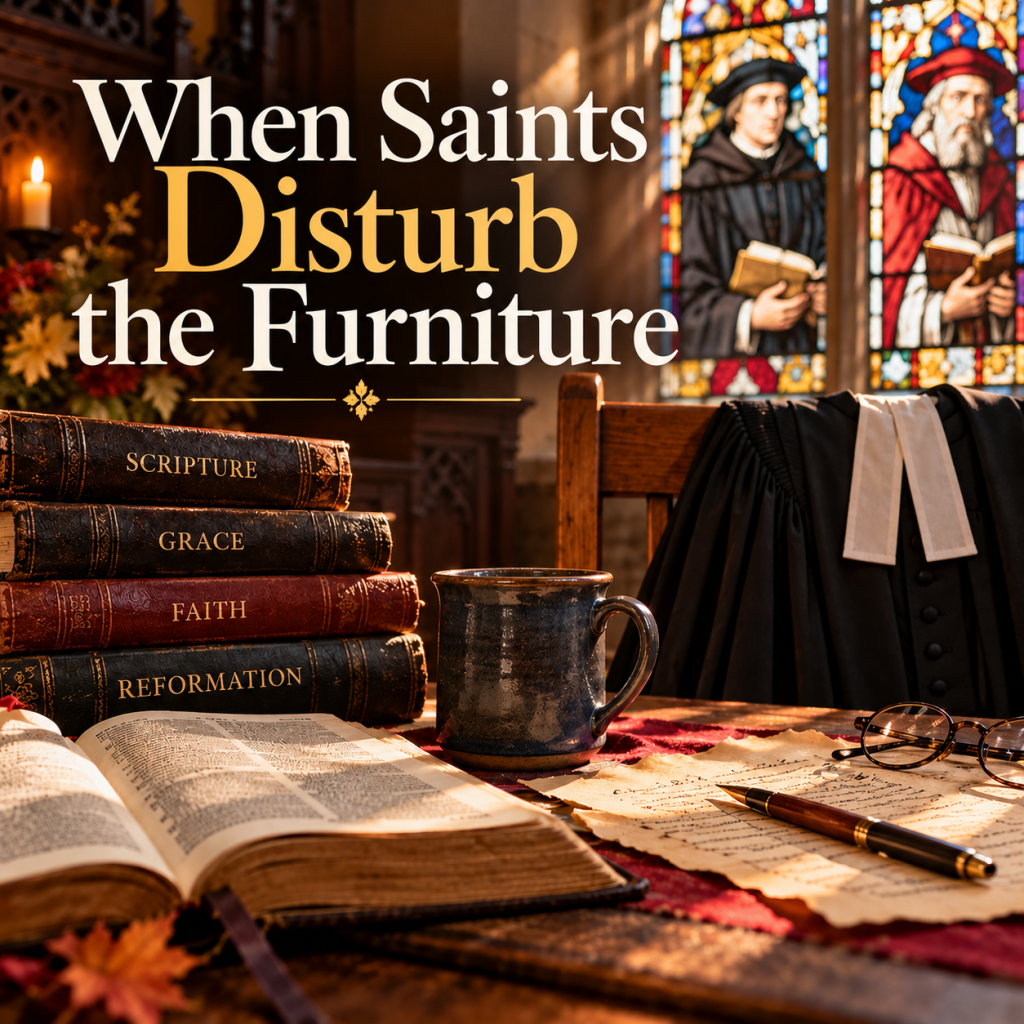
We put their names on churches. We carve them into stone. We place them in stained-glass windows where they stand serenely in shafts of coloured light, looking remarkably composed for people whose actual lives were frequently characterized by controversy, danger, disagreement, poverty, persecution, and the occasional unpleasant encounter with someone carrying a sword.
Time has a remarkable ability to tidy people up.
Give us five hundred years and we can make almost anyone respectable.
Today, as we remember the saints of the Reformation era, it is worth remembering that very few of them were considered particularly respectable at the time.
They were reformers.
And reformers, almost by definition, are people who walk into a room where everyone has finally arranged the furniture exactly as they like it and say,
“Have we ever considered moving the sofa?”
This is seldom well received.
The Church of the Reformation was wrestling with enormous questions: authority, Scripture, worship, grace, salvation, the sacraments, the nature of the Church itself. These were not academic debates conducted politely over tea and digestive biscuits. Kingdoms shifted. Churches divided. Friendships fractured. People suffered. Some died.
And while we rightly remember the courage and conviction of those who sought reform, we should resist the temptation to romanticize the period.
Christians behaved badly.
Sometimes spectacularly badly.
Which, admittedly, is not entirely unknown in other periods of Christian history.
The saints of the Reformation remind us that the Church is simultaneously holy and unfinished.
That may be one of the most important things the saints can teach us.
Because holiness does not mean perfection.
Holiness means belonging to God.
The saints were not people who had somehow completed Christianity while the rest of us were still looking for the instruction manual. They were human beings caught up in the grace of God. They had virtues and blind spots. Courage and prejudice. Wisdom and stubbornness. Moments when they saw the Gospel with extraordinary clarity and moments when they could not see beyond the assumptions of their own age.
In other words, they were people.
And God used them anyway.
There is hope in that.
Quite a lot of hope, actually.
Because if the Church were built only from people who had achieved complete theological clarity, flawless moral judgment, perfect patience, and unbroken charity, our parish directories would be considerably thinner.
Mine certainly would not contain my photograph.
But God has never waited for perfect people.
God called Abraham, who occasionally treated the truth as though it were an optional accessory.
God called Moses, who began his vocation by explaining to God why God had chosen the wrong person.
God called David, whose biography would require an exceptionally talented public relations department.
Jesus called Peter, who could move from divine insight to catastrophic misunderstanding with astonishing speed.
And then the risen Christ entrusted the Gospel to all of them.
This is the strange economy of grace.
God works through unfinished people.
Tomorrow we arrive at All Saints’ Day, that glorious celebration when the Church remembers not simply the famous saints whose names appear in calendars, but the vast communion of faithful people whose lives have been gathered into the life of God.
Most of them never had churches named after them.
They did not write theological treatises.
They never addressed councils or confronted kings.
They simply lived faithfully.
Someone taught a child to pray.
Someone visited a neighbour who was lonely.
Someone quietly fed people who were hungry.
Someone forgave when forgiveness was difficult.
Someone remained faithful through grief.
Someone discovered that love was more important than being right.
Someone kept showing up.
And perhaps that is where sainthood most often begins.
Not with greatness.
With faithfulness.
The saints remind us that Christianity is not primarily a collection of ideas preserved from the past. It is a life handed from one generation to another.
Someone handed the faith to us.
A parent.
A grandparent.
A priest.
A Sunday School teacher.
A friend.
Perhaps someone whose name we have not spoken aloud for years.
They became, whether they knew it or not, part of that great procession of witnesses through whom the Gospel travelled until eventually it reached us.
And now, rather inconveniently, it is our turn.
We are not merely people who remember the saints.
We are people being called into the same holiness.
Not stained-glass holiness.
Not halo-polished holiness.
Ordinary holiness.
The holiness of kitchens and hospital rooms.
The holiness of committee meetings and grocery stores.
The holiness of forgiving someone.
The holiness of admitting we were wrong.
The holiness of noticing someone everyone else has overlooked.
The holiness of discovering that the person across the theological divide may still be our brother or sister in Christ.
Perhaps that is an especially important lesson from the saints of the Reformation.
The reformers remind us that the Church sometimes needs courageous voices willing to say, “Something must change.”
But history also reminds us that reform without humility can become another form of certainty, and certainty without love can become remarkably destructive.
The Church is always being reformed because the Church is always being called more deeply into Christ.
The work is never finished.
There will always be another room where the furniture needs moving.
There will always be another assumption that needs questioning.
There will always be another neighbour whom we have not yet learned to love.
And there will always be grace.
That may be the most important thing.
Grace for reformers.
Grace for traditionalists.
Grace for saints.
Grace for sinners.
Grace for people who got things wonderfully right.
Grace for people who got some things terribly wrong.
Grace for the Church across the centuries.
And, mercifully, grace for us.
So as we enter these days of saints and souls, perhaps we should not look at the saints as distant spiritual celebrities.
Perhaps we should allow them to disturb the furniture.
Let them remind us that faith can demand courage.
Let them remind us that the Church can change.
Let them remind us that holiness is possible in deeply imperfect lives.
And let them remind us that God is still forming saints.
Even now.
Even here.
Even among people like us.
Which is either tremendously encouraging or slightly alarming.
Probably both.
Follow along on Instagram @renewablespiritual for more daily reflections on faith, life, and the surprising places where God still loves to meet us.
Companion Prayer
God of saints and sinners,
thank you for the faithful people
through whom your grace has travelled across the generations.
Give us courage when your Church needs reforming,
humility when we are certain we are right,
and love strong enough to listen across our differences.
Take our unfinished lives —
our gifts, our failures, our hopes, and our stubbornness —
and use them for your purposes.
Teach us the ordinary holiness
of showing up, forgiving freely,
loving generously,
and following Jesus faithfully.
And when the furniture needs moving,
give us enough courage to move it—
and enough grace not to throw it at anyone.
Amen.