There is something unsettling about the last day of September.
Calendars are wonderfully efficient things. They tell us when seasons begin, when meetings happen, when bills are due, and when one month has politely exhausted its allotted number of days and must surrender the kitchen to the next one.
But some things do not fit neatly inside a calendar.
Grief does not.
Truth does not.
Justice does not.
And reconciliation certainly does not.
Throughout these past days, we have been thinking together about truth and reconciliation with Indigenous peoples. We have considered repentance, relationship, listening, responsibility, cost, faithfulness, and the long work of healing.
And now September ends.
That creates a danger for the Church.
We may unconsciously begin to think that we have completed something.
We wore orange.
We remembered.
We prayed.
We listened.
We acknowledged painful truths.
Perhaps we attended an event, read an article, heard the testimony of a Survivor, learned something about the land on which we live, or spoke honestly about the Church’s involvement in the residential school system.
These things matter.
But none of them constitute completion.
Because reconciliation is not a season in the Church calendar.
It is a way of becoming the Church.
The Danger of Moving On
The Church is very good at seasons.
Advent becomes Christmas. Christmas becomes Epiphany. Lent becomes Easter. Easter becomes Pentecost. We know how to turn the page.
Sometimes that rhythm is a gift.
Sometimes it becomes an excuse.
There are truths from which Christians must refuse to move on.
The history of residential schools is one of them.
The suppression of Indigenous languages, cultures, ceremonies, spirituality, families, and communities is one of them.
The role played by Christian institutions is one of them.
The continuing consequences of colonialism are one of them.
And the remarkable courage, resilience, wisdom, spirituality, and generosity of Indigenous peoples are among them as well.
These cannot simply become subjects we visit once each September before returning to what we consider the Church’s “regular” business.
This is the Church’s regular business.
Because the Gospel is about reconciliation.
Saint Paul writes:
“All this is from God, who reconciled us to himself through Christ, and has given us the ministry of reconciliation.”
— 2 Corinthians 5:18
Notice the language.
God has given us a ministry of reconciliation.
Not an annual observance.
Not a committee assignment.
Not a themed Sunday.
A ministry.
And ministry means something we practise repeatedly until it becomes part of who we are.
What Will We Remember in February?
Perhaps that is the question churches should ask themselves.
Not what will we do on September 30?
What will we remember on February 12?
What will we be doing on an ordinary Tuesday in March?
What relationships will we still be nurturing next June?
What commitments will still appear in parish budgets five years from now?
Which Indigenous voices will have become part of our theological education, preaching, worship, reading, and decision-making?
Which friendships will have deepened?
Which uncomfortable truths will we still be willing to name when there is no national observance reminding us to name them?
Because transformation is revealed by what remains after the moment has passed.
Jesus understood this.
Again and again, he challenged people not merely to experience moments of spiritual awakening but to live differently because of them.
“Follow me.”
“Go and do likewise.”
“Love one another.”
“Take up your cross.”
“Feed my sheep.”
The Gospel continually moves from revelation to response.
We see.
Then we must decide what seeing requires of us.
Memory Is a Christian Discipline
One of the great words of Christian worship is:
Remember.
“Do this in remembrance of me.”
Christian remembrance is never simply nostalgia.
At the Eucharist, we do not remember Jesus as we might remember a childhood holiday or a beloved teacher.
We remember Christ in such a way that the remembered story becomes present among us and shapes how we live now.
Perhaps the Church needs to recover that understanding of memory in the work of reconciliation.
To remember residential schools is not merely to recall that they existed.
It is to allow that truth to shape the Church we are becoming.
To remember Survivors is not merely to honour their courage.
It is to ask whether our institutions are becoming safer, humbler, more accountable places because we have listened to them.
To remember Indigenous children who never returned home is not simply to mourn.
It is to ask what kind of Church we must become so that such violations of human dignity can never again be justified in the name of Christ.
That kind of remembering changes us.
Or at least it should.
The Church Must Build Memory Into Its Bones
Perhaps one of the most practical commitments we can make now is to stop depending upon individual enthusiasm.
Reconciliation cannot survive merely because one priest cares about it.
Or because one parishioner is passionate about it.
Or because one bishop makes it a priority.
People retire.
Clergy move.
Committees change.
Leadership turns over.
If reconciliation matters, then we must build it into the structures of our common life.
Into budgets.
Into parish education.
Into diocesan priorities.
Into theological formation.
Into children’s ministry.
Into preaching.
Into partnerships.
Into land acknowledgements that lead somewhere beyond the acknowledgement.
Into procurement decisions.
Into investments.
Into the ways we understand mission.
Into the stories we tell about ourselves.
Into the questions we ask when making decisions.
We should reach the point where reconciliation is not something the Church occasionally remembers to do.
It becomes one of the ways the Church has learned to be faithful.
And Relationship Cannot Be Institutionalized Entirely
Yet there is another danger.
We can create policies about reconciliation while avoiding actual relationships.
Christian institutions are capable of producing magnificent documents.
Relationships are considerably less tidy.
Relationships require time.
They require showing up.
They require remembering names.
They require accepting invitations.
They require listening when we would rather explain.
They require allowing someone else’s priorities to interrupt our own.
They require patience when trust develops more slowly than our strategic plan anticipated.
And healthy relationships with Indigenous peoples cannot exist simply so that churches may feel successful at reconciliation.
Friendship is not a project.
Relationship is not an achievement.
People are not evidence that our ministry strategy is working.
The goal is not for Indigenous communities to help the Church complete its reconciliation objectives.
The goal is for us to learn how to live together differently.
With truth.
With respect.
With humility.
With justice.
And eventually, perhaps, with trust.
We May Not Live to See the Finished Work
This may be one of the hardest truths.
The healing required is larger than any one generation.
Some wounds were created across generations.
Some consequences continue across generations.
It should not surprise us if healing also requires generations.
Christians are accustomed to wanting redemption stories with satisfying endings.
We like resurrection by Sunday morning.
But reconciliation may ask us to plant trees beneath whose shade we will never sit.
We may begin relationships whose deepest fruits will be enjoyed by people who come after us.
We may change institutions without ever knowing the full consequences.
We may apologize without receiving the response we hoped for.
We may work faithfully and still leave unfinished work behind.
That does not make the work meaningless.
It makes it an act of faith.
The Letter to the Hebrews speaks of faithful people who died without receiving everything that had been promised, but who nevertheless lived toward the promise.
There is holiness in beginning work we cannot finish.
There is humility in knowing that we are not the culmination of the story.
And there is hope in preparing a more truthful and just Church for generations we may never meet.
So Tomorrow Matters
Tomorrow will be October 1.
There will be other concerns.
Other sermons.
Other meetings.
Other headlines.
Other crises.
Other demands upon our attention.
And that is precisely why tomorrow matters.
The test of our commitment to reconciliation will not be how deeply we felt today.
It will be what we choose tomorrow.
And the day after that.
And six months from now.
And ten years from now.
Will we keep learning?
Will we keep listening?
Will we keep telling the truth?
Will we keep confronting the colonial assumptions that still linger within our institutions and within ourselves?
Will we support Indigenous leadership?
Will we build genuine relationships with Indigenous neighbours and communities?
Will we honour Indigenous voices without trying to control them?
Will we put resources behind our words?
Will we teach the next generation a more truthful history than many of us received?
Will we allow reconciliation to change not only what the Church says, but how the Church lives?
Those are harder questions than asking whether we wore orange today.
They are also more important.
The Last Post Cannot Be the Last Word
This is the final reflection in this particular series.
But it must not become the final word.
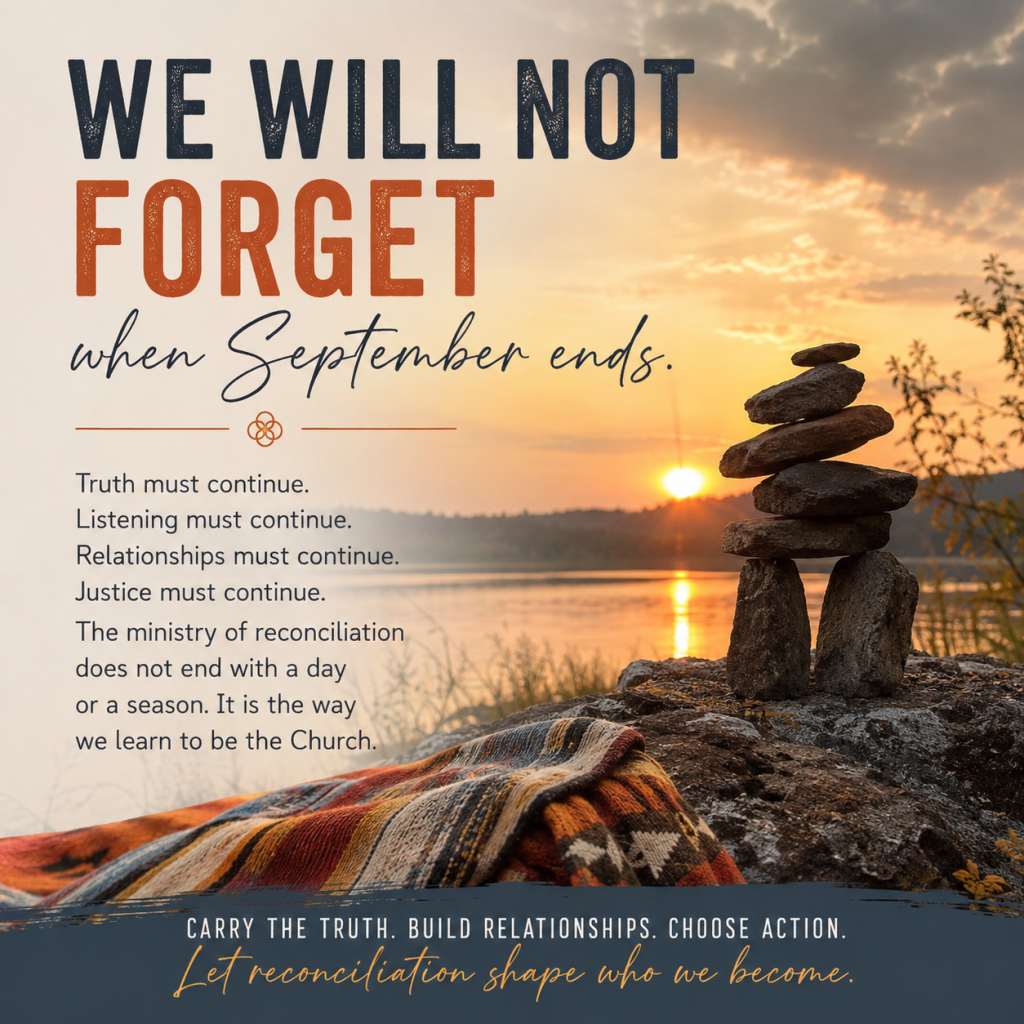
Truth must continue.
Listening must continue.
Relationships must continue.
Repentance must continue.
Learning must continue.
Justice must continue.
Prayer must continue.
And the patient work of reconciliation must continue.
Perhaps the Church’s renewed commitment can begin with something wonderfully simple:
We will not forget when September ends.
We will carry the truth with us.
We will allow it to shape our institutions.
We will nurture relationships that cannot be measured by annual reports.
We will remain present when attention moves elsewhere.
We will accept that healing may take longer than our lifetimes.
And we will trust that the God who has entrusted to us the ministry of reconciliation will continue forming us into people capable of practising it.
Not perfectly.
Not quickly.
Not without cost.
But faithfully.
September ends tonight.
The ministry of reconciliation does not.
Perhaps that is exactly where our real work begins.
Follow along on Instagram @renewablespiritual for more daily reflections on faith, life, and the surprising places where God still loves to meet us.
A Prayer When September Ends
God of truth and reconciliation,
do not let our commitment end with this day.
Keep us listening, learning, remembering, and acting.
Give your Church courage to seek justice, nurture relationships, and walk humbly with Indigenous peoples.
Make reconciliation not simply something we observe, but part of who we become.
Amen.