There is a particular danger that comes whenever the Church speaks about something important year after year.
The words can become familiar.
We learn the prayers. We recognize the language. We know when to wear orange. We know which acknowledgements belong at the beginning of gatherings. We know the history better than we once did. We have attended workshops, listened to speakers, read reports, passed resolutions, and perhaps even made solemn commitments about the kind of Church we hope to become.
All of these things matter.
But eventually a difficult question must be asked:
What has actually changed?
Not in our vocabulary.
Not in our intentions.
Not even in our awareness.
What has changed in the way we live?
For Christians, this is not an unreasonable question. Jesus asks versions of it throughout the Gospel. He seems remarkably uninterested in discipleship that remains safely confined to good intentions.
“By their fruits you will know them.”
Fruit is visible.
Fruit can be examined.
Fruit is what eventually reveals what kind of tree we have been tending.
That may be one of the questions the Church needs to carry into the work of reconciliation with Indigenous peoples.
What fruit is our commitment producing?
The Anglican Church has spent years speaking about reconciliation. We have acknowledged painful truths about our participation in residential schools and other systems that harmed Indigenous peoples, families, languages, cultures, communities, and spiritual traditions. We have apologized. We have listened. We have committed ourselves publicly to a different relationship.
Those commitments matter.
But promises made by the Church become credible only when they become practices of the Church.
That means reconciliation must eventually become visible in our budgets, calendars, partnerships, leadership, education, advocacy, worship, property decisions, community relationships, and priorities.
If reconciliation matters only when September arrives, then we have created an observance rather than a relationship.
If Indigenous voices are welcomed only when we are discussing Indigenous issues, we have not yet learned what partnership means.
If we acknowledge traditional territory while remaining uninterested in the Indigenous communities whose land we acknowledge, our words risk becoming detached from relationship.
If we speak passionately about reconciliation but never allow that commitment to influence how we spend money, use buildings, exercise power, choose leaders, or engage public issues, then reconciliation remains safely theoretical.
And the Gospel has never been particularly interested in theoretical love.
Jesus repeatedly moves love from sentiment into action.
Feed the hungry.
Welcome the stranger.
Visit the prisoner.
Care for the vulnerable.
Forgive.
Repair.
Restore.
Follow.
Christian love develops hands and feet.
So must reconciliation.
Perhaps one of the next stages in the Church’s journey is learning to practise accountability.
Accountability can be uncomfortable because it asks us to look honestly at the distance between what we say and what we do.
A parish might ask:
What relationships have we actually built with Indigenous neighbours?
Whose voices have shaped our understanding?
What have we learned this year that we did not know last year?
Where have Indigenous people influenced our decisions rather than simply been invited to participate in decisions already made?
What resources have we committed?
What relationships have continued beyond special Sundays and commemorative days?
What uncomfortable truth have we allowed to change us?
And perhaps most importantly:
What will we do differently next year because of what we have learned this year?
These are not questions designed to produce guilt.
They are questions designed to produce faithfulness.
The Church should not be afraid of accountability. Christians already believe that transformation is possible.
Indeed, transformation stands near the centre of our faith.
We believe that grace can change people.
We believe repentance can redirect lives.
We believe broken relationships can be healed.
We believe enemies can become neighbours.
We believe resurrection can emerge from places that once appeared hopeless.
But resurrection is not the restoration of the old arrangement.
The risen Christ does not simply return everyone to the way things were before Good Friday.
Something new begins.
That may be an important theological truth for reconciliation.
The goal cannot simply be better relations while leaving every old structure untouched.
Reconciliation asks whether something genuinely new can grow between Indigenous and non-Indigenous peoples — relationships marked by truth, mutual respect, justice, humility, friendship, and shared responsibility for the future.
And that will require the Church to become comfortable with being changed by relationship.
Real relationships always change us.
Friendship changes us.
Marriage changes us.
Parenthood changes us.
Community changes us.
Love changes us.
If our relationship with Indigenous peoples never changes the Church, then we should ask whether we have actually entered relationship at all.
Perhaps this is where a refreshed commitment to reconciliation must begin.
Not with another promise that we care.
But with a willingness to ask where caring has become action.
Not simply with another statement.
But with practices that can be seen.
Not simply with remembering the past.
But with decisions that reshape the future.
September 30 will soon arrive, and another National Day for Truth and Reconciliation will eventually pass.
The orange shirts will be folded.
Special services will conclude.
Public ceremonies will finish.
Social media will turn toward something else.
And that may be precisely when the Church’s commitment becomes most important.
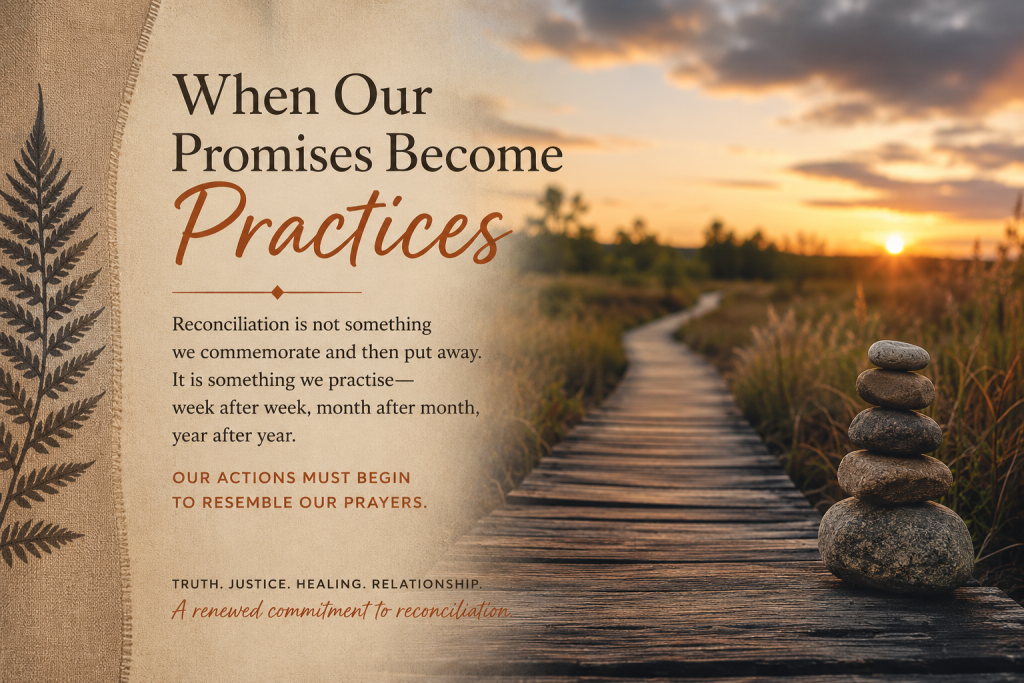
Because reconciliation is not something we commemorate and then put away.
It is something we practise.
Week after week.
Month after month.
Year after year.
Relationship after relationship.
Until our actions begin to resemble our prayers.
Until our budgets begin to resemble our theology.
Until our partnerships begin to resemble our promises.
Until Indigenous neighbours do not simply hear the Church saying that reconciliation matters, but can point to the life of the Church and say:
Yes. We can see that it does.
Tomorrow, as this series comes to its conclusion, there will be one final question for us to consider.
But today, perhaps this question is enough:
If someone examined the life of our church without hearing any of our words, would they be able to tell that reconciliation matters to us?
That is a difficult question.
It may also be a holy one.
Follow along on Instagram @renewablespiritual for more daily reflections on faith, life, and the surprising places where God still loves to meet us.
Companion Prayer
God of truth and reconciliation,
save us from promises that never become practices.
Give us courage to examine our lives,
our churches, our priorities, and our relationships.
Where our words have outrun our actions, lead us to repentance.
Where we have listened without changing, disturb our comfort.
Where relationships have been wounded, teach us the patient work of rebuilding trust.
Help us to listen humbly to Indigenous voices,
to act justly, to share responsibility,
and to remain faithful when the commemorations have ended.
By your Spirit, transform our good intentions into faithful action,
until our lives bear visible fruit
of truth, justice, healing, and renewed relationship.
In the name of Jesus Christ,
who calls us not simply to speak of love, but to live it.
Amen.