There comes a moment in every serious commitment when good intentions are no longer enough.
At first, reconciliation can feel like learning. We listen to stories we were not taught. We confront histories we were encouraged to forget. We begin to understand the terrible legacy of residential schools, the Sixties Scoop, broken treaties, displaced communities, suppressed languages, and generations of policies designed to separate Indigenous peoples from land, culture, family, and identity.
That learning matters.
But eventually truth asks a more difficult question:
Now that we know, what are we prepared to change?
That may be one of the most important questions facing the Church in Canada.
Because reconciliation that costs us nothing will eventually become little more than another church programme.
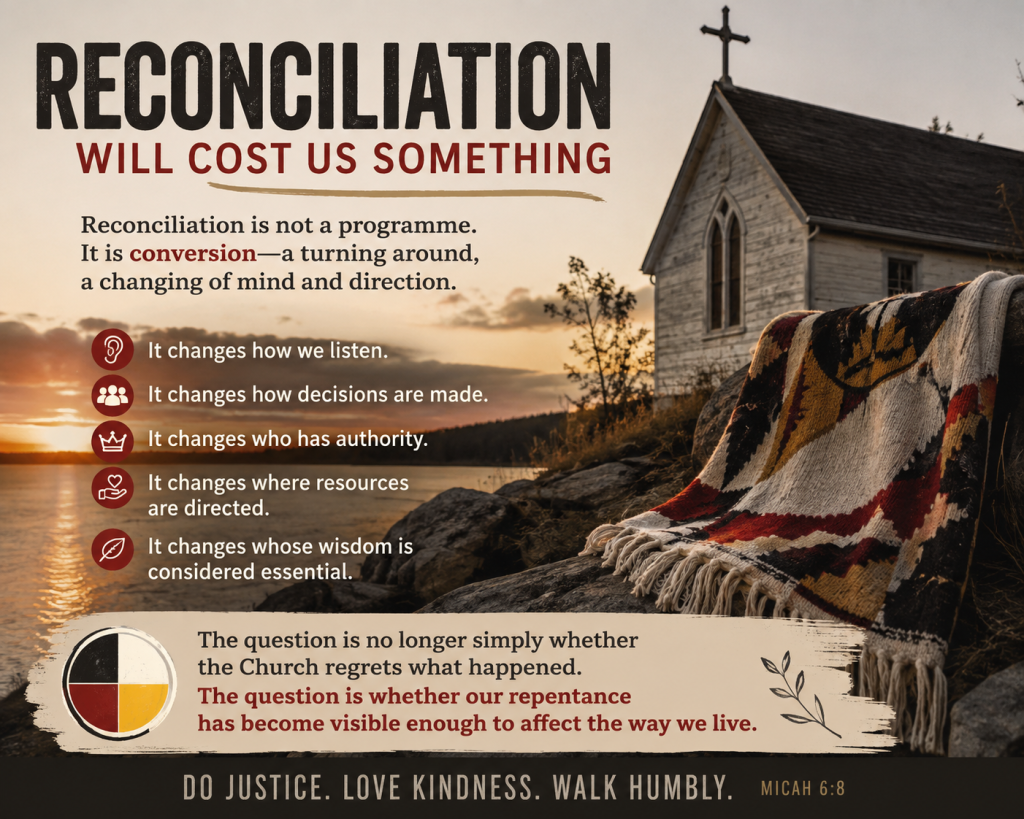
And reconciliation is not a programme.
It is conversion.
The Gospel word for conversion is metanoia — a turning around, a changing of mind and direction. Jesus does not simply invite people to recognize that something has gone wrong. He calls them to walk differently because they have recognized it.
That distinction matters enormously.
The Church can acknowledge the harm done to Indigenous peoples while continuing to protect the very habits and assumptions that helped create that harm. We can apologize for colonialism while still expecting Indigenous people to encounter Christianity primarily on our terms. We can honour Indigenous spirituality at special services while remaining suspicious when Indigenous Christians ask the Church itself to change.
We can become remarkably comfortable with reconciliation provided reconciliation does not rearrange the furniture.
But genuine relationship always rearranges something.
It changes how we listen.
It changes how decisions are made.
It changes who has authority.
It changes where resources are directed.
It changes whose wisdom is considered essential rather than optional.
And sometimes it requires those who have traditionally occupied the centre to move aside enough for another voice to be heard.
This is where reconciliation becomes more than sentiment.
For generations, churches often entered Indigenous communities believing that we possessed something they needed. We arrived as teachers, missionaries, administrators, and authorities. Even when individuals acted with compassion, the larger system too often assumed that European Christianity and culture stood above Indigenous traditions.
Reconciliation asks us to abandon that posture.
Perhaps one of the most important spiritual disciplines the Church can practise now is learning how not to be in charge.
That is difficult for institutions.
It is also deeply Christian.
John the Baptist understood something about faithful ministry when he said of Christ, “He must increase, but I must decrease.”
There are moments when faithfulness requires becoming smaller so that something else may flourish.
For churches committed to reconciliation, that may mean supporting Indigenous leadership without attempting to control it. It may mean providing resources without attaching institutional strings. It may mean advocating publicly when Indigenous communities ask for allies. It may mean examining parish investments, land relationships, educational practices, worship, partnerships, and budgets.
And it certainly means asking Indigenous neighbours what meaningful relationship actually looks like rather than deciding the answer ourselves.
The question is no longer simply whether the Church regrets what happened.
The question is whether our repentance has become visible enough to affect the way we live.
Imagine if every parish in Canada asked one practical question this year:
What is one thing we can change because we are serious about reconciliation?
Not another statement.
Not another committee report.
Not another photograph for social media.
Something tangible.
Learn whose traditional territory your church occupies and understand the history of that land. Build a relationship with a nearby Indigenous community or organization without beginning with an agenda. Support Indigenous-led ministries financially. Invite Indigenous teachers and compensate them properly for their time and knowledge. Learn about the Calls to Action of the Truth and Reconciliation Commission and identify those that specifically address churches. Advocate when Indigenous communities continue to face injustice involving water, housing, health, education, land, or treaty rights.
Then, having done one thing, do another.
Relationships are built that way.
Slowly.
Faithfully.
Repeatedly.
The Church has spoken many words about reconciliation. Some have been important. Some have been necessary. Some have been long overdue.
But we are approaching the point where the credibility of those words will depend increasingly upon what follows them.
The prophet Micah did not tell God’s people merely to admire justice.
“Do justice, love kindness, and walk humbly with your God.”
Do. Love. Walk.
They are verbs.
Perhaps that is the invitation before the Church now.
To move from remembering reconciliation to practising it.
From speaking about relationship to building it.
From acknowledging history to changing the future.
And from asking Indigenous peoples to trust our intentions to becoming, slowly and patiently, people whose actions are worthy of trust.
Truth and reconciliation will cost the Church something.
It may cost us comfort.
It may cost us control.
It may cost us money.
It may cost us cherished assumptions about ourselves and our history.
But discipleship has never been about protecting ourselves from the cost of love.
Jesus called it taking up a cross.
And perhaps one of the crosses the Canadian Church must carry in this generation is the long, humble work of becoming trustworthy neighbours again.
Not for one Sunday.
Not for one week in September.
But for as long as healing requires.
Reconciliation will become credible when Indigenous peoples can see not only that the Church has changed its words, but that we have been willing to change ourselves.
Follow along on Instagram @renewablespiritual for more daily reflections on faith, life, and the surprising places where God still loves to meet us.
A Prayer for Costly Reconciliation
God of truth and mercy,
give us courage to move beyond words into action.
Teach us to listen humbly, surrender control freely,
and change what must be changed.
Make our repentance visible in the way we live,
and our reconciliation faithful enough to rebuild trust.
Help us become trustworthy neighbours,
for as long as healing requires.
Amen.