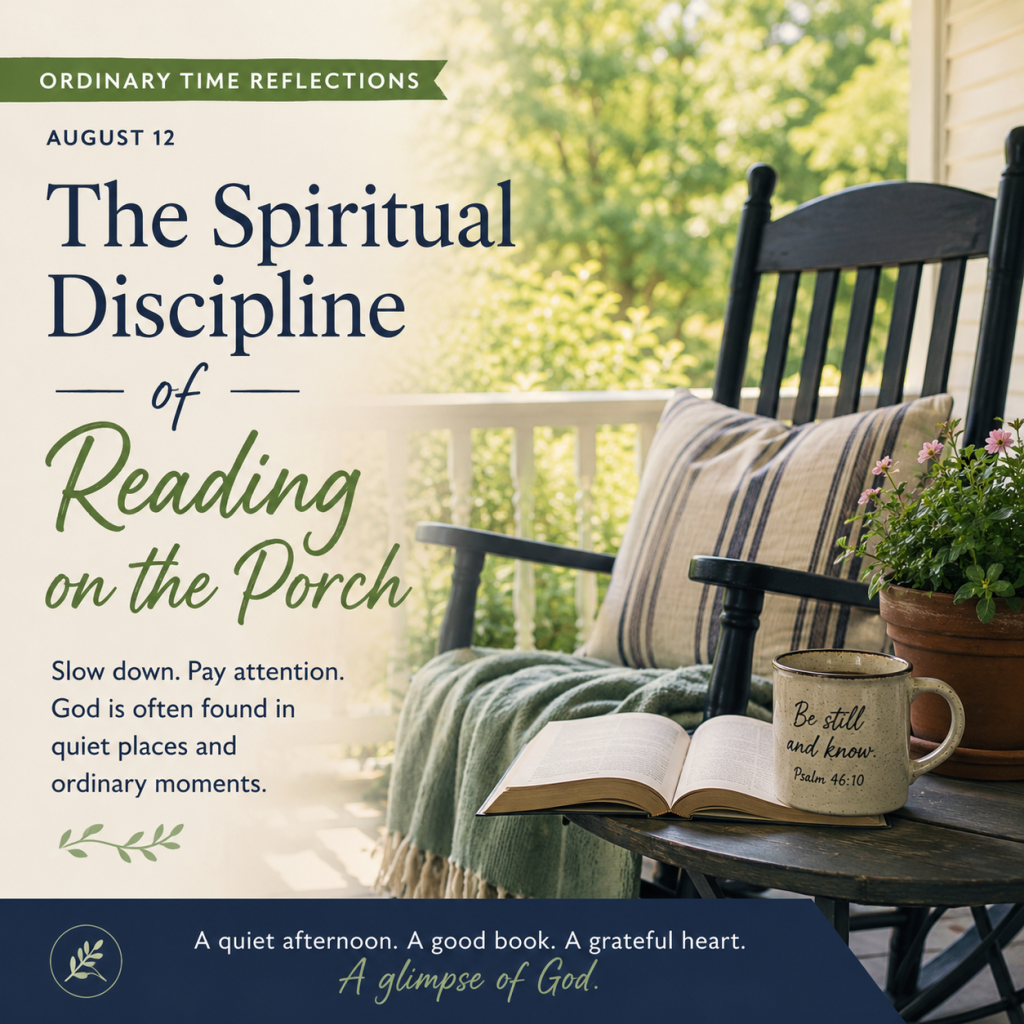
There comes a certain point in every Canadian summer when a porch chair quietly begins calling one’s name.
It does not shout.
It does not send notifications.
It simply waits.
And if one has been paying attention to the rhythms of creation for any length of time, one eventually recognizes that resisting the invitation is usually a mistake.
Now I have spent enough years in parish ministry to know that porches come in many varieties. Some are grand wraparound affairs with enough room for half the parish. Others are little more than three wooden steps and a chair that has survived several questionable paint jobs. A surprising number lean ever so slightly in a direction that engineers might politely describe as “optimistic.”
Grace seems remarkably unconcerned.
The true purpose of a porch has never been architectural.
It exists to slow us down.
Of course, every respectable porch also requires a book.
This is where matters become wonderfully complicated.
There are those disciplined souls who actually finish every book they begin.
I admire these people enormously.
I have never entirely understood them.
Most of us possess what might be called a “summer reading pile,” which is less a carefully organized literary project and more an expression of extravagant hope.
By August it generally contains theology, history, mystery novels, gardening books, biographies, one cookbook we have absolutely no intention of following precisely, and at least one volume purchased because someone confidently declared, “You simply must read this.”
It has been sitting beside the chair ever since.
Meanwhile, the dog has shown considerably more interest in it than we have.
Still, there is something quietly holy about opening a book on a summer afternoon.
Reading asks something of us that our hurried lives rarely do.
It asks us to stay.
To linger.
To pay attention.
To listen to another voice without immediately preparing our own reply.
That, it seems to me, bears more than a passing resemblance to prayer.
I have often found that two of the greatest spiritual disciplines in my own life have been taking time simply to sit and read, and taking time simply to sit and write. Neither activity always looks particularly holy. In fact, much of what I read has nothing to do with theology, and much of what I write never becomes a sermon, a blog post, or anything anyone else will ever read.
That is not really the point.
Reading gently draws my mind into new places while giving my body permission to rest. Writing does something equally valuable. It allows me to gather the scattered thoughts, dreams, questions, and little observations that have accumulated throughout the day and shape them into something a little more coherent. Sometimes those pages become something worth sharing. More often, they simply become a conversation between God, my own heart, and an old notebook.
Both practices remind me that not every moment has to produce something. Sometimes the greatest gift is simply creating enough quiet for the soul to catch up with the rest of us.
The Scriptures often describe God’s wisdom arriving not through spectacle, but through quiet attentiveness. Elijah found God not in the wind or earthquake or fire, but in what the King James Version beautifully called “a still small voice.” Jesus Himself regularly withdrew from crowds into places where silence could once again become audible.
Perhaps our porches become little monasteries without anyone noticing.
There, between the turning of pages and the scratching of a pen, between the songs of robins and the gentle sway of the rocking chair, we slowly remember that our worth has never depended upon constant productivity.
The rocking chair keeps moving.
The breeze keeps blowing.
The neighbourhood carries on with bicycles, lawn mowers, children chasing one another with astonishing enthusiasm, and somebody somewhere inevitably attempting to barbecue something just a little too enthusiastically.
Life continues.
And we discover that we need not manage all of it.
Perhaps that is one of God’s quieter gifts.
A porch reminds us that we are allowed simply to receive the day.
Not every moment must accomplish something.
Some moments exist simply to be inhabited with gratitude.
I suspect this is one reason Jesus so often taught people to notice ordinary things—birds, flowers, seeds, vineyards, fishermen, bread. Holiness has always been hiding in plain sight, waiting for someone willing to slow down long enough to recognize it.
So if you happen to find yourself on the porch today with a book in your lap—or perhaps a notebook resting beside your coffee—do not worry if you read only a few pages or write only a few lines before becoming distracted by the breeze, the clouds, or the neighbour walking past with a friendly wave.
You may have accomplished less than you intended.
But perhaps you practiced something even more important.
You remembered how to be fully present in a world that God still lovingly refuses to hurry.
And that may be one of the finest chapters you write—or read—all summer.
Follow along on Instagram @renewablespiritual.
Companion Prayer
Gracious God,
Thank you for the gift of quiet moments that restore our souls. Teach us to slow our hurried pace, to delight in simple pleasures, and to discover your presence in the turning of a page, the song of a bird, and the gentle breeze of an ordinary afternoon. May our times of rest deepen our faith, renew our spirits, and remind us that we are loved not for what we accomplish, but for who we are in you. Grant us hearts that are attentive, grateful, and ready to receive each day as your gift.
Amen.