There is something deeply satisfying about a list.
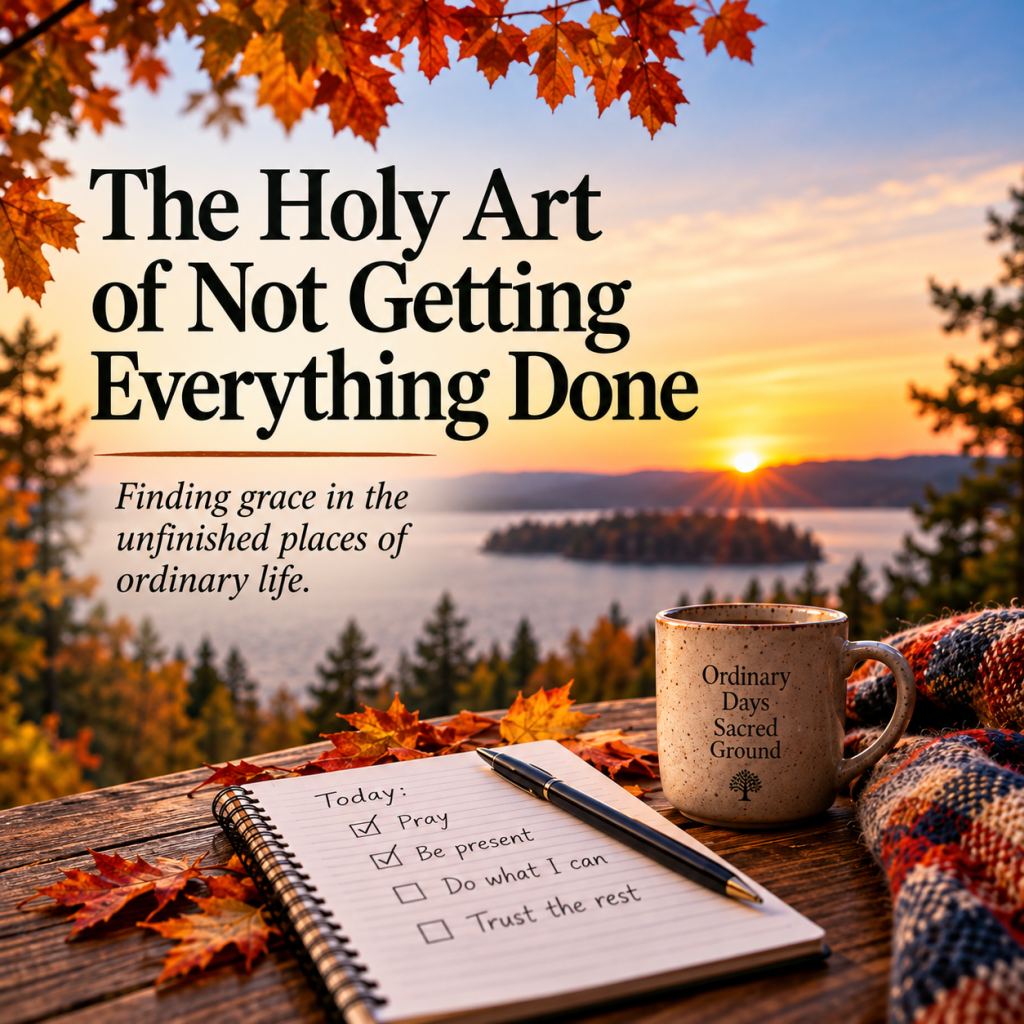
I am particularly fond of lists because they create the impression that life is under control.
You write down six things in the morning, place a small box beside each one, and then proceed through the day with the serene confidence of a person who believes the universe can be managed with a ballpoint pen.
Occasionally this even works.
You answer the email.
You make the telephone call.
You pick up the groceries.
You return the library book that has been sitting beside the front door for three weeks specifically so that you would remember to return it.
And then, with considerable ceremony, you place a checkmark beside each accomplishment.
There are few pleasures quite so immediate.
Unfortunately, somewhere around item four, life usually becomes involved.
Someone telephones.
A meeting runs long.
The car develops an interesting new noise.
The dog is sick.
A friend needs to talk.
The computer decides that precisely now would be an excellent time to install seventeen updates.
And by supper, the list that began the morning as a declaration of human competence has become documentary evidence for the prosecution.
Three boxes remain unchecked.
We have not finished.
And we do not like unfinished things.
The Religion of Getting Things Done
We live in a culture that admires completion.
Projects should be finished.
Goals should be achieved.
Inboxes should apparently reach something called “zero,” although I have always regarded Inbox Zero as one of those mythical places like Atlantis or a church meeting that ends ten minutes early.
Even our language reveals the expectation.
We ask one another, “What did you get done today?”
Rarely does someone ask:
“Where did you notice grace today?”
Or:
“Who needed you today?”
Or:
“Did anything beautiful interrupt your schedule?”
Productivity is useful, of course. Things genuinely need doing. Laundry cannot survive indefinitely on theological reflection. Eventually someone has to put it in the washing machine.
But trouble begins when productivity quietly becomes identity.
I accomplished something, therefore I matter.
I finished something, therefore the day was worthwhile.
I was useful, therefore I am valuable.
And somewhere beneath all of that is the exhausting suspicion that perhaps God is keeping a list too.
Jesus Was Surprisingly Interruptible
One of the remarkable things about Jesus in the Gospels is how often his plans are interrupted.
He is walking somewhere when someone calls out.
He is teaching when somebody arrives.
He is travelling when a sick person needs attention.
He is attempting to get away for some rest when an entire crowd appears.
If I had been organizing Jesus’ ministry, I would have suggested a better appointment system.
Perhaps colour-coded.
Possibly with an administrative assistant.
Certainly with clearly posted office hours.
But Jesus seems remarkably unconcerned about the efficiency of the schedule.
Again and again, the interruption becomes the ministry.
The person who was not on the agenda becomes the person standing directly in front of him.
And Jesus notices.
That may be one of the quiet disciplines of Christian life: learning that the unexpected thing is not necessarily preventing us from doing God’s work.
Sometimes the unexpected thing is God’s work.
Ordinary Time Is Full of Unfinished Things
These autumn days between Thanksgiving and All Saints are full of unfinishedness.
The garden is nearly finished but not quite.
Some leaves have fallen; others remain stubbornly attached to the trees as though they have not received the memorandum.
The daylight is shortening.
Winter is coming, but autumn has not yet packed its bags.
The Church calls this Ordinary Time.
And perhaps Ordinary Time teaches us something about living faithfully in the middle.
Most of life is lived there.
Between beginning and completion.
Between prayer and answer.
Between planting and harvest.
Between diagnosis and recovery.
Between disagreement and reconciliation.
Between grief and whatever healing eventually becomes.
Between the person we once were and the person God is still creating.
We are unfinished people living unfinished lives in an unfinished world.
And remarkably, God does not appear embarrassed by this.
God Seems Quite Comfortable With Process
Scripture begins with creation unfolding.
Abraham begins walking without knowing exactly where the journey will lead.
Israel spends forty years getting somewhere that might have looked considerably closer on a map.
The disciples misunderstand Jesus repeatedly.
Peter takes approximately three years to learn lessons he will later forget in a courtyard.
Paul writes to churches that are very clearly works in progress.
And the Kingdom of God itself is described as something growing — seed becoming plant, yeast working through dough, a tiny beginning moving toward something larger.
God seems rather fond of process.
We prefer instant holiness.
God seems content with growth.
We would like transformation delivered by Tuesday afternoon.
God works through seasons.
Perhaps that is because grace is not simply interested in getting us somewhere.
Grace is forming us while we travel.
The Unchecked Box
So perhaps there is a small spiritual practice available to us at the end of an ordinary day.
Look at the things you did not finish.
The email unanswered.
The cupboard still untidy.
The project half-completed.
The telephone call postponed until tomorrow.
And instead of allowing those things to become evidence that the day somehow failed, simply say:
Enough.
Not because the work does not matter.
Not because responsibility is unimportant.
But because you are not the Messiah.
That position has already been filled.
And this is very good news.
The world will continue while you sleep.
God will remain awake.
Grace will continue working in places you cannot see.
Seeds will grow underground.
Hearts will change slowly.
Mercies will arrive quietly.
And tomorrow morning there will undoubtedly be another list.
Before All Saints
Perhaps that is worth remembering as we move toward All Saints.
The saints were not people who managed to finish themselves.
They were people who learned to trust God with their unfinishedness.
They stumbled.
They doubted.
They occasionally made spectacular mistakes.
Some were undoubtedly difficult to live with.
A few probably left things lying around.
But somewhere in their wonderfully imperfect lives, they discovered that holiness was not the achievement of flawless human beings.
It was the patient work of grace.
And that same grace is working in us.
Even today.
Even when the list remains unfinished.
Even when the prayer remains unanswered.
Even when we are still becoming the people we hoped we would already be.
Perhaps the holiest thing you can do tonight is not squeeze one more accomplishment out of the day.
Perhaps it is simply to stop.
Put down the pen.
Leave one box unchecked.
Say your prayers.
Turn off the light.
And trust that the God who has begun a good work in you has not misplaced the project.
After all, tomorrow is another ordinary day.
And ordinary days, as we are discovering, are precisely where God seems to do some of God’s finest work.
Follow along on Instagram @renewablespiritual for more daily reflections on faith, life, and the surprising places where God still loves to meet us.
Companion Prayer
God of unfinished lives and patient grace,
teach me to know when enough is enough.
When the list remains unfinished,
when plans are interrupted,
and when I have not accomplished all I intended,
remind me that my worth is not measured
by what I manage to complete.
Give me grace to notice the holy interruptions,
wisdom to do faithfully what is mine to do,
and humility to leave the rest in your hands.
Keep forming me through these ordinary days,
and help me trust that what remains unfinished in me
is still held within your patient love.
Tonight, let me put down the pen,
release what I cannot complete,
and rest in the promise
that you are still at work.
Amen.