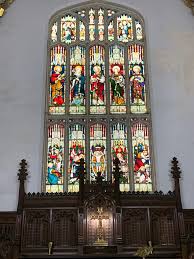
There is a moment, usually sometime between the organist’s warm-up and the choir’s collective decision about what key they will be singing in today, when the light catches the sanctuary window just so. It’s the sort of moment that makes even a long-serving rector stop mid-announcement, forgetting entirely what he meant to say about next Thursday’s potluck. The window glows. The dust motes dance like the heavenly host — albeit a somewhat arthritic host — and one is reminded that God has an astonishing tendency to break through our ordinary days with an entirely unreasonable amount of glory.
And this glory if not reserved to stained glass. I vividly remember attending the induction of a friend and colleague in a neighbouring church. It was the most recent church built in our Diocese, and all the windows in the space were clear glass. My very traditional spirit loooked around and thought “It is sad that they haven’t had the budget to put stained glass in those spaces.” As that induction carried on, clouds rolled in and the evening changed into one of those late-summer thunder storms with grey clouds and lightening flashing. And after having the opportunity to simply see the beauty of God’s creation lived out in the windows of that worship space, I found myself thinking instead, “I hope they never clutter up this space with stained glass.” That window over the altar was radiant as an opening onto seeing God moving all around us.
Of course, the sanctuary window was not originally installed for my spiritual benefit. It was, according to the Building Committee minutes from 1857, “to provide natural illumination while reducing the need for artificial lighting and thus lowering costs.” The saints through the ages have spoken of light as divine revelation; succeeding generations spoke of it as a merciful reduction to the electrical bill. And yet — God works with what God is given.
You see, the window holds a theology all its own. Light pours through it uninvited, unregulated, and entirely unfazed by our human attempts at liturgical control. It will fall boldly on the cross whether it’s Lent or not. It will illuminate the lectern on a Sunday when the preacher is, shall we say, not at their very best. And it will bathe the baptismal font in a radiant glow even when the baby is fiercely objecting to the Christian life by way of a bellowing protest.
Light, you see, does what light does: it reveals, it warms, it pushes back shadows gently but with purpose. It refuses to scold us for our dim corners but quietly fills them. No wonder Jesus was so fond of the metaphor. No wonder the early church built its sanctuaries with windows high and wide — somewhere between an architectural offering and a practical apology for not having invented LED bulbs yet.
And isn’t that just like grace? Beautifully indifferent to our self-consciousness, unwilling to be boxed in by our rules, arriving through the cracks of our careful living. I’ve often thought the sanctuary window preaches the shortest, loveliest sermon imaginable: “Let me in. I will do the rest.”
Even on the cloudiest days — those grey Canadian mornings when the sun seems to have taken a personal day — the window still gathers what little light there is and shares it with the room. Hope doesn’t need much to get started. A thin ray. A shy glimmer. A small mercy refracted into something larger. It’s architectural evangelism: the building itself proclaiming that God will find a way to shine.
And so we sit beneath the window each week — joyful or tired, certain or bewildered — and allow the light to fall where it will. On the beloved. On the broken. On the latecomers and the early arrivers and the rector who forgot to charge his microphone again. There are no favourites in the economy of radiance.
If you ask me, churches should worry less about filling the pews and more about noticing the light that’s already filling the room. For wherever light is, there is Christ — quietly insisting that beauty still matters, that hope is not foolish, and that God’s love remains far more luminous than anything we can manufacture.
May our lives, like that window, always find a way to let the Light in.
Companion Prayer
Holy Light,
Shine through the windows of our hearts —
even the ones we have forgotten to open.
Chase away the shadows of worry and weariness.
Fill us with your warmth, your clarity, your unwavering hope.
Make us bearers of your brightness
in a world too accustomed to dimness.
Amen.